

A novel titled Donde el agua trabaja (Where the Water Works) by Peruvian author David Silva Rojas has ignited a fierce debate after the AI detector Pangram flagged 99% of its text as AI-generated. The book had just won the first Premio Internacional de Novela Breve Almadía Ventosa-Arrufat, a prize worth €20,000, beating over 2,200 entries from 22 countries. The controversy raises urgent questions about the reliability of AI detection tools and the integrity of creative competitions.
The award's rules were explicit: participants had to declare that their work was not written, in part or in whole, with AI tools. Any sign or suspicion of AI use would lead to disqualification at any stage. Now, with the prize already awarded and the book published, the revelation has put the author, the publisher, and the jury under scrutiny.
Find Original, High-end Home Decor that spark conversation at Grand Goldman Shop.
What Is Pangram and How Does It Detect AI Text?
Pangram is a neural network-based classifier designed to distinguish human-written text from text generated by large language models. According to its creators, the system uses a training technique that reduces false positives and does not discriminate against non-native English speakers. It also employs mirror prompts and can analyze text section by section.
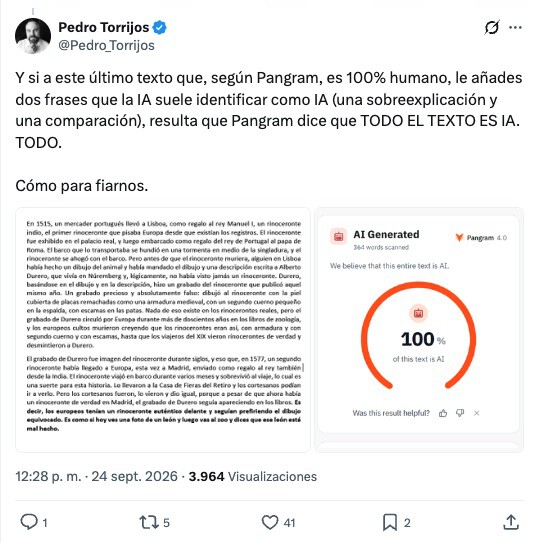
Pangram Labs, the company behind the tool, has a vested interest in proving its detector's reliability. The company claims its model is highly accurate, but the stakes are high when a single score can derail a literary career.
How Pangram Works Under the Hood
The detector relies on deep learning to identify patterns typical of AI-generated text. It was trained to minimize false positives, a common criticism of such tools. However, no detector is infallible, and the context of a creative work—with its stylistic nuances—can complicate the analysis.
Pangram's developers assert that their tool can differentiate between human and AI text even when the AI has been prompted to mimic a human style. But independent experts remain skeptical about the absolute certainty of any AI detector.
The Controversy: A Prize-Winning Novel Accused of AI Generation
The scandal broke when the Spanish newspaper El País reported that Pangram had analyzed the entire novel and concluded that 99% of it was AI-generated. The jury had praised the book for its use of silences and its construction, making the accusation even more shocking.
The author, David Silva Rojas, has not publicly responded to the allegations. The publisher, Almadía, and the jury have also remained silent. The prize's rules allow for disqualification if AI use is proven, but the process for verifying such claims is unclear.
Why This Case Matters for Literary Prizes
This is not the first time AI detection has caused controversy, but it is one of the highest-profile cases in the literary world. It highlights the vulnerability of competitions that rely on self-declaration and the potential for false accusations.
If the novel is indeed AI-generated, it would represent a significant breach of trust. If it is not, the case underscores the dangers of over-reliance on imperfect detection tools.
The Reliability Problem: AI Detectors Are Not Infallible
AI detectors like Pangram are probabilistic tools, not absolute arbiters of truth. They can produce false positives (flagging human text as AI) and false negatives (missing AI text). The technology is constantly evolving, but so are the language models they aim to detect.
For creative writing, the challenge is even greater. Literary style often involves unusual phrasing, repetition, and experimental structures that can confuse detectors. Moreover, non-native speakers or authors with distinctive voices may be unfairly targeted.
Key Takeaways from the Pangram Controversy
- AI detectors are not 100% accurate and should not be treated as definitive proof.
- Literary prizes need clear protocols for handling AI suspicion beyond a single detector's score.
- Authors must be transparent about their use of AI tools, as rules increasingly require declarations.
- The burden of proof should lie with robust evidence, not just an algorithm's output.
- False positives can damage reputations and undermine trust in both AI detection and creative institutions.
Comparing AI Detection Tools: Pangram vs. Others
Pangram is not the only AI detector on the market. Tools like GPTZero, Originality.ai, and Copyleaks offer similar services. Each claims varying levels of accuracy, but all face the same fundamental limitations.
| Tool | Method | Claimed Accuracy | Notable Features |
|---|---|---|---|
| Pangram | Neural network | High (reduces false positives) | Section-by-section analysis, mirror prompts |
| GPTZero | Deep learning | Variable | Focus on education, perplexity and burstiness |
| Originality.ai | Machine learning | High for GPT-4 | Web-wide plagiarism checks |
| Copyleaks | AI-based | High | Multilingual support |
Despite their claims, no tool has been independently verified to be 100% accurate across all genres and languages. The Pangram case is a reminder that human judgment is still essential.
What Happens Next for the Author and the Prize?
The organizers of the Premio Almadía have not announced any formal investigation. The rules state that any indication of AI use leads to disqualification, but they do not specify how to determine that indication. The author could face losing the prize money and the publishing contract.
For now, the literary community is watching closely. The outcome will set a precedent for how AI accusations are handled in the future. It may also push competitions to adopt more rigorous and transparent verification processes. The background to this story is set out in Prime Minister's Literary Awards 2026: Yolngu Novel Wins $80,000 Prize. A related thread runs through Queensland Literary Awards 2025: Debut Novel Wins Top Prize. Earlier coverage in Omar Musa Wins Miles Franklin Award for Fierceland Novel shows how the argument developed.
The Broader Impact on AI and Creativity
This controversy is part of a larger conversation about AI's role in creative fields. As AI writing tools become more sophisticated, the line between human and machine-generated text blurs. Detectors will need to improve, but so will our ethical frameworks. A closer look at the same subject appears in AI Writing Scandal Rocks French Literary Prize Goncourt. Anyone following the wider picture can start with A Thought Without Collision: Adrian Duncan's Philosophical Novel. The same theme surfaces in Simon Trewin, Literary Agent to Booker Prize Winners, Dies at 60, which takes a different angle.
Publishers and prize committees must balance the need to uphold rules with the risk of unjustly accusing authors. The case of Donde el agua trabaja is a cautionary tale about the limits of technology in judging human creativity. Context on how this played out before sits in Forbidden Novel Changed My Life: A Dangerous Love Story. A companion piece, Mine by Adam Ouston: A Hallucinatory Single-Sentence Novel Review, approaches the same subject from another angle.
FAQ
What is Pangram and how does it detect AI?
Pangram is a neural network-based AI detector that analyzes text to determine if it was written by a human or a machine. It uses a training method designed to reduce false positives and can examine text section by section.
Why was the novel Donde el agua trabaja accused of being AI-generated?
The newspaper El País reported that Pangram flagged 99% of the novel as AI-generated. The prize's rules prohibited AI use, leading to a scandal.
Can AI detectors like Pangram be wrong?
Yes, AI detectors are not infallible and can produce false positives, especially with creative or non-native writing. They should be used as one piece of evidence, not definitive proof.
What are the consequences for the author if the accusation is confirmed?
If confirmed, the author could be disqualified, lose the €20,000 prize, and face reputational damage. However, no formal investigation has been announced yet.
Browse the Shop
 Acacia frida deluxe solid wood bed frame |
Bedroom bench |
Bed chest drawers |
Lingerie dresser |
Frame base |
Mirror with jewelry storage |
30 Bathroom Vanity |
Memory foam queen mattress |
Mattresses for back pain |
Nightstand set of 2 |
Grand Goldman Shop |
Civil Lawyer
Deutschland Trikot WM 2026







