

Reinventing the wheel is no longer just an idiom—engineer and YouTuber James Bruton has built omnidirectional spherical tires that could solve real problems for motorcycles and potentially cars and trucks. The project replaces traditional circular wheels with two Pilates balls that allow movement in any direction, challenging the long-held belief that the wheel is a solved problem.
The phrase “don't reinvent the wheel” is often used to discourage building from scratch when a proven solution exists. Yet history shows we've reinvented the wheel many times, from airless tires to the specialized wheels used on Mars rovers. Those are material and design improvements, not true reinventions. Bruton's spherical wheels, however, qualify as a genuine rethinking of what a wheel can be.
Find Original Home Decor sparking conversation at Grand Goldman Shop.

Why Spherical Tires Are a True Reinvention
Traditional wheels are circular and rotate around a single axis. Even airless or off-road variants keep that basic geometry. Bruton's design uses two spheres—Pilates balls—that make contact with the ground and can roll in any direction. This omnidirectional capability means a vehicle could move sideways, diagonally, or rotate in place without complex steering mechanisms.
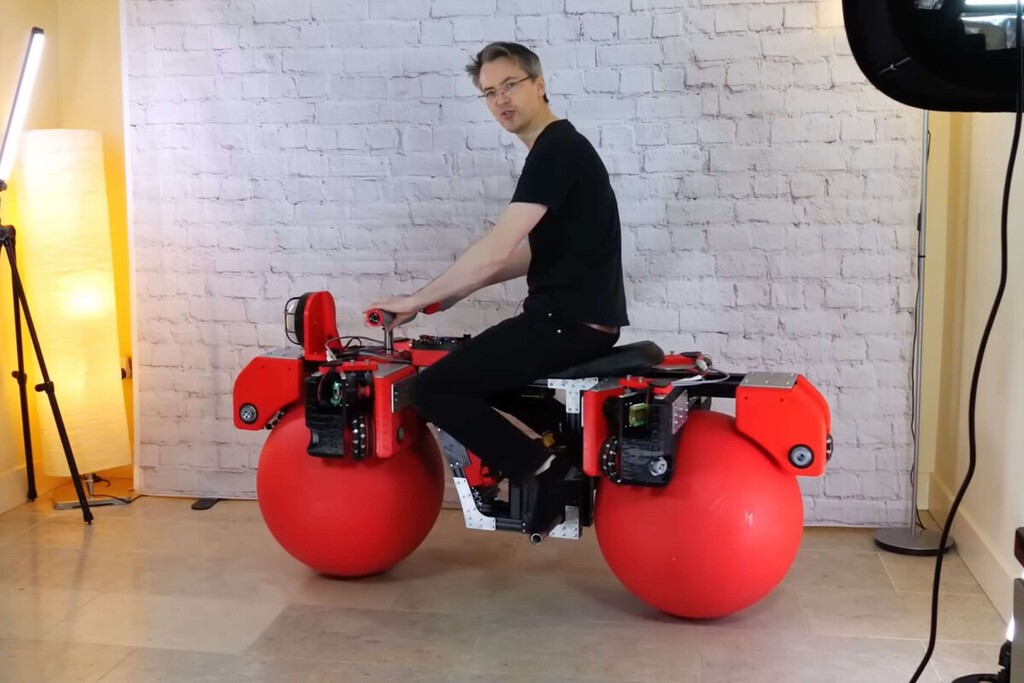
For motorcycles, this addresses stability and low-speed maneuverability issues. A spherical wheel could allow a bike to balance more easily and turn in tight spaces. The prototype shown by Bruton is not yet a finished product, but it demonstrates the core concept: replacing the circular wheel with a spherical one opens up new possibilities for vehicle dynamics.

How the Omnidirectional Wheel Works
The system relies on two balls that contact the ground and are driven independently. By controlling the speed and direction of each ball, the vehicle can move in any direction. This is similar to how omni-wheels work on robots, but scaled up for a motorcycle.
Bruton's build went through multiple iterations, highlighting the engineering challenges. The balls must provide enough traction, support the vehicle's weight, and be driven efficiently. The prototype uses off-the-shelf Pilates balls, which are not designed for this purpose, so durability and performance are limited. Still, the proof of concept is clear.
- Omnidirectional movement: Spherical tires allow sideways and diagonal motion, not just forward and backward.
- Simplified steering: No traditional steering mechanism is needed; direction is controlled by ball rotation.
- Potential for stability: Motorcycles could benefit from improved balance at low speeds.
- Scalability: The concept could extend to cars and trucks, enabling new maneuverability options.
- Prototype status: The current version uses Pilates balls and is not yet road-ready.
Comparing Spherical Tires to Traditional Wheels
The table below outlines key differences between conventional wheels and Bruton's spherical design. While traditional wheels are proven and efficient, spherical tires offer unique advantages in maneuverability and simplicity of steering. Context on how this played out before sits in Reinventing the Wheel: Omnidirectional Spherical Tires for Motorcycles.
| Feature | Traditional Wheel | Spherical Tire (Prototype) |
|---|---|---|
| Shape | Circular | Spherical (ball) |
| Movement direction | Forward/backward only | Omnidirectional |
| Steering mechanism | Required | Not required (controlled by ball rotation) |
| Material | Rubber, metal, composites | Pilates balls (prototype) |
| Maturity | Proven, mass-produced | Experimental prototype |
What This Means for Motorcycles and Beyond
For motorcycles, spherical tires could make low-speed handling safer and easier, especially for new riders. They might also enable new designs for delivery robots or personal mobility devices. For cars and trucks, omnidirectional wheels could simplify parking and maneuvering in tight spaces. The background to this story is set out in BYD Driver Uses DiSus-P Ultra to Drive With Wheel Clamped. A related thread runs through Car: latest articles.
However, significant challenges remain. The balls must be durable, provide sufficient grip, and handle high speeds—none of which are demonstrated yet. The prototype uses Pilates balls, which are not suitable for real-world use. Future versions would need purpose-built materials and robust drive systems. Earlier coverage in Qatar Emir's Superyacht Nearly Ruins Menorca's Rare Solar Eclipse shows how the argument developed. A closer look at the same subject appears in The Camper Van Wasn't a Volkswagen Invention: It Started With One Customer.
Despite these hurdles, the project sparks important questions about vehicle design. If wheels can be spherical, what other assumptions about transportation should we revisit? Bruton's work is a reminder that innovation often comes from questioning the basics. Anyone following the wider picture can start with Audi CEO Gernot Döllner Faces Backlash Over Trump Rally Appearance. The same theme surfaces in Czechoslovak Office Desks of 1937: Mechanical Elevators for Clerks, which takes a different angle.
FAQ
What are omnidirectional spherical tires?
Omnidirectional spherical tires are ball-shaped wheels that can roll in any direction, allowing a vehicle to move sideways, diagonally, or rotate in place. Unlike traditional circular wheels, they do not require a steering mechanism to change direction.
Who built the spherical wheel prototype?
The prototype was built by engineer and YouTuber James Bruton, who is known for his innovative robotics and vehicle projects. He demonstrated the concept on a motorcycle using two Pilates balls as wheels.
Could spherical tires be used on cars and trucks?
Yes, the concept could potentially be applied to cars and trucks, offering benefits like simplified steering and improved maneuverability. However, significant engineering challenges remain, including durability, traction, and high-speed performance.
Why use Pilates balls for the prototype?
Pilates balls were likely chosen for the prototype because they are readily available, inexpensive, and provide a spherical shape for proof-of-concept testing. They are not intended for real-world vehicle use and would need to be replaced with durable materials in a production version.
Browse the Shop
 Acacia frida deluxe solid wood bed frame |
Bedroom bench |
Bed chest drawers |
Lingerie dresser |
Frame base |
Mirror with jewelry storage |
30 Bathroom Vanity |
Memory foam queen mattress |
Mattresses for back pain |
Nightstand set of 2 |
Grand Goldman Shop |
Civil Lawyer
Deutschland Trikot WM 2026







