

The European Space Agency's Euclid telescope has captured the sharpest and largest image yet of the Milky Way's core, revealing over 60 million stars in a single day. This unprecedented view of our galaxy's center promises to revolutionize our understanding of dark matter and exoplanets.
The image is a mosaic of nine photographs, each covering an area larger than a full Moon, and offers a level of detail that previous surveys could not match. Astronomers are already using it to search for gravitational microlensing events, which can reveal hidden exoplanets and compact objects.
Find Original Home Decor sparking conversation at Grand Goldman Shop.

Why the Milky Way's Core Is So Captivating
The center of our galaxy is a dense hub of stars, gas, and dust, making it a prime target for astronomers hunting for exoplanets and studying stellar populations. However, until now, most images lacked the resolution needed to resolve individual stars in such crowded regions.
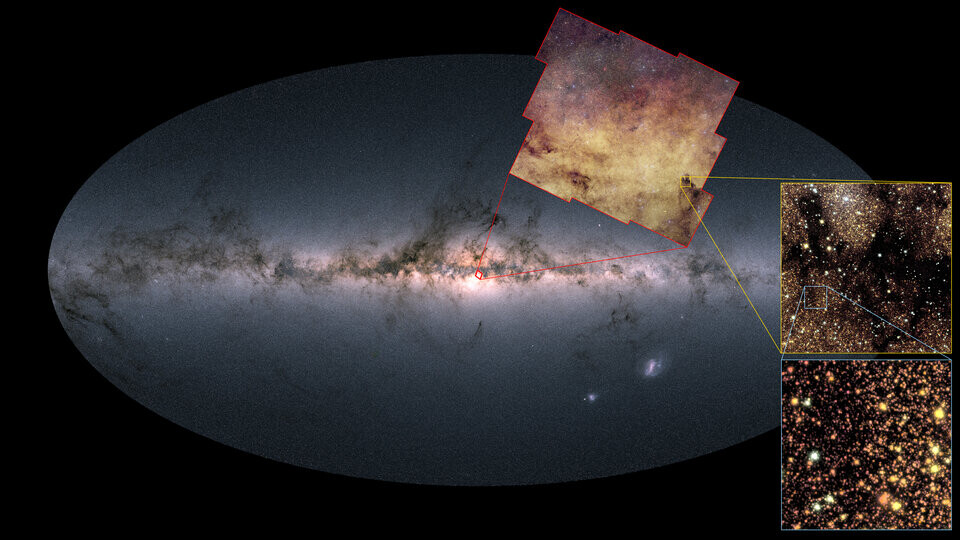
Euclid, designed primarily to study dark matter and dark energy, has turned its sharp gaze toward this chaotic environment. Its ability to capture wide areas of the sky with high clarity has provided a treasure trove of data for researchers.
Euclid's Dual Mission: Dark Matter and More
Euclid was built to map the large-scale structure of the universe and understand how dark matter and dark energy have shaped its expansion. By observing billions of distant galaxies, it helps scientists infer the distribution of invisible matter.
But the telescope's powerful optics are also ideal for studying our own galaxy. The new mosaic demonstrates Euclid's versatility, offering a glimpse into the heart of the Milky Way while still pursuing its primary cosmological goals.
The Mosaic: A New Window into the Galactic Center
The mosaic consists of nine overlapping images, each covering an area larger than the full Moon. Together, they reveal more than 60 million stars, along with nebulae and star clusters, in unprecedented detail.
This massive dataset is already being mined for gravitational microlensing events. These occur when a foreground object passes in front of a background star, temporarily magnifying its light. By studying these events, astronomers can detect planets and other dark objects that would otherwise remain invisible.
- Euclid captured nine images covering an area larger than a full Moon each.
- The mosaic reveals over 60 million stars in the Milky Way's core.
- The image is the largest and most detailed of this region to date.
- Primary goal: detect gravitational microlensing events to find exoplanets.
- Euclid's main mission is to study dark matter and dark energy.
Hunting for Microlensing Events
Gravitational microlensing is a powerful technique for finding exoplanets, especially those that are far from their host stars or have low mass. When a planet passes in front of a background star, its gravity bends the starlight, causing a temporary brightening.
The dense star field of the galactic center provides millions of potential background sources, making it an ideal laboratory for microlensing surveys. Euclid's sharp vision and wide field of view allow astronomers to monitor these events more efficiently than ever before.
What This Means for Exoplanet Research
The new image could lead to the discovery of numerous exoplanets, including rogue planets that wander through space without a star. It also helps characterize the distribution of planets in the crowded galactic bulge.
By combining Euclid's data with other surveys, scientists hope to build a comprehensive census of exoplanets in the Milky Way's core, shedding light on how planetary systems form and evolve in extreme environments.
Comparing Euclid's View with Previous Surveys
Previous images of the galactic center, such as those from the Hubble Space Telescope or ground-based observatories, often struggled with dust obscuration and limited fields of view. Euclid's infrared capabilities penetrate the dust and capture a wider area in a single shot. The background to this story is set out in NASA's Roman Telescope Gains 12 Extra Years to Explore Dark Matter. A related thread runs through Cosmic Dawn Simulation: MEGATRON Reveals Milky Way Birth. Earlier coverage in Milky Way 10% Larger Than Thought, Measured via Gamma Rays shows how the argument developed.
| Feature | Euclid | Previous Surveys |
|---|---|---|
| Field of view | Larger than a full Moon per image | Smaller fields, often crowded |
| Resolution | Sharp enough to resolve millions of stars | Limited by dust and crowding |
| Number of stars captured | Over 60 million | Typically fewer, with less detail |
| Primary purpose | Dark matter, dark energy, microlensing | Various, often targeted |
What to Watch Next
Astronomers will continue to analyze the mosaic, searching for microlensing signals and studying the stellar population. Future Euclid observations will cover even more of the sky, building a vast archive of data. A closer look at the same subject appears in ESA's Arrakihs Mission: Unraveling Dark Matter Mysteries. Anyone following the wider picture can start with Milky Way Flipped After Dwarf Galaxy Collision 10 Billion. The same theme surfaces in Dark Matter Hunt: Xenon Experiment Reveals Unexplained Signal, which takes a different angle.
The mission is expected to last several years, during which it will map a third of the sky. The galactic center image is just the beginning of a new era in understanding our cosmic neighborhood. Context on how this played out before sits in Dark Matter Mystery: How Giant Planets Could Reveal the Invisible Universe. A companion piece, Milky Way Flipped in Collision with Dwarf Galaxy 10bn Years Ago, approaches the same subject from another angle.
FAQ
What is the Euclid telescope?
Euclid is a space telescope built by the European Space Agency to study dark matter and dark energy. It observes billions of galaxies to map the universe's structure.
Why is the Milky Way's core important?
The core is densely packed with stars, making it a prime location to search for exoplanets via microlensing and to study stellar dynamics.
How does microlensing help find exoplanets?
Microlensing occurs when a planet's gravity bends light from a background star, causing a temporary brightness increase. This reveals the planet's presence.
How many stars are in the new image?
The mosaic contains more than 60 million stars, along with nebulae and star clusters, in unprecedented detail.
Browse the Shop
 Acacia frida deluxe solid wood bed frame |
Bedroom bench |
Bed chest drawers |
Lingerie dresser |
Frame base |
Mirror with jewelry storage |
30 Bathroom Vanity |
Memory foam queen mattress |
Mattresses for back pain |
Nightstand set of 2 |
Grand Goldman Shop |
Civil Lawyer
Deutschland Trikot WM 2026







