

In a remarkable fusion of art and science, a 17th-century painting by Flemish Baroque master Jan Brueghel the Elder has been found to contain detailed depictions of bats that anticipate modern scientific illustrations by four centuries. The painting, titled Air and housed in the Museum of Fine Arts of Lyon, was recently analyzed by Spanish researchers who confirmed that Brueghel's work is not just an allegorical masterpiece but also a surprisingly accurate zoological record.
This discovery sheds new light on the intersection of art and natural history during the Baroque period, revealing that artists like Brueghel were keen observers of the natural world, often ahead of their time.
Find Original Home Decor sparking conversation at Grand Goldman Shop.

The Painting That Doubles as a Zoological Treatise
Painted around 1611, Air is part of a series of allegorical works representing the four elements. The central figure is Urania, the muse of astronomy, seated on a cloud and holding an armillary sphere. Above her, the god Apollo drives his chariot across the sky, while a multitude of birds fills the air.
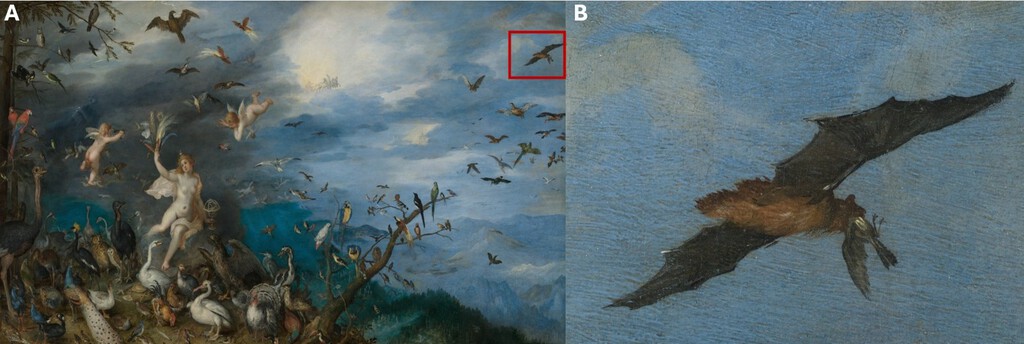
At first glance, the painting showcases Brueghel's skill in rendering diverse bird species—experts have identified 60 different kinds, from ostriches and peacocks to swans, flamingos, cranes, owls, and chickens. But among the flying creatures, there are also three species of bats, depicted with such precision that they caught the attention of modern researchers.
Bats in the Baroque Sky: A Scientific First
The bats in Air are not merely decorative; they are rendered with careful attention to anatomical detail. The researchers, whose findings were published in a recent study, compared Brueghel's bats with modern scientific illustrations and found striking similarities in wing structure, posture, and facial features.
This is significant because bats were often misunderstood and feared in early modern Europe, frequently associated with darkness and the devil. Brueghel's accurate portrayal suggests he had access to specimens or detailed observations, possibly through his connections with naturalists of the time.
Why This Matters for Art and Science
The discovery highlights the role of artists as observers and recorders of biodiversity. In an era before photography, paintings like Air served as valuable documents of species that might otherwise have been overlooked.
Moreover, it underscores the interdisciplinary nature of knowledge in the 17th century, when art and science were not separate domains but intertwined pursuits. Brueghel's work is a testament to the curiosity and empirical spirit that would later fuel the Scientific Revolution.
Key Takeaways from the Research
- Jan Brueghel the Elder's painting Air (c. 1611) contains detailed depictions of three bat species.
- Spanish researchers confirmed the bats are anatomically accurate, anticipating modern scientific illustrations by 400 years.
- The painting includes 60 bird species, showcasing Brueghel's extensive knowledge of avian diversity.
- The findings suggest Baroque artists played a role in early zoological documentation.
- The study reinforces the value of interdisciplinarity in understanding historical scientific knowledge.
Comparing Brueghel's Bats to Modern Science
To appreciate the accuracy of Brueghel's work, consider the following comparison between the bats in Air and modern scientific standards.
| Feature | Brueghel's Depiction (1611) | Modern Scientific Illustration |
|---|---|---|
| Wing Structure | Accurate membrane and finger bones | Detailed skeletal and muscular anatomy |
| Posture | Natural flying and roosting poses | Varied, including flight and rest |
| Facial Features | Recognizable ears and snout | Precise measurements and proportions |
| Species Identification | Three distinct types | Over 1,400 species globally |
While modern illustrations are more precise due to technological advances, Brueghel's bats are remarkably close to what a contemporary zoologist would produce.
The Legacy of Jan Brueghel the Elder
Jan Brueghel the Elder (1568–1625) was a renowned Flemish painter, known for his landscapes, still lifes, and allegorical scenes. He was the son of Pieter Bruegel the Elder and the father of Jan Brueghel the Younger, both accomplished artists.
His work often featured detailed flora and fauna, reflecting the growing interest in natural history during the Renaissance and Baroque periods. Air is a prime example of his meticulous approach, blending mythological narrative with empirical observation.
What This Means for Art Historians and Scientists
This discovery invites a reevaluation of how we perceive historical artworks. Beyond their aesthetic value, paintings like Air can serve as data points for understanding past ecosystems and human knowledge of them. The background to this story is set out in Richard Dadd: The Painter Behind a 43-Year Asylum Sentence. A related thread runs through Jack Crabtree Obituary: Figurative Painter of Social Realism. Earlier coverage in Terry Lee Obit: Sheffield Painter and Art Lecturer Dies at 93 shows how the argument developed.
For scientists, it offers a glimpse into the early documentation of bat species, which are often underrepresented in historical records. For art historians, it adds a new dimension to Brueghel's oeuvre, highlighting his contributions to natural science. A closer look at the same subject appears in James McNeill Whistler Review: Painter's Art Shines in New Film. Anyone following the wider picture can start with AI Drug Discovery Career: Online MSc in Computer Science at Bath. The same theme surfaces in Trending: latest articles, which takes a different angle.
As researchers continue to study such works, we may uncover more instances where art and science converge, revealing unexpected insights into our shared history. Context on how this played out before sits in Franco Angel Monument in Tenerife Faces Removal Ultimatum. A companion piece, Baroque Painter Jan Brueghel Anticipated Modern Bat Science by 400 Years, approaches the same subject from another angle.
FAQ
What is the significance of the bats in Brueghel's painting?
The bats are depicted with anatomical accuracy that predates modern scientific illustrations by centuries, showing that Brueghel observed nature closely and recorded it faithfully.
How many bat species are in the painting?
Researchers identified three distinct species of bats among the flying creatures in Air.
Why did Brueghel include bats in an allegory of air?
Bats are creatures of the air, and their inclusion fit the theme. Moreover, Brueghel likely aimed to showcase his skill in rendering diverse species, including those less commonly depicted.
Where is the painting currently located?
Air is housed in the Museum of Fine Arts of Lyon, France, where it remains on display.
Browse the Shop
 Acacia frida deluxe solid wood bed frame |
Bedroom bench |
Bed chest drawers |
Lingerie dresser |
Frame base |
Mirror with jewelry storage |
30 Bathroom Vanity |
Memory foam queen mattress |
Mattresses for back pain |
Nightstand set of 2 |
Grand Goldman Shop |
Civil Lawyer
Deutschland Trikot WM 2026







