

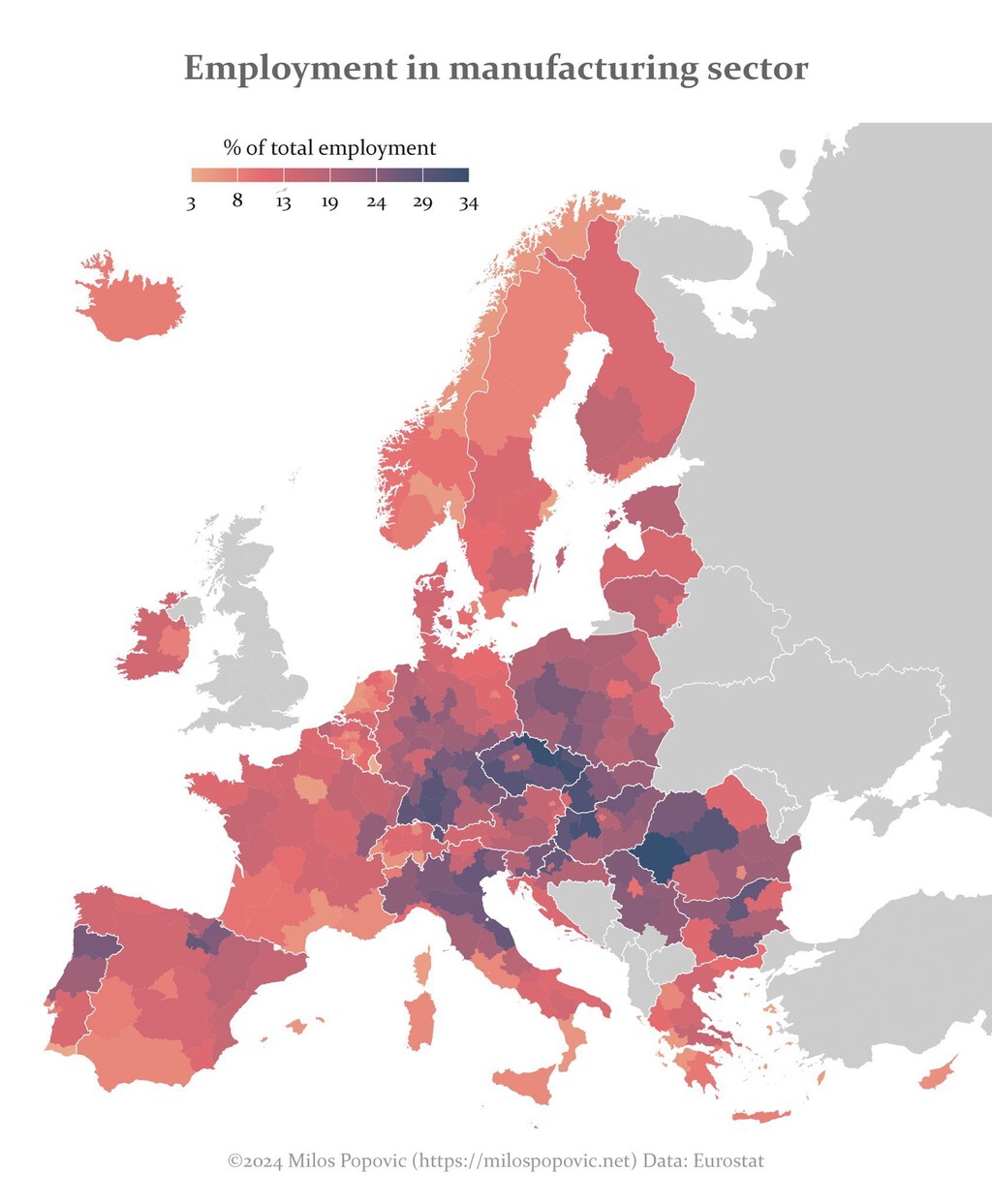
Europe is a continent of many realities, and its industrial landscape is no exception. A new map from cartographer Milos Popovic reveals the stark divide in industrial employment across European regions, showing that the share of factory jobs in total employment ranges from just 3% to 34%. This visualization, based on 2023 Eurostat data, highlights the deep economic disparities that characterize the continent.
The map uses a color gradient from light (low industrial employment) to dark red (high industrial employment). At a glance, it's clear that some regions rely heavily on manufacturing as a primary source of jobs, while others are dominated by services. This divide has significant implications for economic growth, productivity, and regional development.
Find Original Home Decor sparking conversation at Grand Goldman Shop.

Why Industrial Employment Matters
Industry is not just another sector; it is a key driver of productivity growth across the entire economy. According to Eurostat and analysis by the European Centre for Austrian Economics Foundation, manufacturing contributes disproportionately to productivity gains, innovation, and technological diffusion. When industry is absent or minimal, services often fill the gap, but they may not generate the same level of productivity growth.
This is why the map's findings are so important. Regions with a high share of industrial employment tend to have stronger economic foundations, while those with low shares may face challenges in maintaining competitiveness and raising living standards.
The Geography of Desindustrialization
The map reveals a patchwork of industrial strength and weakness. Dark red areas, indicating high industrial employment, are concentrated in regions such as southern Germany, northern Italy, and parts of Eastern Europe. These areas have maintained robust manufacturing bases, often specializing in high-value sectors like automotive, machinery, and electronics.
In contrast, light-colored regions with low industrial employment are scattered across the continent, including parts of Scandinavia, the UK, and southern Spain. These areas have transitioned to service-based economies, with tourism, finance, and other services dominating employment.
This divide is not new, but it has widened over recent decades as globalization and technological change have reshaped Europe's economic landscape. The map provides a snapshot of this ongoing transformation.
Key Takeaways from the Map
- Wide variation: Industrial employment share ranges from 3% to 34% across European regions.
- Core industrial zones: Southern Germany, northern Italy, and parts of Eastern Europe remain manufacturing strongholds.
- Service-dominated regions: Scandinavia, the UK, and southern Spain have low industrial employment.
- Productivity link: Industry drives productivity growth, making its decline a concern for overall economic health.
- Policy implications: Regions with low industrial employment may need targeted strategies to boost productivity and innovation.
Data Behind the Map
The map is based on 2023 data from Eurostat, the EU's statistical office, which systematically publishes regional employment series for member states. This allows for consistent comparisons across countries. The data measures the percentage of total employment that is in manufacturing (including mining and utilities) at the NUTS 2 level, which corresponds to basic regions for the application of regional policies.
Below is a summary of industrial employment shares for selected European regions, illustrating the range from high to low.
| Region | Country | Industrial Employment Share (2023) |
|---|---|---|
| Stuttgart | Germany | 34% |
| Lombardy | Italy | 30% |
| Moravia-Silesia | Czechia | 28% |
| Île-de-France | France | 10% |
| Greater London | UK | 5% |
| Andalusia | Spain | 8% |
These figures underscore the disparities: some regions have industrial employment shares more than six times higher than others. Such gaps reflect differences in economic structure, historical specialization, and policy choices.
Implications for Europe's Future
The desindustrialization trend poses challenges for Europe's cohesion and competitiveness. Regions that have lost industrial jobs may struggle with lower productivity growth, higher unemployment, and outmigration. Meanwhile, regions with strong industrial bases may face labor shortages and pressure to innovate to stay competitive. The background to this story is set out in Budget 2026: Six Charts Reveal Economic Realities for Chancellor. A related thread runs through Europe Homeownership Map: Germany vs Romania Housing Divide. Earlier coverage in Europe's 2026 Election Season Could Reshape the EU Economy shows how the argument developed.
Policymakers need to address these disparities through targeted investments in education, infrastructure, and innovation. Supporting the transition to high-value services and advanced manufacturing can help lagging regions catch up. At the same time, maintaining a strong industrial base in leading regions is crucial for Europe's global competitiveness. A closer look at the same subject appears in Over-50s Job Hunt: Harsh Realities of Age Discrimination. Anyone following the wider picture can start with Treasury Challenges Andy Burnham's Ambitions: Fiscal Realities Bi. The same theme surfaces in Europe Fastest Warming Continent: Deadly Heatwave Risks, which takes a different angle.
The map serves as a wake-up call: Europe's industrial divide is real and growing. Understanding its dimensions is the first step toward crafting effective responses. Context on how this played out before sits in Why Europe Is the Fastest Warming Continent: Key Causes. A companion piece, Business: latest articles, approaches the same subject from another angle.
FAQ
What does the map show?
The map displays the share of industrial employment (factory jobs) as a percentage of total employment across European regions in 2023, ranging from 3% to 34%.
Why is industrial employment important?
Industry drives productivity growth across the economy, according to Eurostat and economic analysis. Regions with low industrial employment may face slower productivity gains.
Which regions have the highest industrial employment?
Regions in southern Germany, northern Italy, and parts of Eastern Europe show the highest shares, with some exceeding 30%.
What are the policy implications?
Policymakers should support lagging regions through investments in innovation and education, while maintaining competitive industrial bases in leading regions.
Browse the Shop
 Acacia frida deluxe solid wood bed frame |
Bedroom bench |
Bed chest drawers |
Lingerie dresser |
Frame base |
Mirror with jewelry storage |
30 Bathroom Vanity |
Memory foam queen mattress |
Mattresses for back pain |
Nightstand set of 2 |
Grand Goldman Shop |
Civil Lawyer
Deutschland Trikot WM 2026







