

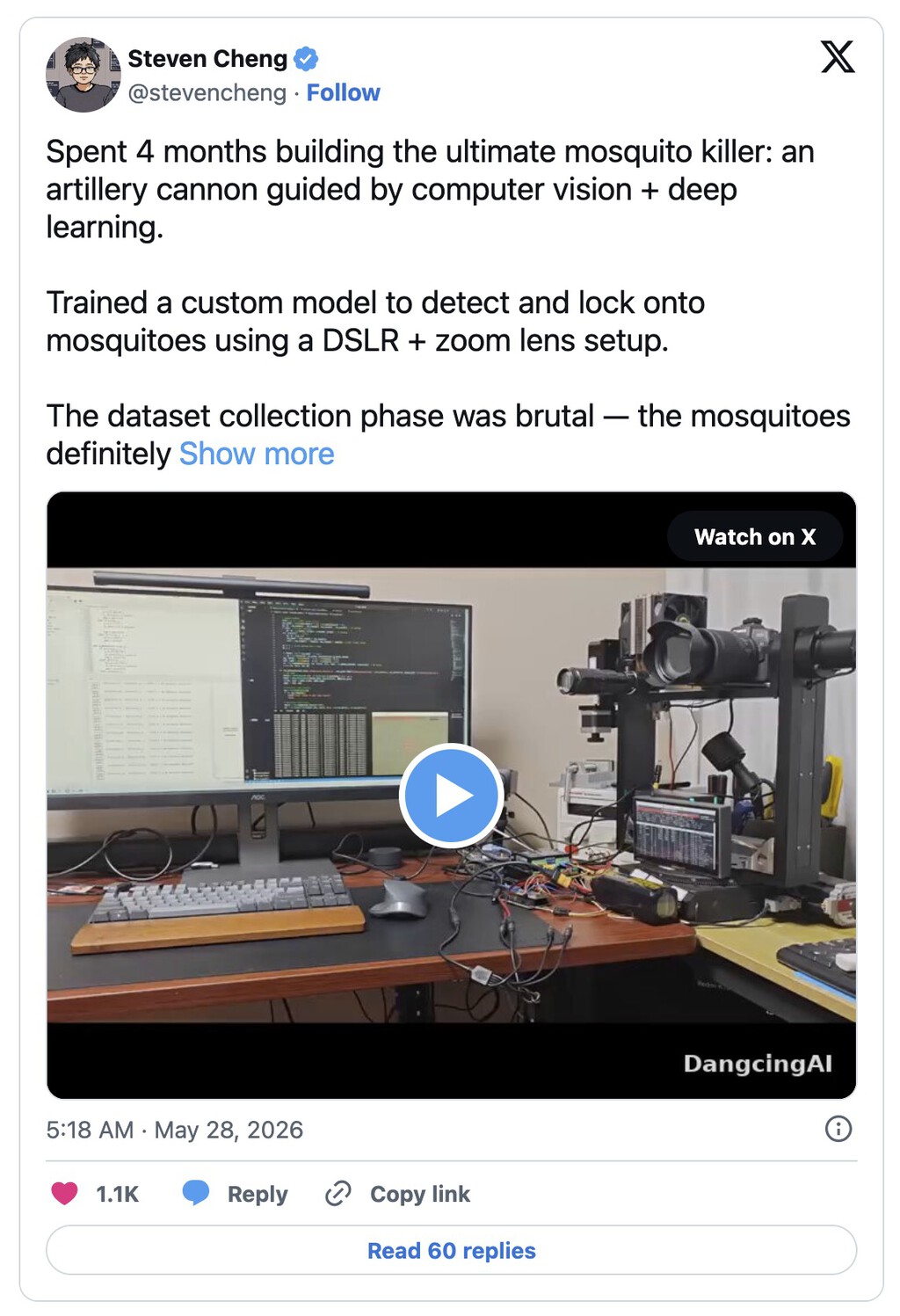
A Chinese engineer has built a DIY laser mosquito killer that uses artificial intelligence to detect and eliminate mosquitoes with surprising precision. Steven Cheng, a young engineer, combined a laser emitter, a camera, and a computer running computer vision algorithms and deep learning to create a system that can identify and "fry" mosquitoes mid-flight. This homemade device is a craft version of a commercial product from a Chinese startup, but its roots trace back to Cold War-era missile defense research.
How the DIY Laser Mosquito Killer Works
The system relies on a camera to scan the environment and a laser to target mosquitoes. Computer vision algorithms analyze the camera feed to distinguish mosquitoes from other objects, and deep learning models improve detection accuracy over time. Once a mosquito is identified, the laser fires a low-power beam that is sufficient to kill the insect without harming humans or pets.
Find Original Home Decor sparking conversation at Grand Goldman Shop.

Steven Cheng's project demonstrates how accessible AI and laser technology have become. What once required a team of scientists and expensive equipment can now be replicated by a single engineer with off-the-shelf components and open-source software. The result is a device that could potentially be scaled for home use, offering a high-tech alternative to traditional mosquito repellents.
The Origins: From Missile Defense to Mosquito Laser
The idea of using lasers against mosquitoes likely originated with Lowell Wood, an astrophysicist who was a key architect of Ronald Reagan's Strategic Defense Initiative, often called "Star Wars." Wood discussed the concept with Nathan Myhrvold, former CTO of Microsoft and a prolific inventor. Together, they proposed adapting missile-defense laser technology to combat malaria by killing mosquitoes.
Myhrvold's company, Intellectual Ventures, developed a prototype and showcased it in a TED talk in 2010. The device was compelling because mosquitoes are so lightweight that a low-intensity laser could kill them without damaging human skin or pet fur. Despite the buzz, the project never gained commercial traction and faded from the spotlight.
Why the Original Prototype Failed to Take Off
Although the technology worked in principle, practical challenges hindered its adoption. The system was complex and expensive, and the market for such a device was uncertain. Additionally, safety concerns and regulatory hurdles likely played a role in stalling development. The prototype remained a lab curiosity rather than a consumer product.
The Commercial Revival by a Chinese Startup
Recently, a Chinese startup picked up where Intellectual Ventures left off and began offering a commercial laser mosquito killer. This product brings the concept to a broader audience, albeit with a higher price tag. The startup's version likely incorporates advances in AI and computer vision that were not available a decade ago, making the device more reliable and user-friendly.
Steven Cheng's DIY project is essentially a homemade version of this commercial product, highlighting how far the technology has come. It also raises questions about the future of pest control, where AI and robotics could replace traditional methods like chemical sprays and nets. The background to this story is set out in Oriental Hornet: How to Identify & Eliminate It Safely. A related thread runs through Wasps & Hornets: Identify and Eliminate Nests Safely. Earlier coverage in Spring Pests: Identify & Eliminate Them Before They Invade shows how the argument developed.
Key Takeaways
- AI-powered detection: The system uses computer vision and deep learning to identify mosquitoes with high accuracy.
- Low-power laser: The laser is strong enough to kill mosquitoes but safe around humans and pets due to the insects' low mass.
- Historical roots: The concept originated from missile-defense research by Lowell Wood and Nathan Myhrvold.
- Commercial potential: A Chinese startup now offers a consumer version, and DIY enthusiasts like Steven Cheng are building their own.
- Future outlook: The technology could evolve into a mainstream, eco-friendly alternative to chemical repellents.
Comparison of Laser Mosquito Killers
| Feature | Intellectual Ventures Prototype (2010) | Chinese Startup Commercial Product | Steven Cheng's DIY Version |
|---|---|---|---|
| Detection method | Basic computer vision | Advanced AI and deep learning | Computer vision with deep learning |
| Laser power | Low-intensity | Low-intensity, optimized | Low-intensity |
| Target | Mosquitoes | Mosquitoes | Mosquitoes |
| Status | Prototype only | Available for purchase | DIY project |
| Cost | High (research) | Premium consumer price | Low (off-the-shelf parts) |
What This Means for the Fight Against Mosquito-Borne Diseases
Mosquitoes are vectors for diseases such as malaria, dengue, and Zika, causing millions of infections annually. Traditional control methods include insecticide-treated nets, sprays, and environmental management. A laser-based system could offer a targeted, chemical-free approach that reduces reliance on pesticides and minimizes ecological impact. A closer look at the same subject appears in China's AI Laser Turret Kills Mosquitoes, Reviving a 20-Year-Old US Idea. Anyone following the wider picture can start with Termite Control: Prevent, Monitor & Eliminate Infestations. The same theme surfaces in Scabies Pest Control: Complete Guide to Eliminate Mites, which takes a different angle.
However, widespread adoption faces obstacles. The cost of commercial devices may be prohibitive for endemic regions, and regulatory approval for laser devices varies by country. Moreover, the effectiveness of such systems in dense outdoor environments remains to be proven. Still, the convergence of AI, computer vision, and photonics opens new possibilities for public health interventions. Context on how this played out before sits in Einhell Laser Level for DIY: Precision Made Easy. A companion piece, Bosch Laser Measure: The Ultimate DIY Tool for Precision, approaches the same subject from another angle.
FAQ
Is the laser mosquito killer safe for humans and pets?
Yes, because mosquitoes are extremely lightweight, a low-power laser can kill them without causing harm to humans or pets. The laser intensity is carefully calibrated to target only small insects.
Who invented the laser mosquito killer?
The concept was first proposed by astrophysicist Lowell Wood and engineer Nathan Myhrvold, who developed a prototype at Intellectual Ventures in 2010. More recently, a Chinese startup commercialized the idea, and DIY enthusiasts like Steven Cheng have built their own versions.
Can I build a laser mosquito killer at home?
Building a laser mosquito killer requires expertise in computer vision, laser safety, and programming. Steven Cheng's project shows it is possible with off-the-shelf components, but it is not a beginner project and should be approached with caution due to laser hazards.
What are the advantages of using lasers over chemical repellents?
Laser-based systems offer a chemical-free, targeted approach that does not contribute to pesticide resistance or environmental pollution. They can also operate continuously without the need for reapplication, potentially reducing mosquito populations more effectively in certain settings.
Browse the Shop
 Acacia frida deluxe solid wood bed frame |
Bedroom bench |
Bed chest drawers |
Lingerie dresser |
Frame base |
Mirror with jewelry storage |
30 Bathroom Vanity |
Memory foam queen mattress |
Mattresses for back pain |
Nightstand set of 2 |
Grand Goldman Shop |
Civil Lawyer
Deutschland Trikot WM 2026







