

Seismic sensors in Catalonia detected Spain's World Cup-winning goal, proving that a packed room of cheering fans can move the ground as surely as a small tremor. The Spanish national team beat Argentina 1-0 in the final, claiming their second world title, and the celebration was not only seen and heard—it was measured.
Jordi Díaz Cusí, a seismologist at Geosciences Barcelona (GEO3BCN-CSIC), shared a graph on X showing records from the Educational Seismic Network during the match. The data revealed vibration spikes at the exact moments of the first goal, Mikel Merino's disallowed goal, and the final whistle, captured by seismometers in schools and institutes across Catalonia.
Find Original Home Decor sparking conversation at Grand Goldman Shop.

What the Seismic Graph Shows
The graph displays readings from nine stations, including the GEO3BCN building in Barcelona and institutes in Santa Coloma de Farners, Sabadell, Olot, Banyoles, Mollet, Santa Coloma de Gramenet, and Torroella de Montgrí. The recordings span just over half an hour of the match.
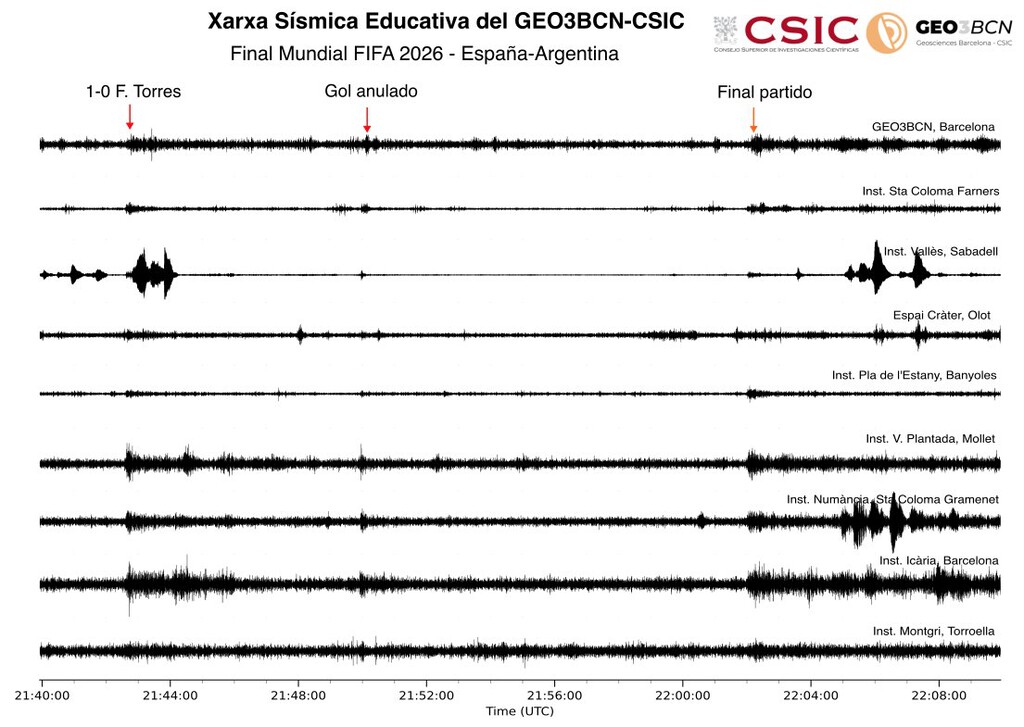
Three arrows mark the key moments: Ferran's goal, the disallowed play, and the end of the game. At some stations, like the Vallès institute in Sabadell, the traces spike very visibly at those instants; at others, the change is much more subtle. The difference depends largely on how many people were celebrating near each sensor.
Why It Matters: The Power of Collective Celebration
This isn't the first time human activity has been captured by seismometers. Concerts, football matches, and even traffic can generate detectable vibrations. But the Educational Seismic Network offers a unique window into how everyday events register on scientific instruments.
The fact that a goal—a moment of collective joy—can be recorded as a distinct signal highlights the sensitivity of modern seismic equipment. It also shows how crowds can produce ground motion that, while harmless, is measurable and can be used for educational purposes.
- Seismic sensors can detect vibrations from crowds celebrating major events.
- The strength of the signal depends on proximity and crowd size.
- Educational networks provide real-world data for students.
- Such recordings help demystify how seismometers work.
- Human-induced vibrations are distinct from tectonic earthquakes.
How the Educational Seismic Network Works
The Educational Seismic Network is a project that places seismometers in schools and institutes, allowing students to monitor ground motion in real time. During the World Cup final, these instruments captured the enthusiasm of fans in different locations.
Each station recorded a unique pattern based on local conditions. For example, the Sabadell station showed sharp peaks, likely because a large group gathered nearby. Other stations, farther from celebrations, picked up weaker signals. This variability is valuable for teaching students about wave propagation and signal analysis.
Comparing Seismic Signals: Goals vs. Earthquakes
While the vibrations from a goal are tiny compared to a real earthquake, they share some characteristics. Both produce seismic waves that travel through the ground and are recorded by seismometers. However, the frequency and duration differ significantly.
| Event Type | Typical Magnitude | Duration | Frequency Content |
|---|---|---|---|
| World Cup goal celebration | Very low (not on Richter scale) | Seconds to minutes | Higher frequency (human-induced) |
| Small earthquake | Magnitude 2-3 | Seconds | Broad frequency range |
| Large earthquake | Magnitude 6+ | Minutes | Low frequency dominant |
This comparison helps students understand how different sources generate distinct seismic signatures. The goal celebrations produced short, high-frequency bursts, while earthquakes typically have lower frequencies and longer durations. The background to this story is set out in Spain Wins World Cup: Ferran Torres Goal Dethrones Argentina. A related thread runs through Scaloni Praises Messi: World Cup Final Legacy. Earlier coverage in Tottenham Fans Walk Out as Aston Villa Win Despite Late Spurs Goals shows how the argument developed.
What to Watch Next
As sports and other large gatherings continue to excite fans, seismic networks may capture more of these human-made signals. Researchers and educators can use such events to engage the public and demonstrate the reach of seismic monitoring. A closer look at the same subject appears in Argentina World Cup Final Conspiracy Theories Explained. Anyone following the wider picture can start with Vibration sensors: the device that detects before the alarm. The same theme surfaces in Spain World Cup Final Peak Performance Analysis, which takes a different angle.
The next time a big match or concert takes place, pay attention—you might just see it on a seismogram. And who knows, maybe your cheers will be recorded too. Context on how this played out before sits in Spain's Adaptable World Cup Excellence: Nico Williams &. A companion piece, Socceroos Denied Famous Win as Brazil Goal Cancels Irankunda Stunner, approaches the same subject from another angle.
FAQ
Can a goal really be detected by a seismometer?
Yes, if the celebration is large enough and occurs near a sensitive seismometer. The vibrations from stomping, jumping, and cheering can be recorded as distinct signals, though they are much smaller than tectonic earthquakes.
Why did some stations show stronger signals than others?
The strength of the signal depends on the number of people celebrating and their distance from the sensor. Stations closer to large crowds, like the one in Sabadell, recorded more pronounced spikes.
Is this data useful for science?
While not a primary research focus, such recordings are valuable for educational outreach. They help students and the public understand how seismometers work and how ground motion can be generated by both natural and human activities.
What is the Educational Seismic Network?
It is a project that installs seismometers in schools and institutes, allowing students to monitor and analyze seismic activity in their area. It aims to promote science education and awareness of geophysics.
Browse the Shop
 Acacia frida deluxe solid wood bed frame |
Bedroom bench |
Bed chest drawers |
Lingerie dresser |
Frame base |
Mirror with jewelry storage |
30 Bathroom Vanity |
Memory foam queen mattress |
Mattresses for back pain |
Nightstand set of 2 |
Grand Goldman Shop |
Civil Lawyer
Deutschland Trikot WM 2026







