

Mercadona's profit engine is not private label—it's crushing rivals on profitability despite earning less per product. The Spanish grocery giant has long ceased to be just a chain of stores; it is a social phenomenon that controls nearly 30% of the food distribution market and 51% of the prepared meals business. Its financials, therefore, offer a masterclass in retail strategy.
Mercadona's Financial Performance: A Closer Look
When Mercadona presented its 2025 financial results, the headline figure was €41.858 billion in consolidated revenue, an 8% annual increase. But beneath that number lie more revealing metrics. Net sales rose 7.2% to €38.178 billion, and after subtracting procurement costs (€28.639 billion), the gross margin tells a deeper story.
Find Original Home Decor sparking conversation at Grand Goldman Shop.

Despite a lower gross margin per sale compared to competitors, Mercadona's overall profitability ratio is significantly higher. This counterintuitive advantage stems from operational efficiency and scale.
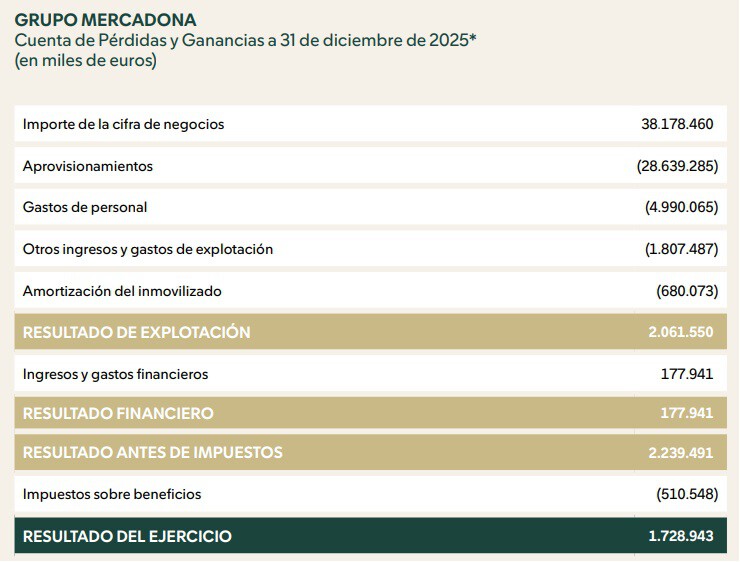
The Profitability Paradox: Lower Margins, Higher Returns
At first glance, earning less per product might seem like a disadvantage. But Mercadona turns this into a strength by optimizing its supply chain, reducing waste, and driving volume. The company's focus on efficiency allows it to maintain lower prices while still generating higher returns on investment.
Key Takeaways from Mercadona's Strategy
- Volume over margin: Mercadona prioritizes high turnover and cost leadership, which compensates for thinner margins.
- Supply chain control: Tight integration with suppliers reduces costs and ensures product availability.
- Private label dominance: While not the sole driver, own-brand products enhance margin control and customer loyalty.
- Operational efficiency: Streamlined logistics and store operations minimize overhead.
- Customer-centric approach: Consistent quality and low prices build trust and repeat visits.
How Mercadona Outperforms Competitors
Mercadona's ability to generate higher profitability ratios than rivals like Carrefour or Lidl is rooted in its unique business model. By focusing on a limited assortment of products, the company simplifies inventory management and negotiates better terms with suppliers.
Moreover, its integrated approach to logistics—from distribution centers to store shelves—reduces handling costs and spoilage. This operational excellence translates into a competitive edge that is hard to replicate.
Comparative Financial Metrics
| Metric | Mercadona | Industry Average |
|---|---|---|
| Gross Margin per Sale | Lower | Higher |
| Profitability Ratio | Higher | Lower |
| Market Share (Food Distribution) | ~30% | Fragmented |
| Prepared Meals Market Share | 51% | Diverse |
| Revenue Growth (2025) | 8% | Varies |
Why Mercadona's Model Matters for the Industry
Mercadona's success challenges the conventional wisdom that higher margins per product are essential for profitability. Instead, it demonstrates that scale, efficiency, and customer loyalty can drive superior financial outcomes.
This model has implications beyond groceries. Retailers across sectors can learn from Mercadona's disciplined approach to cost management and its relentless focus on the customer experience. The background to this story is set out in Mercadona Portugal: 55% of Households Now Shop at the Chain. A related thread runs through Consum Overtakes Mercadona in Valencia Retail Space Race. Earlier coverage in Mercadona and María Pombo Want to Make Tortilla the Spanish Pizza shows how the argument developed.
The Road Ahead: Challenges and Opportunities
As Mercadona continues to grow, it faces challenges such as market saturation and increasing competition from discounters. However, its strong financial position and loyal customer base provide a solid foundation for future expansion. A closer look at the same subject appears in Verdifresh Sales Surge 19% on Mercadona Partnership. Anyone following the wider picture can start with Mercadona Market Share Stalls: What the Data Reveals. The same theme surfaces in Anitín Breadsticks Sales Hit €110 Million Thanks to Mercadona, which takes a different angle.
Investors and analysts will watch closely to see if Mercadona can sustain its profitability edge in a rapidly evolving retail landscape. Context on how this played out before sits in Turkish Supermarket File Copies Mercadona and Now Faces EU Probe. A companion piece, Mercadona Juice Theft: Shoplifting or Robbery? 2-Year Sentence Sought, approaches the same subject from another angle.
FAQ
How does Mercadona achieve higher profitability despite lower margins?
What is Mercadona's market share in Spain?
Is private label the main driver of Mercadona's success?
What was Mercadona's revenue in 2025?
Browse the Shop
 Acacia frida deluxe solid wood bed frame |
Bedroom bench |
Bed chest drawers |
Lingerie dresser |
Frame base |
Mirror with jewelry storage |
30 Bathroom Vanity |
Memory foam queen mattress |
Mattresses for back pain |
Nightstand set of 2 |
Grand Goldman Shop |
Civil Lawyer
Deutschland Trikot WM 2026







