

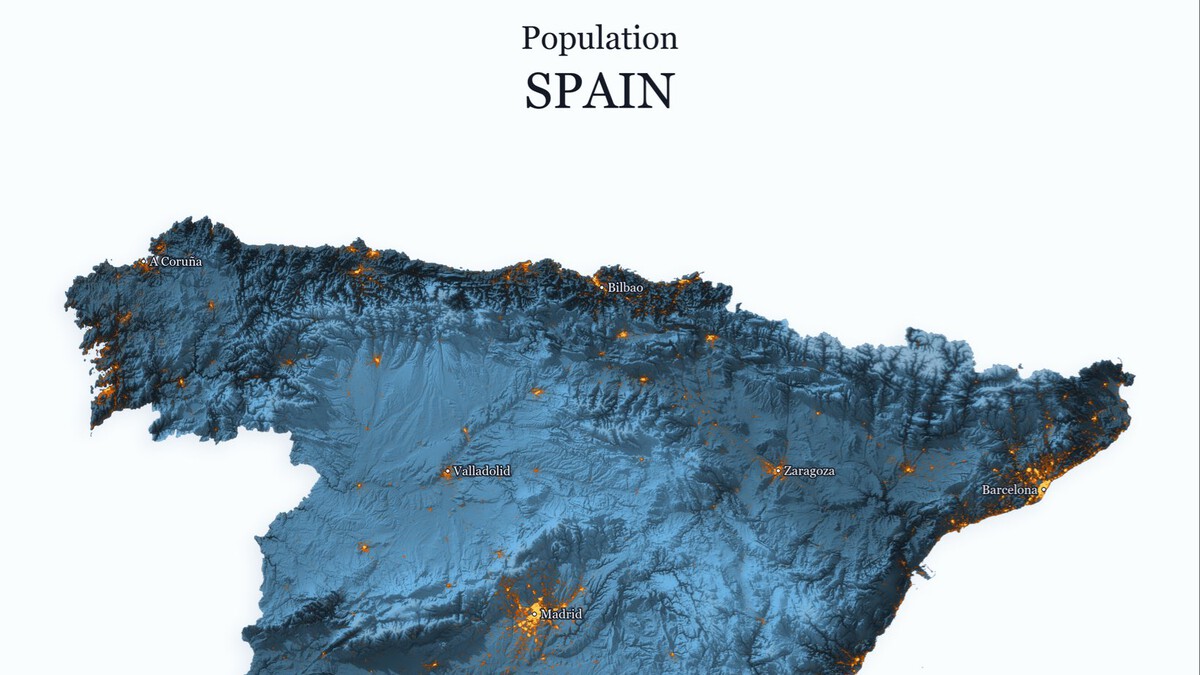
Spain's population map shows a country that is not empty but concentrated, with stark contrasts in where people live. According to the National Statistics Institute (INE), Spain's population reached 49,801,559 as of July 1, 2026, yet the national density of about 95-97 inhabitants per square kilometer is below the EU average of 109.1. This statistic alone suggests a sparsely populated country, but the reality is far more nuanced: Spain's inhabitants are highly unevenly distributed, a phenomenon often called 'la España vaciada' (emptied Spain), though it might better be described as 'la España concentrada' (concentrated Spain).
What the Map Reveals About Spain's Population Distribution
The map provides a striking visual of the enormous inequality in population distribution. According to INE data, 40.9% of the population lives in municipalities with more than 100,000 inhabitants, while only 2.9% reside in municipalities with 1,000 inhabitants or fewer. This means that a small number of large urban areas hold a disproportionate share of the population, leaving vast rural regions sparsely populated.
Find Original Home Decor sparking conversation at Grand Goldman Shop.

Moreover, population growth is also concentrated. Madrid and Catalonia alone account for half of the state's population growth since 2015, as reported by elDiario.es. This trend exacerbates the divide between dynamic urban centers and declining rural areas.
Key Takeaways from Spain's Demographic Data
- 40.9% of Spaniards live in municipalities with over 100,000 residents.
- Only 2.9% live in towns of 1,000 people or fewer.
- 48% of municipalities have a density below 12.5 inhabitants per square kilometer, and most have fewer than 500 residents.
- Madrid and Catalonia drive half of Spain's population growth since 2015.
- There are 78,000 localities with fewer than 100 inhabitants, up 23,000 since 1998.
The Official Diagnosis: Depopulation and Low Density
The Ministry of Territorial Policy has long diagnosed this depopulation and the enormous density gap. Nearly half of all municipalities fall below the threshold of 12.5 inhabitants per square kilometer, and the majority of these have fewer than 500 residents. This is not just a rural issue; it affects access to services, infrastructure, and economic opportunities.
The situation is expected to worsen. The Strategy for the Demographic Challenge describes that Spain has 78,000 localities with fewer than 100 inhabitants, which is 23,000 more than in 1998. This trend of rural exodus and aging populations in small villages shows no sign of reversing.
Why This Concentration Matters
This concentration has significant implications for Spain's economy, society, and politics. Urban areas thrive with investment and talent, while rural regions struggle with depopulation, leading to school closures, reduced healthcare access, and limited public services. The gap also influences electoral politics and regional development policies.
Understanding this distribution is crucial for policymakers, businesses, and citizens alike. It affects everything from where companies choose to invest to how government allocates resources for infrastructure and social programs.
Comparing Spain's Density with the EU
Spain's national density is lower than the EU average, but this figure masks the internal disparity. The table below illustrates the contrast between Spain and the EU, and between urban and rural areas within Spain. The background to this story is set out in Mister Calvo 2026: A Bald Beauty Pageant Against Rural Depopulation. A related thread runs through Spain's Immigration Myth: Can It Really Offset an Aging Population. Earlier coverage in Climate Change Kills: Pedro Sánchez's Stark Warning to Spain shows how the argument developed.
| Indicator | Spain | EU Average |
|---|---|---|
| Population density (inhabitants/km²) | 95-97 | 109.1 |
| % population in municipalities >100,000 | 40.9% | — |
| % population in municipalities ≤1,000 | 2.9% | — |
| % municipalities with density <12.5/km² | 48% | — |
What to Watch Next
As Spain's population continues to concentrate, the challenge of balancing growth with territorial cohesion will intensify. The government's demographic strategy aims to address these imbalances, but reversing rural depopulation is a long-term endeavor. Key indicators to monitor include population growth in Madrid and Catalonia, the number of small municipalities losing residents, and policy responses to improve rural connectivity and services. A closer look at the same subject appears in Why the US Has Fewer Elevators Than Spain Despite 7x Population. Anyone following the wider picture can start with Spain's Summer Population Surge Strains Towns and Services. The same theme surfaces in Solar Ambulance: A Solution for Spain's Depopulated Rural Areas, which takes a different angle.
For now, the map serves as a powerful reminder that Spain's demographic reality is one of concentration, not emptiness. Recognizing this is the first step toward crafting effective solutions for all regions. Context on how this played out before sits in Trending: latest articles.
FAQ
What is 'la España vaciada'?
'La España vaciada' refers to the depopulated rural areas of Spain, where low population density and aging demographics create challenges for service provision and economic development. It highlights the contrast with densely populated urban centers.
How does Spain's population density compare to the EU?
Spain's population density is about 95-97 inhabitants per square kilometer, which is lower than the EU average of 109.1. However, this national figure obscures the extreme internal concentration in certain regions.
Which regions drive Spain's population growth?
Madrid and Catalonia alone account for half of Spain's population growth since 2015, according to elDiario.es. This underscores the ongoing concentration of population in these dynamic areas.
What percentage of Spaniards live in small municipalities?
Only 2.9% of the population lives in municipalities with 1,000 inhabitants or fewer, while 40.9% live in municipalities with over 100,000 inhabitants, according to INE data.
Browse the Shop
 Acacia frida deluxe solid wood bed frame |
Bedroom bench |
Bed chest drawers |
Lingerie dresser |
Frame base |
Mirror with jewelry storage |
30 Bathroom Vanity |
Memory foam queen mattress |
Mattresses for back pain |
Nightstand set of 2 |
Grand Goldman Shop |
Civil Lawyer
Deutschland Trikot WM 2026







