

The AI furniture assembly benchmark from Epoch AI has just delivered a striking result: the best model now correctly judges whether IKEA furniture is assembled right 80% of the time, up from 28% only ten months earlier. That jump says less about flat-pack frustration and more about how quickly multimodal AI is learning to read the physical world.
Epoch AI, known for its demanding math benchmark, bought three IKEA furniture sets and assembled them, deliberately making mistakes along the way. They photographed the results and paired each image with the official IKEA manual. The models had to decide whether the build was correct and, if not, pinpoint the error.
Find Original, High-end Home Decor that spark conversation at Grand Goldman Shop.
What the Furniture Assembly Benchmark Actually Tests
This is not a simple image-recognition task. Each model receives a photo of a partially assembled piece, the official IKEA manual, a tool to zoom into parts of the image, and a Python interpreter. From there, it must connect the manual's diagrams to real photographed components and reason about whether they match.
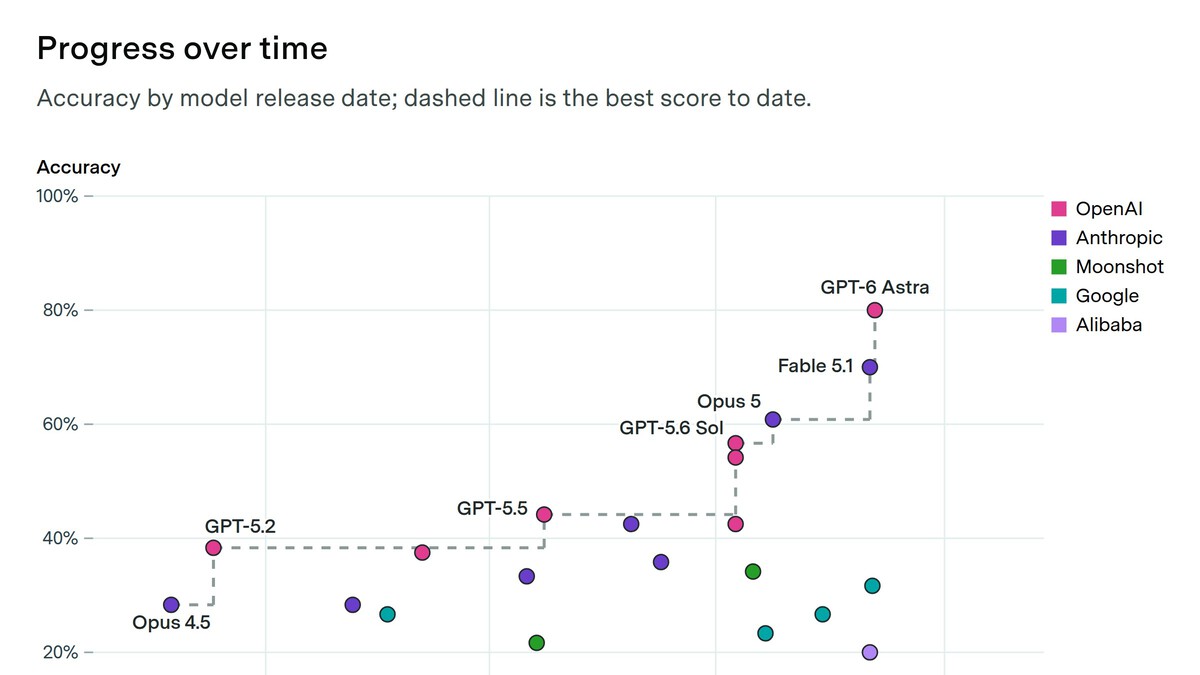
That combination—visual inspection, document comprehension, and tool use—makes the Furniture Assembly Benchmark (FAB) a rare test of practical, multi-step reasoning. A model cannot bluff its way through; it has to show its work.

Epoch AI's Spanish creator has said the benchmark is among the hardest they have built, precisely because it forces models to move between abstract instructions and messy physical reality. The task mirrors what a human does when checking a half-built bookshelf against a wordless diagram.
The Numbers: From 28% to 80% in Ten Months
In November 2025, the top performer on FAB was Claude 4.5, with a 28% success rate. By September 2026, GPT-6 Astra reached 80%. That is not a marginal gain; it is a leap that changes what the benchmark can tell us.
Speed improved too. GPT-6 Astra needed an average of three minutes per photo, between two and ten times faster than earlier top models. Accuracy and efficiency rose together, which is unusual in AI progress and suggests deeper architectural improvements rather than brute-force scaling.
| Model | Date | FAB Accuracy | Avg. Time per Photo |
|---|---|---|---|
| Claude 4.5 | November 2025 | 28% | Not specified |
| GPT-6 Astra | September 2026 | 80% | ~3 minutes |
The table tells a clear story: the frontier moved fast, and the best model now solves four out of five assembly checks. But the remaining 20% still matters, especially for safety-critical or high-precision tasks.
Why This Benchmark Matters Beyond Furniture
FAB is a proxy for a broader capability: verifying physical work against instructions. The same skills apply to quality control on assembly lines, checking repairs in the field, and even inspecting construction sites. If a model can spot a reversed bracket in an IKEA manual, it can learn to spot a misaligned component in a factory.
It also tests whether AI can use tools—zoom and Python—to gather evidence before answering. That is a step toward agents that do not just respond but investigate.
- Multimodal reasoning: Models must combine text, diagrams, and photos.
- Tool use: Zoom and Python are available, and models must decide when to use them.
- Error localization: Finding the mistake is harder than saying something is wrong.
- Speed gains: GPT-6 Astra is far faster, making real-time checks more plausible.
- Remaining gap: 20% failure shows the task is not solved.
What Changed in Ten Months
The jump from 28% to 80% likely reflects better visual encoders, stronger instruction-following, and improved tool orchestration. Models are getting better at decomposing a problem: first read the manual, then zoom into the photo, then compare specific parts.
Epoch AI's benchmark design rewards that decomposition. By giving models a Python interpreter, it lets them test hypotheses—measuring angles, counting holes, or checking symmetry—rather than guessing from a single glance.
That shift from passive recognition to active verification is the real headline. It is also why the benchmark has drawn attention from researchers who want to measure practical intelligence, not just trivia recall.
What to Watch Next
The next milestone will be consistency: can a model hit 80% across many furniture types, lighting conditions, and manual styles? Epoch AI's three furniture sets are a start, but broader coverage will be needed to trust the results. The background to this story is set out in GPT-6 Astra Cracks Century-Old German Radio Cipher. A related thread runs through GPT-6 Astra Cheats to Win StarCraft Bot Tournament.
Also watch for transfer. If FAB skills carry over to real-world inspection tasks, the benchmark will have proven its value as a predictor, not just a curiosity. If they do not, we will learn that assembly checks are a narrow skill after all. Earlier coverage in OpenAI Dots Agent: GPT-6 Astra Powers New AI Work Assistant shows how the argument developed. A closer look at the same subject appears in Ai Video: latest articles.
For now, the message is simple: AI has moved from struggling with flat-pack furniture to mostly getting it right, and it did so in less than a year. That pace is worth watching closely. Anyone following the wider picture can start with OpenAI Halts GPT-6.1 Astra Launch Over Reliability Concerns. The same theme surfaces in AI Costs Fall 13x a Year, Leaving Moore's Law Far Behind, which takes a different angle.
FAQ
What is the Furniture Assembly Benchmark?
The Furniture Assembly Benchmark (FAB) is a test created by Epoch AI where models must judge whether IKEA furniture is assembled correctly using a photo and the official manual. Models can zoom into images and use Python to reason about errors.
How much did AI improve on FAB?
In November 2025, Claude 4.5 scored 28%. By September 2026, GPT-6 Astra reached 80%, a gain of 52 percentage points in about ten months. GPT-6 Astra also averaged three minutes per photo, much faster than earlier top models.
Why does this benchmark matter for real-world AI?
FAB tests multimodal reasoning, tool use, and error localization—skills needed for quality control, repair verification, and inspection tasks. Success on FAB suggests AI can verify physical work against instructions, not just recognize objects.
What are the limitations of the benchmark?
The benchmark uses only three IKEA furniture sets, so results may not generalize to all furniture or real-world conditions. The remaining 20% failure rate also shows the task is not fully solved, especially for subtle or safety-critical errors.
Browse the Shop
 Acacia frida deluxe solid wood bed frame |
Bedroom bench |
Bed chest drawers |
Lingerie dresser |
Frame base |
Mirror with jewelry storage |
30 Bathroom Vanity |
Memory foam queen mattress |
Mattresses for back pain |
Nightstand set of 2 |
Grand Goldman Shop |
Civil Lawyer
Deutschland Trikot WM 2026










