

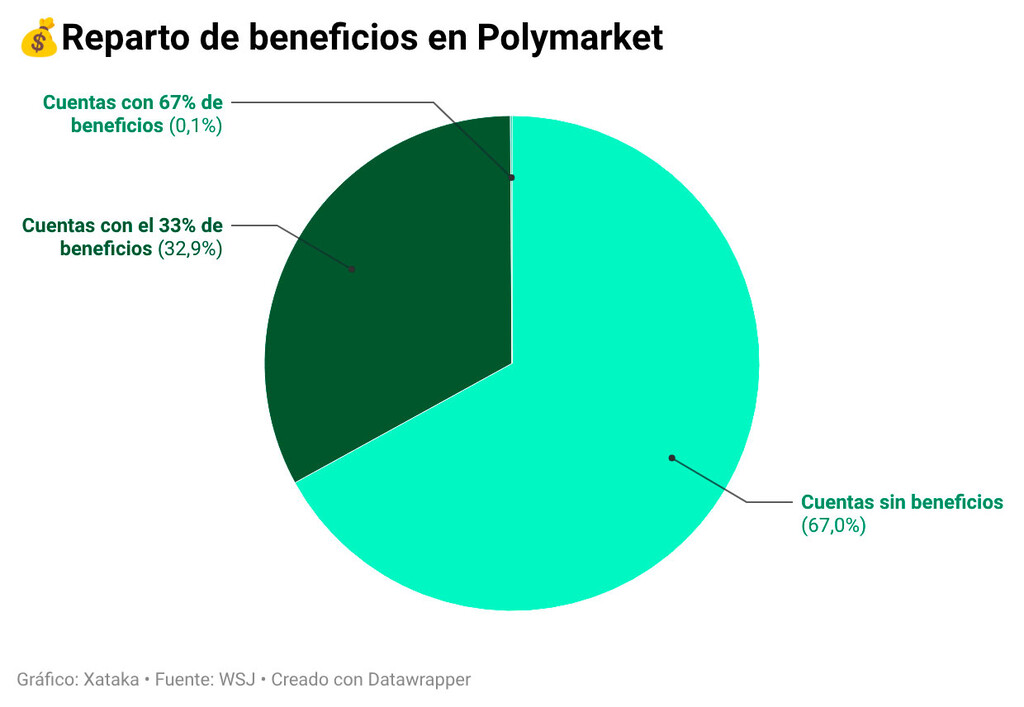
A massive analysis of Polymarket confirms what many suspected: professional traders win big while most users lose money. The Wall Street Journal reviewed 1.6 million accounts from 2022 onward and found that just 2,000 users—0.1% of the total—captured 67% of all profits. That's roughly $500 million split among them, or about $250,000 each. Meanwhile, the rest of the gains are thinly spread, and a large share of users are actually in the red.
What the Polymarket Analysis Revealed
The numbers are stark. The top 0.1% of accounts took home two-thirds of all profits. The remaining third is divided among roughly one-third of all analyzed users. The largest group? They aren't just missing out—they're losing money. In other words, many users are financing the party for a select few.
Find Original Home Decor sparking conversation at Grand Goldman Shop.

This pattern isn't unique to Polymarket. On Kalshi, a competitor, the ratio of profitable to unprofitable users is 1 to 2.9. For every person making money, nearly three are losing it. The house—or in this case, the pros—always seem to win.
Who Are the Winners on Polymarket?
They aren't everyday people with a good eye. They are professional traders, often with sophisticated tools, deep pockets, and years of experience. These traders can afford to take calculated risks, hedge positions, and exploit small inefficiencies in the market. For them, prediction markets are just another asset class.
Retail users, on the other hand, often treat Polymarket like a casino. They bet on outcomes they feel strongly about—elections, sports, pop culture—without a systematic edge. That emotional approach leads to losses, which subsidize the professionals.
Why Most Users Lose Money
Prediction markets are often marketed as a way to get rich by forecasting the future. But the reality is that they are zero-sum games. Every dollar won by one trader is a dollar lost by another. With professionals dominating, the odds are stacked against casual users.
Moreover, the structure of these markets favors those who can trade frequently and in large volumes. Professionals can arbitrage price differences, provide liquidity, and react to news faster than amateurs. The result is a wealth transfer from the many to the few.
Key Takeaways for Retail Traders
- Only 0.1% of Polymarket users capture 67% of profits, averaging $250,000 each.
- Most users lose money: on Kalshi, nearly three losers for every winner.
- Professionals dominate with tools, capital, and experience that retail users lack.
- Prediction markets are zero-sum: your loss is someone else's gain.
- Emotional betting on outcomes you care about often leads to poor decisions.
Polymarket vs. Kalshi: Profitability Comparison
| Platform | Profitable Users | Unprofitable Users | Ratio (Profit: Loss) |
|---|---|---|---|
| Polymarket | ~33% | ~67% | 1:2 |
| Kalshi | ~26% | ~74% | 1:2.9 |
The table shows that both platforms have a similar pattern: a minority of users make money, while the majority lose. Polymarket's top-heavy distribution is even more extreme, with a tiny fraction capturing most of the gains. The background to this story is set out in Prediction Markets Could Replicate US Boom in UK – Here's How. A related thread runs through Polymarket and Kalshi Now Host Bets on US Health Crises. Earlier coverage in Prediction Markets Accuracy Tested by US Midterms After Brazil Miss shows how the argument developed.
What This Means for the Future of Prediction Markets
As prediction markets grow in popularity, scrutiny will increase. Regulators may look closer at how these platforms operate and whether they adequately disclose the risks. For retail users, the lesson is clear: treat prediction markets as entertainment, not an investment strategy. Without a genuine edge, you're likely to be the one funding the pros. A closer look at the same subject appears in Spain Blocks Polymarket and Kalshi in Gambling Crackdown. Anyone following the wider picture can start with Climate Betting Markets: Can Prediction Odds Forecast Our Planet. The same theme surfaces in Prediction Markets Could Catch Fire in UK, Replicating US Boom, which takes a different angle.
Still, the technology behind prediction markets has value for forecasting. When used by informed traders, these markets can aggregate information efficiently. But that doesn't mean everyone should participate with real money. Context on how this played out before sits in Climate Prediction Markets: Weather Bets Surge 500%. A companion piece, Polymarket HSBC Lloyds Failure Bets Spark UK Regulatory Alarm, approaches the same subject from another angle.
FAQ
How much do the top Polymarket traders make?
According to the Wall Street Journal analysis, the top 0.1% of users—about 2,000 accounts—split roughly $500 million in profits, averaging $250,000 each.
What percentage of Polymarket users are profitable?
The analysis suggests that only about one-third of users are profitable, with the majority losing money. The top 0.1% capture 67% of all profits.
Is Polymarket a good way to make money?
For most people, no. Prediction markets are zero-sum and dominated by professionals. Retail users without a systematic edge are likely to lose money.
How does Kalshi compare to Polymarket in terms of user profitability?
Kalshi has a profit-to-loss ratio of 1 to 2.9, meaning nearly three users lose money for every one who profits. Polymarket's distribution is even more skewed toward the top.
Browse the Shop
 Acacia frida deluxe solid wood bed frame |
Bedroom bench |
Bed chest drawers |
Lingerie dresser |
Frame base |
Mirror with jewelry storage |
30 Bathroom Vanity |
Memory foam queen mattress |
Mattresses for back pain |
Nightstand set of 2 |
Grand Goldman Shop |
Civil Lawyer
Deutschland Trikot WM 2026







