

The NASA Tang myth—that the space agency invented the orange powdered drink for astronauts—is one of the most enduring and profitable misunderstandings in space history. For decades, millions have believed that Tang was created by NASA to feed its astronauts. The reality is far more curious: the product was already being sold in American supermarkets before John Glenn orbited the Earth, and its initial sales were far from exciting for its manufacturers.
It took NASA's adoption of Tang for its missions to turn an ordinary drink into a symbol of space conquest. This association gave rise to one of the most profitable misunderstandings of the space race.
Find Original, High-end Home Decor that spark conversation at Grand Goldman Shop.

The Birth of Tang: A Supermarket Invention
The story began in 1957 when William A. Mitchell, a food chemist at General Foods, developed a mixture of flavored crystals that allowed an orange-flavored drink to be prepared simply by adding water. The product, known as Tang Flavor Crystals, hit American supermarkets in 1959 with a very period-appropriate pitch: a practical alternative to juice, enriched with vitamin C, that required no squeezing or refrigeration before preparation.
However, initial sales were modest, and the drink struggled to stand out among the many processed products flooding American homes. Nevertheless, its creator worked for General Foods, which saw potential in the product despite its slow start.
NASA's Adoption: A Match Made in Space
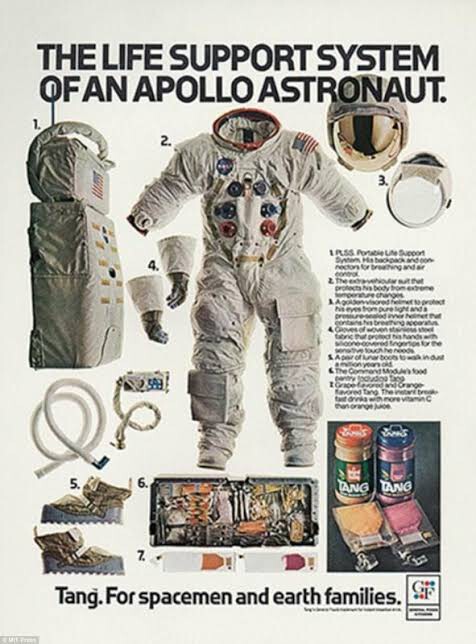
When NASA began planning manned spaceflights, it needed foods that were lightweight, non-perishable, and easy to prepare in microgravity. Tang fit the bill perfectly: it was a powder that could be mixed with water, provided vitamin C, and required no refrigeration. NASA included Tang in the food rations for Project Mercury, and later for Gemini and Apollo missions.
Astronauts like John Glenn and Neil Armstrong were seen with Tang, and the association stuck. But NASA never invented Tang; it simply adopted an existing product. The space agency's use of Tang was a practical choice, not a testament to its creation.
The Misunderstanding That Sold Millions
The public's belief that NASA invented Tang for astronauts became a marketing goldmine for General Foods. Sales of Tang skyrocketed as consumers associated the drink with the glamour and patriotism of the space program. The myth was so powerful that even today, many people still believe Tang was a NASA invention.
This misunderstanding is a classic example of how association with a prestigious entity can transform a product's fortunes. General Foods did not actively dispel the myth; instead, it leveraged the space connection in its advertising, cementing Tang's place in American culture. The longer history behind the story is traced in NASA Offers $150,000 to Stop Astronauts Becoming High-Voltage Capacitors.
Key Takeaways
- Tang was invented by William A. Mitchell at General Foods in 1957 and launched in supermarkets in 1959.
- NASA did not invent Tang; it adopted the product for astronaut missions because it was practical for space travel.
- The association with NASA turned Tang into a space icon and dramatically boosted sales.
- The myth persists because it was never officially corrected and was reinforced by advertising.
- Tang remains a case study in the power of branding and association.
Tang vs. Other Space Foods
| Product | Invented by NASA? | Year Introduced | Used in Space? |
|---|---|---|---|
| Tang | No (General Foods) | 1959 | Yes (Mercury, Gemini, Apollo) |
| Space Food Sticks | No (Pillsbury) | 1960s | Yes (Apollo) |
| Freeze-dried Ice Cream | No (various) | 1970s | Yes (Apollo) |
As the table shows, Tang was not unique in being a commercial product adopted by NASA. Other foods like Space Food Sticks and freeze-dried ice cream also had civilian origins but became associated with space travel. The background to this story is set out in Ex-Nasa Astronauts Launch Voting Campaign to Restore Democracy. A related thread runs through Over 100 Ex-Nasa Astronauts Launch New Voting Campaign. Earlier coverage in Zambia's Space Race: The Afronauts' Untold Pan-African Story shows how the argument developed.
The Legacy of the Tang Myth
The Tang myth illustrates how a simple association can create a lasting impression. It also highlights the importance of verifying historical claims, even those that seem harmless. For NASA, Tang was just one of many foods used in space; for General Foods, it was a marketing windfall. A closer look at the same subject appears in Spacecraft Rescue Mission for NASA Telescope Fails. Anyone following the wider picture can start with Did NASA Overlook Evidence of Life on Mars? 50 Years Later. The same theme surfaces in Register of British Slave-Traders Shatters Profit Myth, which takes a different angle.
Today, Tang is still sold worldwide, and its space connection remains a key part of its identity. The story serves as a reminder that sometimes the most profitable stories are not the ones that are true, but the ones that capture the public imagination. Context on how this played out before sits in US Confirms Space Weapons Deployment: Global Arms Race. A companion piece, Solitaire: The Microsoft Windows Game That Defined Office Procrastination, approaches the same subject from another angle.
FAQ
Did NASA invent Tang?
No, NASA did not invent Tang. Tang was created by William A. Mitchell at General Foods in 1957 and was available in supermarkets by 1959, before NASA adopted it for space missions.
Why did NASA use Tang?
NASA used Tang because it was a lightweight powder that could be mixed with water, provided vitamin C, and required no refrigeration—ideal for space travel.
How did the Tang myth start?
The myth started when NASA included Tang in astronaut missions, and the public assumed NASA had invented it. The association was reinforced by advertising and media coverage.
Did Tang sales increase because of NASA?
Yes, Tang sales soared after NASA adopted it for space missions. The space association turned Tang into a household name and a symbol of the space age.
Browse the Shop
 Acacia frida deluxe solid wood bed frame |
Bedroom bench |
Bed chest drawers |
Lingerie dresser |
Frame base |
Mirror with jewelry storage |
30 Bathroom Vanity |
Memory foam queen mattress |
Mattresses for back pain |
Nightstand set of 2 |
Grand Goldman Shop |
Civil Lawyer
Deutschland Trikot WM 2026
Acacia frida deluxe solid wood bed frame |
Bedroom bench |
Bed chest drawers |
Lingerie dresser |
Frame base |
Mirror with jewelry storage |
30 Bathroom Vanity |
Memory foam queen mattress |
Mattresses for back pain |
Nightstand set of 2 |
Grand Goldman Shop |
Civil Lawyer
Deutschland Trikot WM 2026










