

Spanish technology will play a critical role in NASA's Artemis II mission, as Madrid-based Airbus Crisa has designed the Thermal Control Unit (TCU) for the European Service Module. This unit is essential for maintaining a comfortable environment for astronauts and equipment during the 10-day lunar flyby scheduled for April 1, 2026.
The Artemis II mission marks humanity's return to the Moon after more than half a century. While the four astronauts won't land on the lunar surface, they will travel farther from Earth than any humans before them, testing the Orion spacecraft's systems in preparation for future landing missions.
Find Original Home Decor sparking conversation at Grand Goldman Shop.

What Is the Thermal Control Unit and Why Is It Critical?
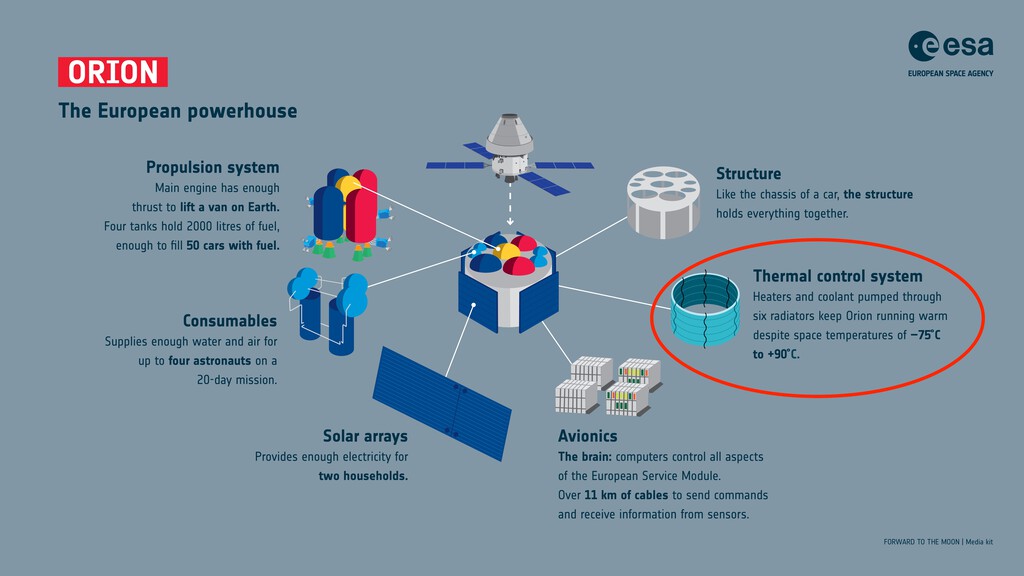
The TCU, manufactured at Airbus Crisa's facility in Tres Cantos, Madrid, is responsible for supplying air and water to the astronauts and ensuring that onboard temperatures remain within safe limits. Without this system, the crew and equipment would be exposed to extreme temperature fluctuations in space.
Fernando Gómez-Carpintero, general director of Airbus Crisa, explained that the Orion spacecraft actually carries two TCUs, providing redundancy in case one fails. This dual-system approach is a hallmark of space mission safety protocols.
How the TCU Works
The TCU regulates the flow of coolant to various parts of the spacecraft, dissipating heat generated by electronics and life support systems. It also helps maintain a stable environment inside the crew capsule, where temperatures must stay within a narrow range for the astronauts' comfort and safety.
Airbus Crisa's expertise in thermal control systems has been honed over decades of space projects, including contributions to the International Space Station and various satellites. This experience positions the company as a key player in Europe's space industry.
The European Service Module: A Collaborative Effort
The Orion spacecraft consists of two main modules: the crew capsule built by Lockheed Martin for NASA, and the European Service Module provided by the European Space Agency (ESA), with Airbus Defence and Space as the prime contractor. The TCU is part of this European contribution, highlighting the international collaboration behind Artemis.
The European Service Module supplies propulsion, power, water, oxygen, and nitrogen to the crew capsule. It also maintains the spacecraft's temperature, which is where the TCU comes into play. This module is a critical element that enables the Orion spacecraft to support human life during deep space missions.
Spain's Growing Role in Space Exploration
Spain has been increasing its footprint in the space sector, with companies like Airbus Crisa leading the way in developing advanced technologies for international missions. The TCU is just one example of Spanish engineering contributing to global space exploration.
Other Spanish firms are also involved in Artemis, providing components and services that support the mission's success. This participation not only showcases Spanish capabilities but also strengthens Europe's position in the global space economy.
Artemis II Mission Overview
Artemis II is the first crewed mission of the Artemis program, following the uncrewed Artemis I test flight. The mission will send four astronauts on a trajectory around the Moon, testing the Orion spacecraft's life support systems, communications, and navigation.
The crew will travel approximately 230,000 miles from Earth, surpassing the distance record set by Apollo 13. The mission is expected to last about 10 days, during which the astronauts will conduct various tests and observations.
Key Objectives of Artemis II
- Validate the Orion spacecraft's systems with a crew on board.
- Test the European Service Module's performance, including the TCU.
- Demonstrate safe reentry and recovery procedures.
- Collect data to inform future lunar landing missions.
- Inspire the next generation of scientists and engineers.
Challenges and Delays
The Artemis II mission has faced several delays due to technical issues and budget constraints. Originally planned for 2024, the launch has been rescheduled to April 2026 to allow more time for testing and integration.
These delays are not uncommon in space exploration, where safety is paramount. NASA and its partners are committed to ensuring that all systems are ready before committing to a crewed flight.
Comparison of Artemis Missions
| Mission | Launch Date | Crew | Objective |
|---|---|---|---|
| Artemis I | November 2022 | Uncrewed | Test Orion systems |
| Artemis II | April 2026 | 4 astronauts | Lunar flyby |
| Artemis III | TBD | 4 astronauts | Lunar landing |
What This Means for the Future of Space Exploration
The success of Artemis II will pave the way for Artemis III, which aims to land astronauts on the Moon for the first time since 1972. The technologies developed for these missions, including the TCU, will also be applicable to future missions to Mars and beyond.
International collaboration, such as that between NASA and ESA, is essential for advancing space exploration. The contributions of companies like Airbus Crisa demonstrate how expertise from different countries can come together to achieve remarkable feats. The background to this story is set out in Artemis II Launches Successfully: Humanity Returns to the Moon. A related thread runs through Artemis II Splashdown: Orion Returns Astronauts to Lunar History. Earlier coverage in Artemis II: Humans Return to the Moon After 50 Years shows how the argument developed.
Economic and Scientific Impact
The Artemis program is expected to stimulate economic growth by creating jobs and fostering innovation in the space industry. It also promises scientific breakthroughs, from lunar geology to biomedical research. A closer look at the same subject appears in Artemis II: A US Triumph Powered by European Space Technology. Anyone following the wider picture can start with Artemis II: NASA's Return to the Moon with Seville University. The same theme surfaces in Artemis II Astronauts Return Changed by the Overview Effect, which takes a different angle.
For Spain, participation in Artemis enhances its reputation as a high-tech nation and opens doors for future contracts in the space sector. The TCU is a testament to the country's engineering prowess. Context on how this played out before sits in NASA Sends Three Fully Autonomous Robots to the Moon. A companion piece, NASA Artemis II Astronauts Make Video Calls from Deep Space, approaches the same subject from another angle.
FAQ
What is the Thermal Control Unit (TCU)?
What is the Thermal Control Unit (TCU)?
The TCU is a system designed to regulate temperature and provide air and water to astronauts aboard the Orion spacecraft. It ensures that the crew and equipment remain within safe temperature limits during the mission.
Which Spanish company is involved in Artemis II?
Which Spanish company is involved in Artemis II?
Airbus Crisa, based in Tres Cantos, Madrid, designed and manufactured the Thermal Control Unit for the European Service Module. The company has a long history of contributing to space missions.
When is Artemis II scheduled to launch?
When is Artemis II scheduled to launch?
Artemis II is currently scheduled to launch on April 1, 2026, after several delays. The mission will send four astronauts on a 10-day journey around the Moon.
Why is Artemis II important?
Why is Artemis II important?
Artemis II is the first crewed mission of the Artemis program and will test the Orion spacecraft's systems with astronauts on board. Its success is crucial for future lunar landing missions and the broader goal of human exploration of Mars.
Browse the Shop
 Acacia frida deluxe solid wood bed frame |
Bedroom bench |
Bed chest drawers |
Lingerie dresser |
Frame base |
Mirror with jewelry storage |
30 Bathroom Vanity |
Memory foam queen mattress |
Mattresses for back pain |
Nightstand set of 2 |
Grand Goldman Shop |
Civil Lawyer
Deutschland Trikot WM 2026







