

The dark matter hunt just got more intriguing. The LUX-ZEPLIN (LZ) experiment, buried nearly 1.5 kilometers underground, uses seven tons of liquid xenon to search for weakly interacting massive particles (WIMPs), a leading dark matter candidate. In its latest data analysis, LZ has detected a signal that doesn't quite fit expectations, leaving physicists both puzzled and excited.
Dark matter makes up about 85% of the universe's mass, yet its true nature remains unknown. We infer its existence from gravitational effects on galaxies and cosmic structures. LZ aims to directly detect WIMPs by observing their rare interactions with ordinary matter. The new signal could be a statistical fluctuation, a background contamination, or the first hint of something entirely new.
Find Original, High-end Home Decor that spark conversation at Grand Goldman Shop.
Why Bury a Detector 1.5 Kilometers Underground?
Cosmic rays constantly bombard Earth's surface, creating a noisy background that would overwhelm any dark matter signal. By placing the detector deep underground, LZ shields itself from most of this radiation. The remaining background comes from natural radioactivity in the surrounding rock and materials, which the experiment carefully monitors and mitigates.
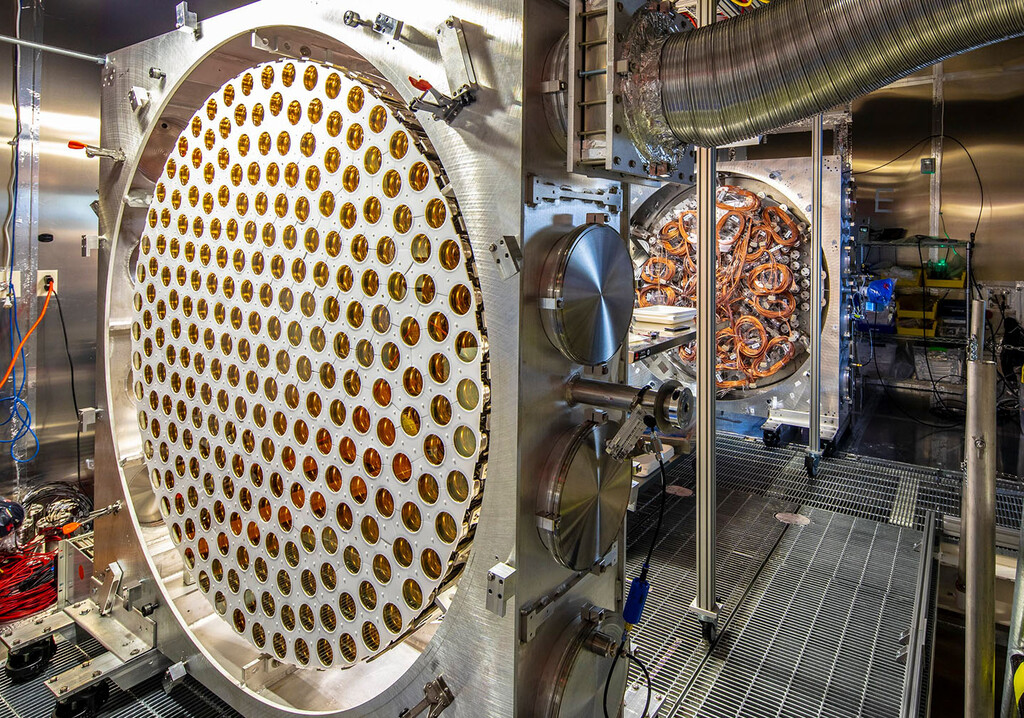
The LZ detector sits in the Sanford Underground Research Facility in South Dakota. Its location provides about 1.5 kilometers of rock overhead, reducing cosmic ray muons by a factor of a million. This allows the experiment to achieve unprecedented sensitivity to rare dark matter interactions.

How Does the LZ Detector Work?
At the heart of LZ is a tank filled with seven tons of liquid xenon. When a particle interacts with a xenon nucleus, it deposits energy and produces two signals: a prompt flash of light (S1) and a delayed signal (S2) from electrons drifting in an electric field. The combination of S1 and S2 helps identify the type of particle and its energy.
The LZ collaboration uses sophisticated analysis to separate potential dark matter events from background noise. The detector is surrounded by active shields, including a water tank and a layer of liquid scintillator, to veto unwanted events. This multi-layered approach is crucial for isolating the faintest signals.
What Is the Unexplained Signal?
In the latest analysis, LZ observed a small excess of events that resemble nuclear recoils, the expected signature of WIMPs. However, the excess is not statistically strong enough to claim a discovery. It could be due to a background process not fully understood, such as radon contamination or detector effects.
The collaboration is cautious. They report the signal with a significance of about 2.5 sigma, far below the 5 sigma threshold required for a discovery in particle physics. This means there's roughly a 1 in 100 chance that the signal is a random fluctuation. Still, the result is intriguing and warrants further investigation.
What Does This Mean for Dark Matter Research?
The LZ result is not a detection, but it provides valuable data to refine dark matter models. If the signal is real, it could point to a lighter WIMP or a different interaction mechanism than previously assumed. Alternatively, it could help identify previously overlooked backgrounds, improving future analyses. Context on how this played out before sits in Dark Matter Hunt: Xenon Experiment Reveals Unexplained Signal.
The LZ experiment is still collecting data, and more results are expected in the coming years. Upgrades to the detector and analysis techniques will increase sensitivity and help confirm or rule out the signal. The dark matter hunt continues, with LZ at the forefront. The background to this story is set out in NASA's Roman Telescope Gains 12 Extra Years to Explore Dark Matter. A related thread runs through Science: latest articles.
- Seven tons of liquid xenon are used to detect rare dark matter interactions.
- 1.5 kilometers of rock shields the detector from cosmic rays.
- The unexplained signal is a small excess of nuclear recoil events.
- Statistical significance is low (2.5 sigma), so it's not yet a discovery.
- Further data will clarify whether the signal is real or background.
Comparing Dark Matter Experiments
| Experiment | Detector Mass | Depth | Location | Status |
|---|---|---|---|---|
| LUX-ZEPLIN (LZ) | 7 tons | 1.5 km | Sanford Underground Research Facility, USA | Operating |
| XENONnT | 8.5 tons | 1.5 km | Gran Sasso, Italy | Operating |
| PandaX-4T | 4 tons | 2.4 km | China Jinping Underground Laboratory | Operating |
| DarkSide-20k | 20 tons | 1.4 km | Gran Sasso, Italy | Under construction |
What to Watch Next
The LZ collaboration will continue to analyze data and improve their understanding of backgrounds. A key focus will be on calibrating the detector with known sources to better model the response to nuclear recoils. This will help determine whether the excess is due to dark matter or something mundane. Earlier coverage in Strange Particle Accelerator Signal May Reveal Universe's Origin shows how the argument developed. A closer look at the same subject appears in Google AI Maps 9 Billion DNA Changes in Genetic Breakthrough.
Meanwhile, other experiments like XENONnT and PandaX-4T are also pushing the boundaries. Together, these global efforts will either confirm the signal or rule it out. The next few years could bring a breakthrough in our understanding of dark matter. Anyone following the wider picture can start with Fossils Now a Millionaire Treasure, Paleontologists Worry. The same theme surfaces in AI Creates First Synthetic Virus: Stanford's Evo Breakthrough, which takes a different angle.
FAQ
What is dark matter and why is it so hard to find?
Dark matter is an invisible substance that makes up most of the universe's mass. It doesn't emit or absorb light, so it can only be detected through its gravitational effects. Its weak interactions with normal matter make it extremely challenging to detect directly.
Why does LZ use liquid xenon?
Liquid xenon is dense and produces measurable signals when particles interact with it. It also has low background radioactivity and can be purified to high levels, making it ideal for rare-event searches.
What would it take to claim a dark matter discovery?
A discovery typically requires a statistical significance of 5 sigma, meaning there's less than a one in 3.5 million chance of a false positive. LZ's current signal is far below this threshold, so more data is needed.
Could the signal be something other than dark matter?
Yes, it could be due to background radiation, detector anomalies, or statistical fluctuations. The LZ team is investigating all possible sources to ensure the signal is not misinterpreted.
Browse the Shop
 Acacia frida deluxe solid wood bed frame |
Bedroom bench |
Bed chest drawers |
Lingerie dresser |
Frame base |
Mirror with jewelry storage |
30 Bathroom Vanity |
Memory foam queen mattress |
Mattresses for back pain |
Nightstand set of 2 |
Grand Goldman Shop |
Civil Lawyer
Deutschland Trikot WM 2026







