

Helium has become the world's most coveted gas as the Strait of Hormuz closure disrupts supplies, and China may have found a substitute. The crisis highlights helium's critical role in cooling technologies from MRI magnets to quantum computers.
The Strait of Hormuz closure has sent shockwaves through global markets, but one unexpected casualty is helium. This noble gas, essential for cooling critical technologies, is now in dangerously short supply. China's new research offers a potential way out.
Find Original Home Decor sparking conversation at Grand Goldman Shop.

Why Helium Is Critical for High-Tech Industries
Helium's unique properties make it indispensable for cooling. Its low boiling point and inert nature allow it to cool superconducting magnets in MRI machines and particle accelerators. It's also vital for cryogenic cooling in quantum computing and neutron detectors.
But not all helium is equal. Helium-4 is relatively abundant, though difficult to contain due to its lightness. Helium-3, however, is scarce and primarily a byproduct of aging tritium nuclear warheads. This scarcity creates a bottleneck for advanced research.
China's Breakthrough: A Helium-Free Cooling Alloy
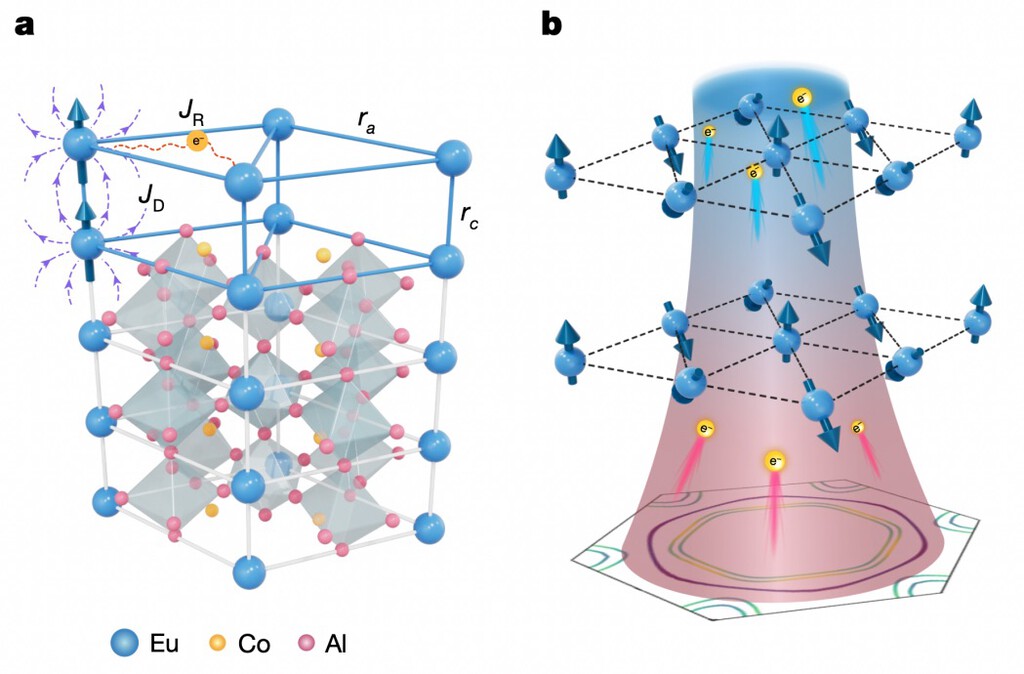
A Chinese research team has published a solution in Nature: a metallic alloy that cools to near absolute zero without helium. The alloy, EuCo₂Al₉ (ECA), is an intermetallic rare-earth compound that achieves 106 millikelvin (–273.05 °C).
This sets a record for the lowest temperature achieved by a metallic magnetocaloric material without helium-3. The alloy combines two properties that make it particularly effective for cryogenic cooling.
How the New Alloy Works
Magnetocaloric materials cool when subjected to a changing magnetic field. The ECA alloy exhibits a large magnetocaloric effect near its ordering temperature, allowing it to reach ultra-low temperatures. This eliminates the need for expensive and scarce helium-3.
The alloy's performance could revolutionize cryogenics, making advanced research more accessible and less dependent on helium supply chains. The background to this story is set out in China's New Tantalum Alloy Withstands 2,400°C Loads. A related thread runs through Iran War and China's Helium Export Ban Reshape Global Chip Supply. Earlier coverage in Carrefour's Portable AC Heats and Cools Without Renovation shows how the argument developed.
Key Implications for Industry and Research
- Reduced dependency on helium-3: The alloy offers a sustainable alternative for ultra-low-temperature cooling.
- Lower costs: Eliminating helium-3 from cooling systems could significantly reduce operational expenses.
- Enhanced research capabilities: Quantum computing and neutron detection could become more widespread.
- Supply chain resilience: The technology mitigates risks from geopolitical disruptions like the Strait of Hormuz closure.
- Environmental benefits: Helium extraction is energy-intensive; reducing demand helps conserve resources.
Comparing Cooling Technologies
| Technology | Cooling Medium | Minimum Temperature | Helium Dependency |
|---|---|---|---|
| Traditional dilution refrigerator | Helium-3/Helium-4 mixture | ~2 mK | High |
| Magnetocaloric with ECA | EuCo₂Al₉ alloy | 106 mK | None |
| Adiabatic demagnetization | Paramagnetic salts | ~1 mK | Low (but uses helium-3) |
| Laser cooling | Photons | ~1 μK | None (but limited to atoms) |
What to Watch Next
The research team's findings could spur further development of magnetocaloric materials. Scaling up production and integrating the alloy into commercial cooling systems will be the next challenges. If successful, this technology could reshape industries reliant on helium. A closer look at the same subject appears in Luis Barragán's Colorful Architecture Cools Homes Without Air Conditioning. Anyone following the wider picture can start with Giant Superatoms: A Key to Universal Quantum Computers. The same theme surfaces in Quantum Computers Could Break Bitcoin Encryption Sooner Than Expected, which takes a different angle.
As helium supplies remain vulnerable to geopolitical events, innovations like ECA offer a glimpse of a more resilient future. The race is on to commercialize helium-free cooling before the next crisis hits. Context on how this played out before sits in China Achieves High-Purity Silicon-28 for Quantum Computing. A companion piece, China's Tiangong Station Cools Atoms to Record 9.7 Picokelvin, approaches the same subject from another angle.
FAQ
What is helium-3 and why is it scarce?
Helium-3 is a rare isotope primarily produced as a byproduct of tritium decay in nuclear warheads. Its scarcity and high cost make it a bottleneck for ultra-low-temperature research.
How does the EuCo₂Al₉ alloy achieve cooling without helium?
The alloy exhibits a strong magnetocaloric effect, meaning it heats up when magnetized and cools when demagnetized. This property allows it to reach cryogenic temperatures without helium-3.
What industries will benefit most from this breakthrough?
Quantum computing, medical imaging (MRI), particle physics, and neutron detection are among the fields that rely on ultra-low temperatures and could benefit from helium-free cooling.
Is this alloy ready for commercial use?
Not yet. While the proof-of-concept is promising, scaling up production and integrating the alloy into practical cooling systems will require further research and development.
Browse the Shop
 Acacia frida deluxe solid wood bed frame |
Bedroom bench |
Bed chest drawers |
Lingerie dresser |
Frame base |
Mirror with jewelry storage |
30 Bathroom Vanity |
Memory foam queen mattress |
Mattresses for back pain |
Nightstand set of 2 |
Grand Goldman Shop |
Civil Lawyer
Deutschland Trikot WM 2026







