

The Milky Way is 10% larger than previously thought, according to a new study by scientists from NASA and the European Space Agency (ESA). The discovery was made by analyzing X-rays from gamma-ray bursts in other galaxies, using the XMM-Newton and Chandra observatories.
This finding challenges our understanding of our home galaxy's size and structure, and it highlights the clever techniques astronomers use to measure what we cannot see directly.
Find Original Home Decor sparking conversation at Grand Goldman Shop.

Why Measuring the Milky Way Is So Hard
Imagine you have never left your house. Could you draw your own building better than the one across the street? Probably not. From your window, you can see the building opposite in detail, but your own building remains a mystery. The same applies to galaxies.
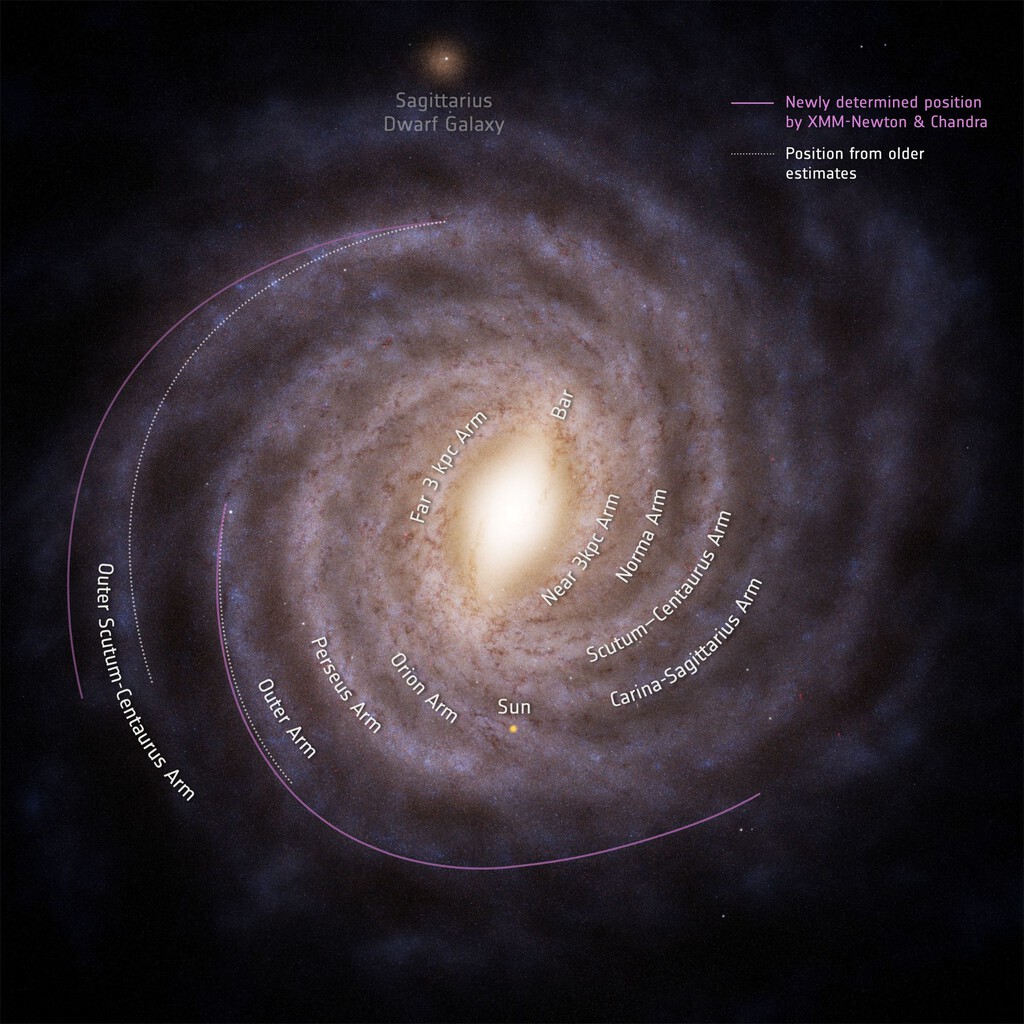
It is often easier to study neighboring galaxies than our own Milky Way. That is why, for a long time, the Milky Way's appearance was a mystery and its size only roughly estimated. Thanks to ESA's Gaia mission, we now have the most precise map of our galaxy, revealing details such as its four spiral arms instead of the two we once thought.
But measuring the full extent of the Milky Way is still tricky because we are inside it, surrounded by dust and gas that obscure our view.
How Gamma-Ray Bursts Reveal the Milky Way's Size
The new measurement relied on gamma-ray bursts (GRBs) — intense flashes of gamma rays from distant galaxies. When these bursts occur, they release X-rays that travel through space. Some of these X-rays pass through the Milky Way's halo, the diffuse cloud of hot gas surrounding our galaxy.
As the X-rays travel through the halo, they are absorbed by the gas. By studying how much absorption occurs, scientists can determine the size of the halo. Using XMM-Newton and Chandra, the team analyzed X-rays from GRBs in other galaxies and found that the distance between the Milky Way's two outermost arms is 10% greater than previously calculated.
This means our galaxy's disk extends further than we thought, making the Milky Way about 10% larger in diameter.
What This Means for Our Understanding of the Galaxy
This discovery has several implications. First, it refines our models of the Milky Way's structure and evolution. A larger galaxy may have a different gravitational influence and interact differently with its environment.
Second, it demonstrates the power of using distant sources to study our own galaxy. As study co-author noted, "we can learn about our galaxy by looking at others." This technique could be applied to other galaxies to improve our understanding of their halos and sizes.
Third, it highlights the importance of multi-wavelength astronomy. By combining data from X-ray observatories like XMM-Newton and Chandra, scientists can probe aspects of the universe that are invisible to other telescopes.
Key Takeaways
- The Milky Way's diameter is about 10% larger than previous estimates.
- The measurement was made using X-ray observations of gamma-ray bursts in other galaxies.
- ESA's XMM-Newton and NASA's Chandra observatories were used to detect the X-rays.
- The study shows how distant objects can help us understand our own galaxy.
- This finding refines our models of the Milky Way's structure and evolution.
Comparison of Previous and New Measurements
| Parameter | Previous Estimate | New Estimate |
|---|---|---|
| Diameter of Milky Way | ~100,000 light-years | ~110,000 light-years |
| Distance between outer arms | Based on models | 10% larger than models |
| Method | Star counts, radio observations | X-ray absorption from GRBs |
Note: The previous estimate of 100,000 light-years is a common figure, but the exact value is still subject to debate. The new measurement suggests a 10% increase. The background to this story is set out in Milky Way Flipped After Dwarf Galaxy Collision 10 Billion. A related thread runs through Granada Divers Now See Giant Manta Rays Their Fathers Never. Earlier coverage in Milky Way's Warped Disc Reveals New Wrinkles, Study Finds shows how the argument developed.
What to Watch Next
Future missions like ESA's Athena X-ray observatory and NASA's James Webb Space Telescope will provide even more detailed data on the Milky Way's halo and structure. Additionally, the Gaia mission continues to map stars with unprecedented precision, which will help refine our galaxy's size and shape. A closer look at the same subject appears in Space Sugar Discovery: Erythrulose Found in Milky Way. Anyone following the wider picture can start with Milky Way Flipped in Collision with Dwarf Galaxy 10bn Years Ago. The same theme surfaces in Cosmic Dawn Simulation: MEGATRON Reveals Milky Way Birth, which takes a different angle.
As we learn more, we may find that the Milky Way is not only larger but also more complex than we ever imagined. Context on how this played out before sits in Ray Exworth's Hidden Sculptures: Astonishing Art Seen by Only. A companion piece, Gretta Ray on Sickness, Surviving and Finding Her New Sound, approaches the same subject from another angle.
FAQ
How did scientists measure the Milky Way's size?They used X-ray observations of gamma-ray bursts in other galaxies. As the X-rays traveled through the Milky Way's halo, they were absorbed by gas. By measuring the absorption, scientists could determine the halo's size and thus the galaxy's diameter.
Why is it easier to study other galaxies than the Milky Way?Because we are inside the Milky Way, dust and gas block our view, making it hard to see the overall structure. Other galaxies are seen from outside, so their shapes and sizes are easier to measure.
What are gamma-ray bursts?Gamma-ray bursts are intense flashes of gamma rays, the most energetic form of light, originating from distant galaxies. They are thought to occur during events like the collapse of massive stars or the merger of neutron stars.
Will this change our understanding of the Milky Way?Yes, it refines our models of the galaxy's structure and evolution. A larger galaxy may have a different gravitational influence and interact differently with its environment. It also demonstrates a powerful technique for studying our own galaxy using distant sources.
Browse the Shop
 Acacia frida deluxe solid wood bed frame |
Bedroom bench |
Bed chest drawers |
Lingerie dresser |
Frame base |
Mirror with jewelry storage |
30 Bathroom Vanity |
Memory foam queen mattress |
Mattresses for back pain |
Nightstand set of 2 |
Grand Goldman Shop |
Civil Lawyer
Deutschland Trikot WM 2026







