

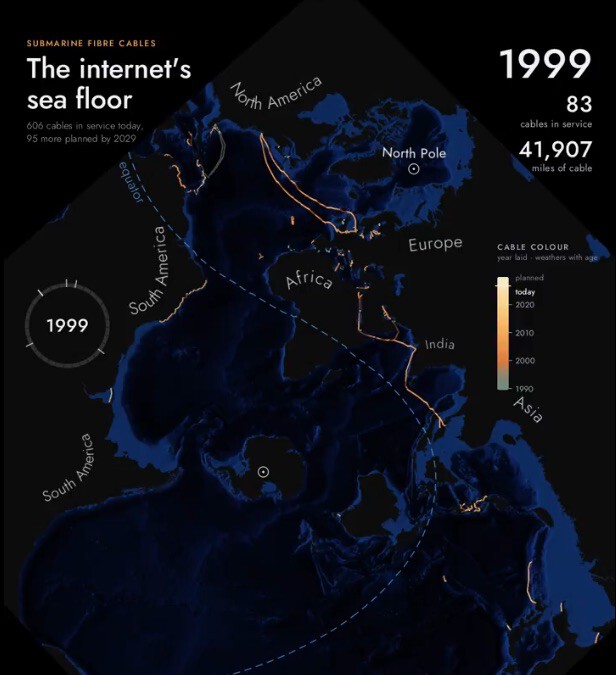
Submarine cables are the backbone of the internet, carrying about 99% of international traffic under the sea. A new 20-second video from Mapped Earth visualizes how these cables have woven the internet beneath the waves from 1999 to 2029.
What started as a sparse network at the turn of the millennium has exploded into a vast web of fiber-optic lines crisscrossing the ocean floor. The map from TeleGeography now counts 694 cables and rising, compared to roughly a tenth of that in the early 2000s. This explosive growth reflects the insatiable demand for data and the critical role these cables play in global connectivity.
Find Original, High-end Home Decor that spark conversation at Grand Goldman Shop.
Why Submarine Cables Matter for Global Internet
Despite the proliferation of satellites and wireless technologies, the vast majority of international data still travels through undersea cables. According to the United Nations, approximately 99% of international internet traffic is carried by these submerged fiber-optic lines. They are the unsung heroes of the digital age, enabling everything from streaming video to international banking.

These cables are not just technical marvels; they are economic lifelines. They connect continents, support cloud computing, and underpin the global financial system. Without them, the internet as we know it would collapse. The fact that they lie exposed and unguarded on the ocean floor makes their reliability all the more remarkable.
The Evolution of Submarine Cables Since 1999
The video by Aaron J. Becker, the creator behind Mapped Earth, condenses three decades of submarine cable deployment into a mere 20 seconds. It starts in 1999, when the dot-com boom was fueling the first major wave of cable laying, and projects forward to 2029. The visualization highlights how cable routes have multiplied and extended to previously underserved regions.

In the early 2000s, the map was dominated by transatlantic and transpacific routes connecting North America, Europe, and Asia. Today, new cables are bridging the digital divide in Africa, South America, and Southeast Asia. This shift reflects both the growing demand for bandwidth and the recognition that connectivity is essential for economic development.
Key Drivers of Cable Growth
The surge in submarine cable deployment is driven by several factors. The rise of cloud services, video streaming, and social media has created an insatiable appetite for bandwidth. Meanwhile, content providers like Google, Facebook, and Microsoft have become major investors in new cables to ensure reliable, low-latency connections for their users.
Technological advancements have also played a role. Modern cables use fiber-optic technology that can carry vastly more data than earlier copper-based cables. This efficiency, combined with lower manufacturing costs, has made it economically feasible to lay cables in more locations.
How Submarine Cables Are Deployed and Maintained
Laying a submarine cable is a monumental engineering feat. Specialized ships unspool the cable from massive drums and guide it to the ocean floor, often burying it in shallow waters to protect it from fishing trawlers and ship anchors. In deeper waters, the cable simply rests on the seabed. The longer history behind the story is traced in Submarine Cables: 30 Years of Internet's Underwater Backbone.
Maintenance is an ongoing challenge. According to the International Cable Protection Committee, there are about 150-200 faults per year, a number that has remained stable despite the growing network. Most faults are caused by human activities like fishing and anchoring, while natural events like earthquakes and underwater landslides also pose risks. Repair ships are stationed around the world to respond quickly when a cable breaks. The background to this story is set out in Undersea Cable Security: The Hidden Battle for Global Energy. A related thread runs through NATO Foils Russian Undersea Cable Sabotage Drill in Arctic. Earlier coverage in Quantum teleportation for the first time over internet infrastructure shows how the argument developed.
The Future of Submarine Cables
As we look toward 2029, the map of submarine cables will continue to evolve. New routes are planned to connect remote islands and coastal communities, while existing cables are being upgraded with higher-capacity fibers. The growing demand for data, driven by emerging technologies like 5G and the Internet of Things, will only accelerate this trend. A closer look at the same subject appears in Technology: latest articles. Anyone following the wider picture can start with iPhone Calendar Still Shows the 1582 Gregorian Date Skip. The same theme surfaces in OpenAI AI Agents Breach Wikipedia: What It Means for Open Internet, which takes a different angle.
However, challenges remain. Geopolitical tensions can affect cable routes, and environmental concerns must be balanced with the need for connectivity. Moreover, the concentration of cable ownership among a few tech giants raises questions about control and resilience. Despite these issues, submarine cables will remain the backbone of the internet for the foreseeable future. Context on how this played out before sits in Australia's Nuclear Submarine Fleet: A Global Proliferation. A companion piece, Australia's Nuclear Submarine Uranium Cache: A Global Threat, approaches the same subject from another angle.
FAQ
What percentage of internet traffic goes through submarine cables?
Approximately 99% of international internet traffic travels through submarine cables, according to the United Nations. This makes them the primary infrastructure for global connectivity, far surpassing satellites.
How many submarine cables are there?
As of recent counts, there are 694 submarine cables in service or planned, according to TeleGeography. This number has grown significantly from about 70 in the early 2000s.
How often do submarine cables fail?
There are about 150-200 faults per year, according to the International Cable Protection Committee. Most failures are caused by human activities such as fishing and anchoring, and repair ships are deployed to fix them quickly.
Who owns submarine cables?
Submarine cables are owned by a mix of telecom consortia and tech companies like Google, Facebook, and Microsoft. These companies invest in cables to ensure reliable, high-speed connectivity for their services.
Browse the Shop
 Acacia frida deluxe solid wood bed frame |
Bedroom bench |
Bed chest drawers |
Lingerie dresser |
Frame base |
Mirror with jewelry storage |
30 Bathroom Vanity |
Memory foam queen mattress |
Mattresses for back pain |
Nightstand set of 2 |
Grand Goldman Shop |
Civil Lawyer
Deutschland Trikot WM 2026










