

Multiverse Computing's Quasar 438B has been crowned Europe's most intelligent AI model, but confirmation that it is a compressed version of China's GLM-5.2 has sparked a debate about transparency and originality in the AI race.
The Spanish company presented Quasar 438B as a breakthrough for European AI, citing a score of 43 on the Artificial Analysis Intelligence Index—well ahead of competitors like Mistral Medium 3.5, which scored 35. However, the celebration was short-lived as skeptics pointed out that Quasar 438B appears to be a fork of GLM-5.2, the open-weight model from Zhipu.AI released in June 2026.
Find Original Home Decor sparking conversation at Grand Goldman Shop.

What Is Quasar 438B and Why Does It Matter?
Quasar 438B is a reasoning model with 438 billion parameters and a context window of one million tokens, specifically optimized for coding and AI agent tasks. Multiverse Computing claims it is the smartest AI model in Europe, backed by its impressive score on the Intelligence Index.
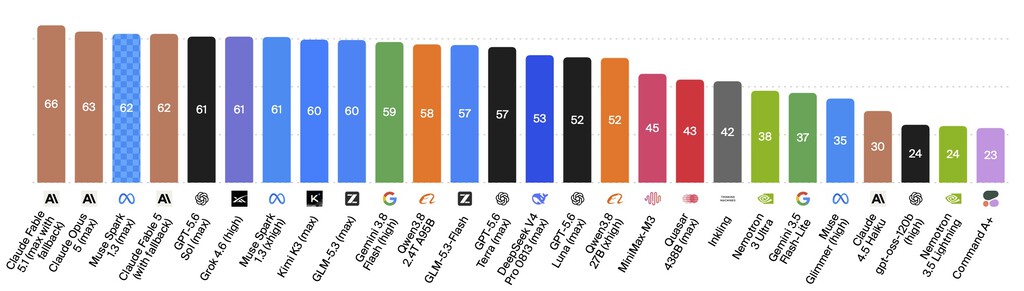
This matters because Europe has been striving to establish itself as a major player in AI, and a homegrown model that outperforms others could boost the continent's tech credibility. But if Quasar is merely a derivative of a Chinese model, it raises questions about the true extent of European innovation.

The GLM-5.2 Connection: What We Know
GLM-5.2 is an open-weight model developed by Zhipu.AI, a Chinese AI lab, and released in June 2026. Open-weight models allow anyone to use and modify them, which is exactly what Multiverse Computing did, according to their updated blog post.
In an update on May 9, 2026, Multiverse stated: "Quasar 438B is a compressed model created from GLM-5.2, the open-weight model from Z.ai. We used CompactifAI, our compression tool, to make it smaller and more efficient, and we have fine-tuned it specifically for agentic and code tasks." They did not mention releasing the weights of Quasar 438B.
Why the AI Community Is Paying Attention
The AI community is scrutinizing this case because it touches on several sensitive issues: transparency, the definition of a "European model," and the ethics of using open-weight models for commercial gain.
While using open-weight models is legal and common, presenting a derivative as a novel, domestically developed model can be misleading. It also raises concerns about the sustainability of AI development if companies rely heavily on existing models rather than pursuing original research.
Key Takeaways
- Multiverse Computing's Quasar 438B is a compressed and fine-tuned version of GLM-5.2, not an entirely new model.
- It achieved a score of 43 on the Artificial Analysis Intelligence Index, surpassing Mistral Medium 3.5.
- The model has 438 billion parameters and a one-million-token context window, optimized for coding and AI agents.
- Multiverse used its CompactifAI compression tool to make the model smaller and more efficient.
- The company has not announced plans to release Quasar's weights, unlike the original GLM-5.2.
How Quasar 438B Compares to Other AI Models
To understand Quasar's position, it helps to compare it with other notable models. The table below summarizes key specifications and performance metrics. Context on how this played out before sits in Multiverse Quasar 438B: Europe's Top AI Model or a GLM-5.2 Clone.
| Model | Developer | Parameters | Context Window | Intelligence Index Score |
|---|---|---|---|---|
| Quasar 438B | Multiverse Computing | 438B | 1M tokens | 43 |
| GLM-5.2 | Zhipu.AI (Z.ai) | Not disclosed | Not disclosed | Not disclosed |
| Mistral Medium 3.5 | Mistral AI | Not disclosed | Not disclosed | 35 |
Note: GLM-5.2's specifications are not fully disclosed, but it is an open-weight model, meaning its weights are publicly available. Quasar's score of 43 is notable, but it's essential to consider the model's lineage when evaluating its significance. The background to this story is set out in Ai Video: latest articles. A related thread runs through Spain's New AI Plan: Will It Deliver or Repeat Past Failures.
What This Means for the European AI Ecosystem
This incident highlights the challenges Europe faces in building a competitive AI industry. While leveraging open-source models can accelerate development, it may not foster the same level of innovation as original research. Earlier coverage in Mistral Raises €3 Billion to Build AI Infrastructure and Challenge US Giants shows how the argument developed. A closer look at the same subject appears in Unitree's World-Model Humanoid Robot Achieves Full Autonomy.
It also underscores the importance of transparency. Companies should clearly communicate the origins of their models to maintain trust and credibility. As AI becomes more integrated into society, such honesty will be crucial. Anyone following the wider picture can start with Dacia Spring 2024 vs BYD Dolphin Surf: Electric Car Battle Under 20,000 Euros. The same theme surfaces in 2,200 NABU Computers Stored 23 Years in a Barn Now Sold on eBay, which takes a different angle.
FAQ
Is Quasar 438B really a clone of GLM-5.2?
Multiverse Computing has confirmed that Quasar 438B is a compressed and fine-tuned version of GLM-5.2, created using their CompactifAI tool. So while it's not an exact clone, it is derived directly from the Chinese model.
Why did Multiverse Computing use GLM-5.2 as a base?
GLM-5.2 is an open-weight model, meaning its weights are publicly available for anyone to use and modify. Multiverse likely chose it because it provided a strong foundation for compression and fine-tuning, saving time and resources compared to training from scratch.
What is CompactifAI and how does it work?
CompactifAI is Multiverse Computing's proprietary compression tool. It reduces the size of large AI models while maintaining performance, making them more efficient for deployment. The exact technical details are not publicly disclosed.
Will Quasar 438B's weights be released?
Multiverse Computing has not announced any plans to release the weights of Quasar 438B. This is in contrast to GLM-5.2, which is open-weight. The company may choose to keep the model proprietary for commercial reasons.
Browse the Shop
 Acacia frida deluxe solid wood bed frame |
Bedroom bench |
Bed chest drawers |
Lingerie dresser |
Frame base |
Mirror with jewelry storage |
30 Bathroom Vanity |
Memory foam queen mattress |
Mattresses for back pain |
Nightstand set of 2 |
Grand Goldman Shop |
Civil Lawyer
Deutschland Trikot WM 2026







