

Lead smelting in the Iberian Peninsula may have begun nearly a millennium earlier than previously thought, according to a groundbreaking study from the University of Granada. Researchers have found direct evidence of lead production at a Bronze Age settlement in Lleida, challenging the long-held belief that the Phoenicians introduced the technology around 1000 B.C.
The discovery at Minferri, an archaeological site in Juneda, pushes the origins of lead metallurgy back to approximately 1900–1700 B.C., fundamentally altering our understanding of early metalworking in the region.
Find Original, High-end Home Decor that spark conversation at Grand Goldman Shop.

The Minferri Discovery: Three Fragments That Rewrite History
Excavations at Minferri uncovered three fragments of lead slag, each weighing between 10 and 24 grams. These unassuming pieces of debris are now recognized as the earliest direct evidence of lead smelting in Iberia.
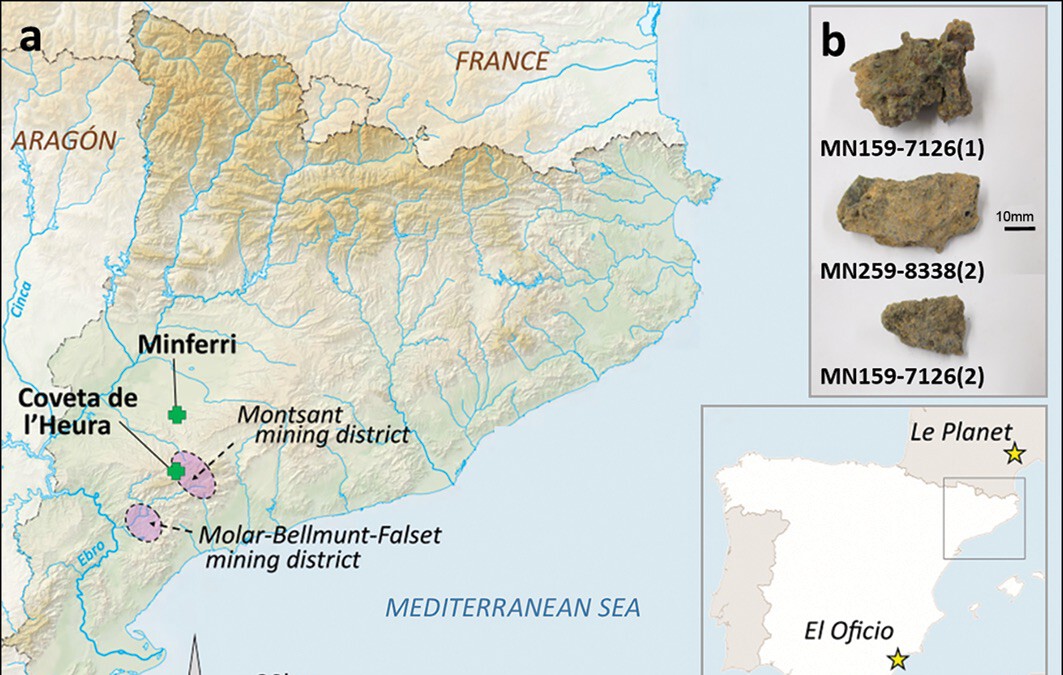
To date the fragments, the research team analyzed a carbonized wheat seed found in the same silo as one of the slag pieces. Radiocarbon dating placed the seed between 1885 and 1692 B.C., providing a secure chronological anchor for the lead production.
The other two fragments came from a well at the same site, which was occupied roughly between 2100 and 1600 B.C. Together, the evidence points to lead smelting activity around 1900–1700 B.C., hundreds of years before any Phoenician influence.
Why the Phoenician Timeline Was Wrong
For decades, the standard narrative held that the Phoenicians, who arrived in Iberia around 1000 B.C., brought with them advanced metallurgical techniques, including lead production as a byproduct of silver extraction. This view was widely accepted because no earlier evidence had been found.
The Minferri findings directly contradict this assumption. The lead slag predates the Phoenician arrival by 700 to 900 years, indicating that local communities had already developed smelting technology independently.
This shift in timeline also changes who we credit: not external traders, but indigenous Bronze Age societies in the Iberian interior.
What This Means for Understanding Early Metallurgy
The discovery underscores that metallurgy in prehistoric Europe was more diverse and decentralized than previously imagined. Lead, often overlooked in favor of copper and bronze, played a role in early technological experimentation.
It also raises questions about the organization of production. The presence of slag at a settlement suggests that smelting was not confined to specialized workshops but occurred within communities, possibly at a household or small-scale level. Context on how this played out before sits in Why Tattoos Are the Norm: A Sociologist Explains Body Art.
Furthermore, the find highlights the importance of revisiting museum collections and excavation archives with new analytical techniques. Similar evidence may exist elsewhere, waiting to be recognized. The background to this story is set out in Bronze Age Treasure Stolen in Four-Minute Spanish Museum Heist. A related thread runs through Trending: latest articles.
- Earliest direct evidence of lead smelting in Iberia dates to 1900–1700 B.C.
- Discovery at Minferri (Lleida) predates Phoenician arrival by 700–900 years.
- Radiocarbon dating of a wheat seed provided precise chronology.
- Challenges the assumption that Phoenicians introduced lead metallurgy.
- Suggests independent development of smelting by local Bronze Age communities.
Key Comparisons: Before and After the Discovery
| Aspect | Previous Understanding | New Evidence |
|---|---|---|
| Earliest lead smelting in Iberia | ~1000 B.C. (Phoenician introduction) | ~1900–1700 B.C. (Minferri) |
| Who produced lead | Phoenician traders as byproduct of silver | Local Bronze Age communities |
| Location of earliest evidence | Coastal Phoenician colonies | Inland settlement of Minferri (Lleida) |
| Technological transmission | Diffusion from Eastern Mediterranean | Independent innovation in Iberia |
What to Watch Next
Researchers will likely examine other Bronze Age sites in Iberia for similar slag remains, potentially pushing the timeline even further back. The study also encourages a reevaluation of lead's role in prehistoric economies. Earlier coverage in World's Oldest Shipwreck Found Off Turkey's Kekova Island shows how the argument developed. A closer look at the same subject appears in Salamanca Cathedral Dig Uncovers Roman Caldron and Ancient Tombs.
As analytical methods improve, more surprises may emerge from overlooked artifacts. The Minferri discovery is a reminder that archaeology constantly revises its stories. Anyone following the wider picture can start with Aerial Photo Reveals 2,100-Year-Old Roman Villa in La Rioja, Spain. The same theme surfaces in Atomic Dreams: The Wildest Nuclear Projects Ever Imagined, which takes a different angle.
FAQ
What exactly was found at Minferri?
Three fragments of lead slag, weighing 10–24 grams each, were found at the Bronze Age settlement of Minferri in Juneda, Lleida. These are the earliest direct evidence of lead smelting in the Iberian Peninsula.
How did researchers date the lead production?
They radiocarbon-dated a carbonized wheat seed found in the same silo as one of the slag fragments. The seed dated to between 1885 and 1692 B.C., placing the lead smelting activity around 1900–1700 B.C.
Why is this discovery important?
It pushes back the origins of lead metallurgy in Iberia by 700–900 years, showing that local communities were smelting lead long before the Phoenicians arrived. This challenges the assumption that advanced metallurgy was introduced by external traders.
Does this mean the Phoenicians didn't bring lead technology?
Not necessarily—the Phoenicians may have brought new techniques or scaled up production. But the Minferri evidence proves that lead smelting already existed in Iberia centuries before their arrival, so the technology was not solely a Phoenician introduction.
Browse the Shop
 Acacia frida deluxe solid wood bed frame |
Bedroom bench |
Bed chest drawers |
Lingerie dresser |
Frame base |
Mirror with jewelry storage |
30 Bathroom Vanity |
Memory foam queen mattress |
Mattresses for back pain |
Nightstand set of 2 |
Grand Goldman Shop |
Civil Lawyer
Deutschland Trikot WM 2026










