

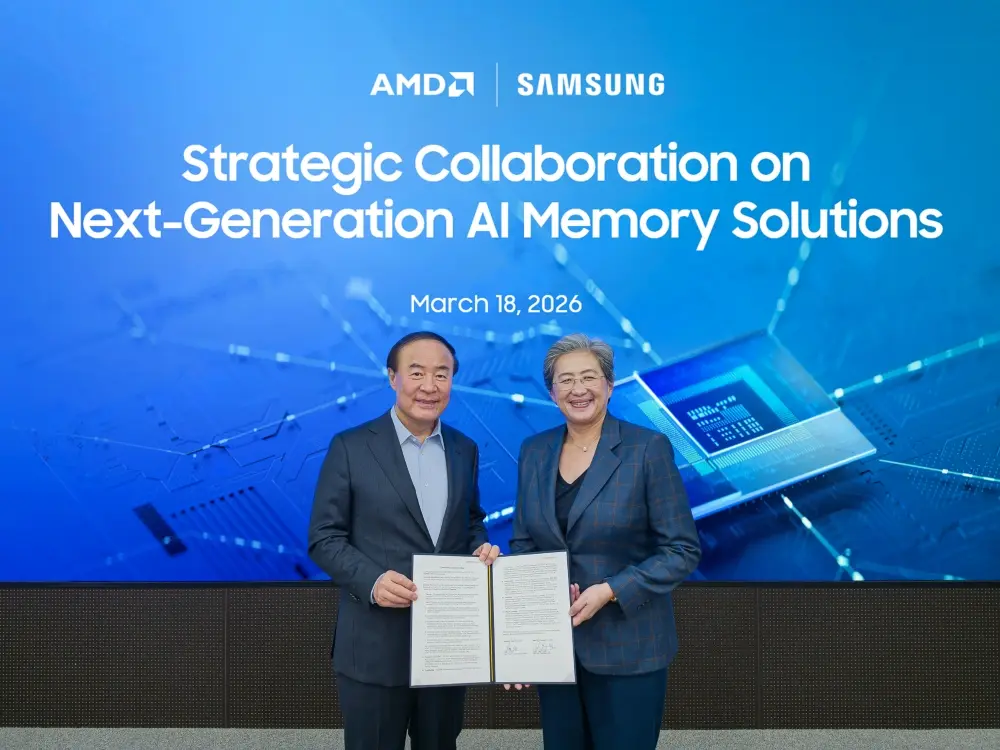
Samsung Electronics en Advanced Micro Devices (AMD) hebben een belangrijke stap gezet om hun strategische relatie te versterken. Op 18 maart 2026, de twee halfgeleiderreuzen tekenden een Memorandum van Overeenstemming (MoU) gericht op het uitbreiden van de samenwerking in kunstmatige intelligentie (AI) geheugentechnologie en het verkennen van een mogelijke foundry-samenwerking om toekomstige AMD-chips te vervaardigen.
Deze stap kan verstrekkende gevolgen hebben voor het wereldwijde AI-hardwarelandschap, en van invloed zijn op toeleveringsketens, concurrentie en prestatienormen van computersystemen voor de volgende generatie.
Find Bleeding Edge Supplements at Scandalous Prices on iHerb.


Wat de deal omvat
AI-geheugensamenwerking
Samsung zal haar rol verdiepen als sleutel leverancier van geavanceerde Geheugen met hoge bandbreedte (HBM) technologie — een cruciaal onderdeel dat gegevens aan AI-processors levert tegen extreem hoge snelheden. Onder de MoU:
-
Samsung levert zijn volgende generatie HBM4-geheugen voor AMD’s komende Instinct MI455X AI-accelerators.
-
De overeenkomst omvat ook geoptimaliseerd DDR5-geheugen voor AMD’s toekomstige EPYC-server-CPU’s.
-
Samsung levert momenteel al HBM3E-chips aan AMD’s huidige AI-accelerators, en deze overeenkomst wijst op continuïteit en uitbreiding van die relatie.
Waarom HBM belangrijk is voor AI
High Bandwidth Memory bevindt zich direct naast AI-processors en verplaatst gegevens sneller dan traditioneel geheugen. AI-belastingen — met name grote taalmodellen en inferentietaken in datacenters — vereisen geheugensnelheden die kunnen meekomen met enorme parallelle rekeneenheden. HBM4’s hoge throughput en bandbreedte zijn essentieel voor de prestaties van de volgende generatie.
Mogelijke foundry-samenwerking op de horizon.
een foundry-deal verkennen. Dit zou AMD dichter bij het gebruik van Samsung’s fabricagecapaciteit brengen om chips te produceren — een verschuiving van AMD’s historische afhankelijkheid van externe contractfabrikanten zoals TSMC.
Wat dit zou kunnen betekenen
-
Gediversifieerde productie: AMD zou extra capaciteit buiten Taiwans TSMC kunnen veiligstellen, waardoor geografische concentratierisico's afnemen.
-
Directe Chipproductie: Samsung’s geavanceerde knooppunten, vooral in het bereik van 3 nm tot 2 nm, zijn concurrerend en zouden AMD’s toekomstige op maat gemaakte logica-producten kunnen ondersteunen.
-
Sterkere veerkracht van de toeleveringsketen: Voorzieningen zoals geopolitieke druk en knelpunten in AI-silicon maken productie uit meerdere bronnen steeds aantrekkelijker.
Navigeren door het foundry-landschap
Hoewel de foundry-divisie van Samsung historisch gezien achter TSMC lag, hebben recente vorderingen — waaronder samenwerkingen met NVIDIA en andere AI-spelers — haar concurrentiepositie versterkt. Samsung’s geavanceerde procestechnologieën, gecombineerd met geheugen- en verpakkingsmogelijkheden onder één dak, positioneren het als een potentieel alternatief voor een high-end chipfabrikant.
Strategische context: Dynamiek van de AI-chipmarkt
De halfgeleiderindustrie bevindt zich in een felle race om te voldoen aan de vraag van generatieve AI, cloudproviders en datacenters. Belangrijke trends die samenhangen met dit Samsung‑AMD-pact zijn onder meer:
Geheugenmarkt met concurrentie
| Leverancier | Geschat marktaandeel in HBM. | Notities |
|---|---|---|
| SK Hynix | ~57% | Huidige marktleider in HBM-levering. |
| Samsung | ~22% | Streeft ernaar de kloof met HBM4-productie te dichten. |
| Overigen | Resterend aandeel | Kleinere leveranciers die op nichemarkten concurreren. |
De inspanningen van Samsung om HBM4-productie op te schalen zijn bedoeld om de concurrentiepositie terug te winnen in high-performance geheugen, dat een schaars en strategisch hulpmiddel in de AI-toeleveringsketen is.
Wijzigingen in de AI-chiptoeleveringsketen
Grote cloudspelers en AI-integrators — van Meta tot OpenAI en Oracle — diversifiëren hun AI-hardwarestacks. AMD’s miljard-dollar AI-chipovereenkomsten met belangrijke klanten hebben druk gelegd op zijn geheugenpijplijnen en fabricatietijdlijnen. Het uitbreiden van de samenwerking met Samsung helpt een deel van die druk te verlichten.
Directiebetrokkenheid en signalen
De deal volgt op hoog niveau contact tussen Samsung-voorzitter Lee Jae‑yong en AMD-CEO Lisa Su, wat het strategische gewicht van dit partnerschap weerspiegelt. Su maakte ook een bezoek aan Samsung’s Pyeongtaek-chipfabriek om productielijnen te bekijken en bredere samenwerking te bespreken.
Deze interacties onderstrepen hoe serieus beide bedrijven het snijpunt tussen geheugenvoorziening en mogelijke foundry-samenwerking beschouwen.
Wat komt hierna?
Belangrijke aandachtsgebieden om in de gaten te houden.
-
HBM4-implementatie: Grootschalige leveringen aan AMD’s AI-accelerators later in 2026 zouden de concurrentiedynamiek kunnen verschuiven ten opzichte van concurrenten die afhankelijk zijn van andere geheugleveranciers.
-
Voortgang van Foundry-gesprekken: Officiële foundry-contracten — als ze werkelijkheid worden — zouden een keerpunt markeren in AMD’s productie-strategie.
-
Industriële concurrentie: De stappen van Samsung kunnen de concurrentie met SK Hynix op het gebied van geheugen en met TSMC in de productie van logische halfgeleiders versterken.
Breder industrieel effect
De MoU signaleert een tijdperk waarin geheugen, rekenkracht en productie steeds meer van elkaar afhankelijk worden:
-
AI-belastingen zullen geheugenarchitecturen vereisen die nauw geïntegreerd zijn met processors.
-
Diversificatie van de toeleveringsketen is niet langer een luxe maar een noodzaak.
-
Strategische allianties zoals Samsung‑AMD zouden kunnen herdefiniëren hoe geavanceerd silicium wordt ontwikkeld en geproduceerd.
Eindconclusie
De MoU tussen Samsung en AMD vertegenwoordigt meer dan een leveranciersovereenkomst — het is een strategische herkalibratie in antwoord op de sterk stijgende AI-vraag. Door de toelevering van geheugen van de volgende generatie vast te leggen en de deur naar foundry-samenwerking te openen, positioneren beide bedrijven zich voor een concurrerende, AI-gedreven toekomst waarin hardwareprestaties en leveringsbetrouwbaarheid belangrijker zijn dan ooit.
Lees verder
Mysterieuze AI-model | Nvidia H200-goedkeuring | Google AI-opt-out | BMG klaagt Anthropic aan | Amazon AI-omzet | Alibaba AI-strategie | VK AI-inhoudslabels | Tencent AI-investering | Softcat winstprognose | Samsung-AMD geheugenovereenkomst
Browse the Shop
 Acacia frida deluxe solid wood bed frame |
Bedroom bench |
Bed chest drawers |
Lingerie dresser |
Frame base |
Mirror with jewelry storage |
30 Bathroom Vanity |
Memory foam queen mattress |
Mattresses for back pain |
Nightstand set of 2 |
Grand Goldman Shop |
Civil Lawyer
Deutschland Trikot WM 2026
Acacia frida deluxe solid wood bed frame |
Bedroom bench |
Bed chest drawers |
Lingerie dresser |
Frame base |
Mirror with jewelry storage |
30 Bathroom Vanity |
Memory foam queen mattress |
Mattresses for back pain |
Nightstand set of 2 |
Grand Goldman Shop |
Civil Lawyer
Deutschland Trikot WM 2026










