

In a stunning shift for South Korea's tech industry, SK Hynix briefly surpassed Samsung Electronics in market capitalization this week, ending Samsung's decades-long reign as the country's most valuable tech company. The milestone underscores how the AI boom has transformed memory chips into the hottest commodity in tech.
Samsung had held the top spot since 2000, becoming the undisputed symbol of South Korean innovation. But the memory crisis—driven by skyrocketing demand for high-bandwidth memory (HBM) used in AI accelerators—has turned the tables. SK Hynix, once a debt-ridden underdog, is now the darling of the semiconductor world.
Find Original Home Decor sparking conversation at Grand Goldman Shop.

Why SK Hynix's Surge Matters for the Tech Industry
The rise of SK Hynix is not just a corporate reshuffle; it signals a broader realignment in the global tech supply chain. Memory chips, once considered a commoditized component, have become strategic assets in the AI era. As companies race to build large language models and generative AI tools, the demand for specialized memory has exploded.
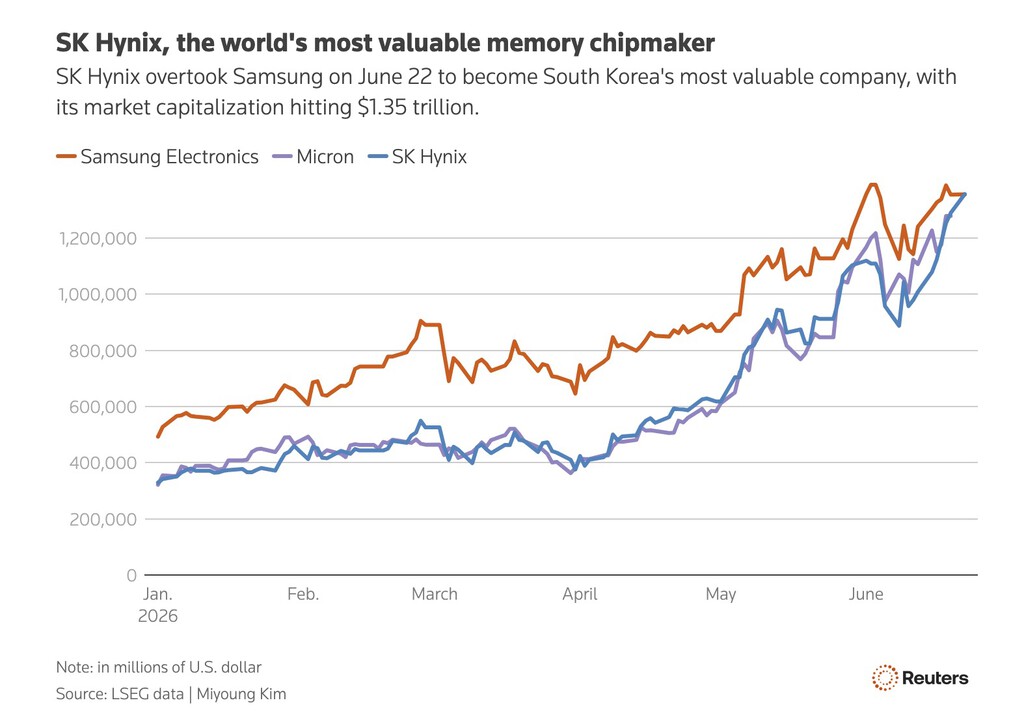
SK Hynix has capitalized on this shift by focusing on HBM, a type of memory that stacks chips vertically to achieve higher bandwidth and lower power consumption. This technology is critical for AI training and inference, and SK Hynix has emerged as a key supplier to Nvidia, the leading AI chip designer. Samsung, meanwhile, has been slower to ramp up HBM production, allowing its rival to gain an edge.
The Market Cap Rollercoaster: A Brief Coup
On the day of the milestone, SK Hynix's stock hit an all-time high, briefly pushing its market value above Samsung's. However, the celebration was short-lived: SK Hynix shares ended the session down 12.5%, while Samsung also fell, allowing the conglomerate to reclaim the top spot—for now.
This volatility highlights the fierce competition and investor sensitivity in the semiconductor sector. Yet the fact that SK Hynix even momentarily overtook Samsung is a testament to its dramatic turnaround. In 2002, the company (then Hynix Semiconductor) was suffocating under debt after an aggressive expansion plan failed. It took years of restructuring and strategic pivots to reach this point.
How the Memory Crisis Fueled SK Hynix's Comeback
The current memory crisis is not a shortage in the traditional sense; it's a demand surge. AI applications require vast amounts of fast, efficient memory, and HBM is in short supply. SK Hynix invested early in HBM, and that bet is paying off. The company's revenue and profits have soared, and its stock has been one of the best performers in the global tech sector.
Samsung, despite its size and resources, has faced challenges in HBM. Reports suggest yield issues and delays in qualifying its HBM products for Nvidia's systems. This has allowed SK Hynix to capture a dominant share of the HBM market, which is expected to grow exponentially as AI adoption accelerates.
What This Means for Samsung and South Korea's Economy
Samsung remains a behemoth, with a diversified portfolio spanning smartphones, consumer electronics, and semiconductors. Its memory business is still substantial, and the company is investing heavily to catch up in HBM. But the psychological blow of losing the top spot—even briefly—is significant. Samsung has been the face of South Korea's tech prowess for a generation, and its dominance was rarely questioned. The background to this story is set out in SK Hynix CEO Warns 2027 Will Be Worst Memory Chip Crisis. A related thread runs through Samsung and SK Hynix's $880 Billion AI Chip Survival Bet. Earlier coverage in Chinese AI Chips Face 50% Price Surge as HBM Memory Shortage Bites shows how the argument developed.
For South Korea, the rise of SK Hynix is a double-edged sword. On one hand, it demonstrates the country's ability to produce world-class tech champions. On the other, it highlights the risks of over-reliance on a few conglomerates. The government has been promoting startups and smaller firms, but the chaebols still dominate the economy. A closer look at the same subject appears in PlayStation 6 Memory Race: Samsung and SK hynix Compete for GDDR7 Supply. Anyone following the wider picture can start with SK Hynix's $26.5 Billion IPO Bet on AI Memory Demand. The same theme surfaces in SK Hynix Profit Soars 632% as AI Memory Shortage Drives Growth, which takes a different angle.
Key Takeaways for Investors and Industry Watchers
- AI-driven demand for HBM memory has reshaped the semiconductor landscape, benefiting early movers like SK Hynix.
- Samsung's delayed HBM ramp has cost it market share and, briefly, its market cap crown.
- Volatility is high: SK Hynix's 12.5% drop on the same day shows how quickly fortunes can reverse.
- Long-term outlook: Both companies are investing billions to expand HBM capacity, so the competition is far from over.
- Supply chain implications: The shift underscores the strategic importance of memory chips in the AI era.
Comparing Samsung and SK Hynix: A Snapshot
| Metric | Samsung Electronics | SK Hynix |
|---|---|---|
| Market Cap (approx.) | ~$350 billion | ~$100 billion (varies) |
| Main Business | Diversified: smartphones, TVs, memory, foundry | Focused: memory (DRAM, NAND, HBM) |
| HBM Market Share | Small but growing | Dominant (supplies Nvidia) |
| 2023 Revenue | ~$200 billion | ~$30 billion |
| Stock Performance (YTD) | Moderate | Strong |
Note: Figures are approximate and for illustrative purposes; market caps fluctuate daily. Context on how this played out before sits in China's NVIDIA Chip Replacement Plan Hits HBM Memory Snag. A companion piece, US Navy Destroyer Loses Power in South China Sea: Readiness Crisis, approaches the same subject from another angle.
FAQ
Did SK Hynix really overtake Samsung?
Yes, but only briefly. On the day in question, SK Hynix's market capitalization surpassed Samsung's intraday, but a sharp decline in SK Hynix's stock price allowed Samsung to regain the lead by the close. It was a symbolic milestone rather than a lasting change.
Why is SK Hynix suddenly so valuable?
SK Hynix has become a key supplier of high-bandwidth memory (HBM) chips, which are essential for AI applications. The AI boom has driven massive demand for HBM, and SK Hynix invested early in this technology, giving it a competitive edge over Samsung.
What challenges does Samsung face in the memory market?
Samsung has reportedly struggled with yield issues and delays in qualifying its HBM products for Nvidia's AI chips. This has allowed SK Hynix to capture a larger share of the high-margin HBM market, putting pressure on Samsung's memory business.
How does this affect South Korea's economy?
The shift highlights the importance of the semiconductor industry to South Korea's economy. While it demonstrates the country's tech prowess, it also underscores the risks of relying heavily on a few large conglomerates. The government is encouraging diversification, but the chaebols remain dominant.
As the AI revolution continues, the battle for semiconductor supremacy will only intensify. Samsung is not sitting idle—it has pledged to invest heavily in HBM and advanced packaging. SK Hynix, meanwhile, is basking in its newfound status but faces the challenge of maintaining its lead. For investors and industry watchers, the message is clear: in the tech world, no throne is permanent.
Browse the Shop
 Acacia frida deluxe solid wood bed frame |
Bedroom bench |
Bed chest drawers |
Lingerie dresser |
Frame base |
Mirror with jewelry storage |
30 Bathroom Vanity |
Memory foam queen mattress |
Mattresses for back pain |
Nightstand set of 2 |
Grand Goldman Shop |
Civil Lawyer
Deutschland Trikot WM 2026







