

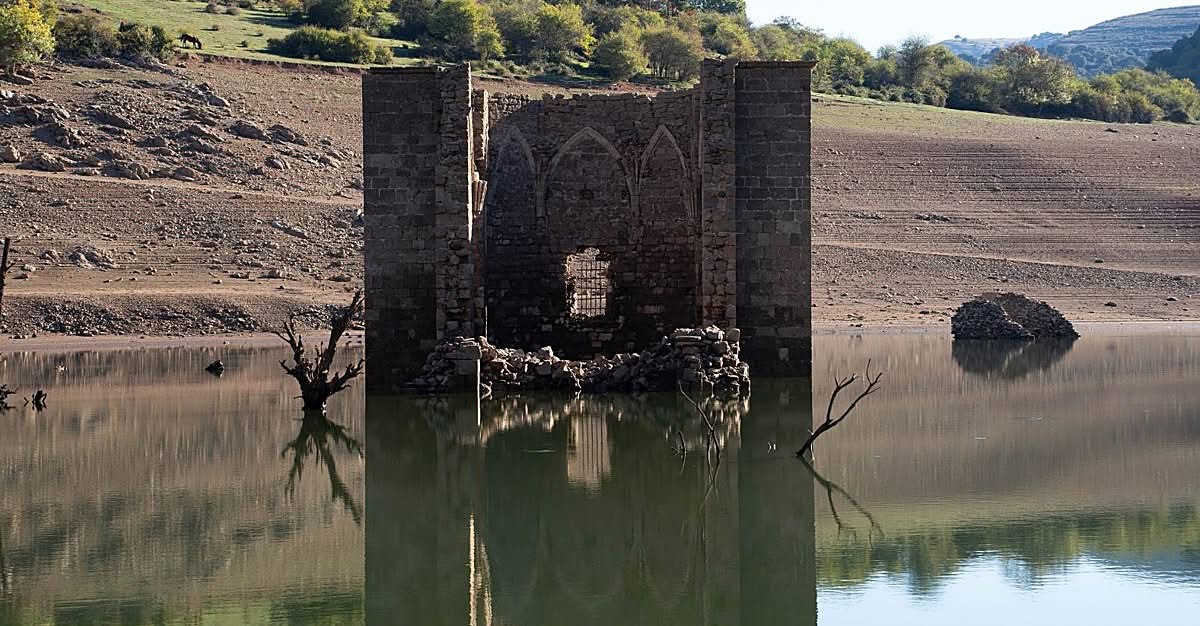
The drought has revealed the ancient sunken village of Mansilla de la Sierra in La Rioja, Spain, as the reservoir's water level drops dramatically. Walls, moss-covered stone arches, and the layout of old streets have emerged from the Mansilla reservoir, located between Mansilla de la Sierra and Villavelayo, about 70 kilometers from Logroño. According to EFE on October 25, the old village has resurfaced in the Najerilla reservoir, offering a stark contrast to earlier this year when the reservoir was nearly full.
What Caused the Village to Reappear?
The reservoir's water level has plummeted due to a severe drought. In February, after doubling its reserves in just three weeks, the reservoir was at 89% capacity, holding about 68 million cubic meters of water. Eight months later, weekends see buses of visitors walking among the mud and ruins. This dramatic swing highlights the region's vulnerability to prolonged dry spells.
Find Original Home Decor sparking conversation at Grand Goldman Shop.

Why Does This Matter?
The receding water exposes not just a curiosity but a significant archaeological site. The village of Mansilla de la Sierra was relocated in the 16th century to the banks of the Gatón River, and the old church of Santa Catalina remained on the shore. Since 2016, archaeologists have been excavating next to the ermita de Santa Catalina, the only building left standing. They have uncovered the apse and presbytery of a Romanesque church that served as the medieval parish church. Beneath it, three overlapping temples and a late-Roman building have been found, along with Celtiberian and Roman pottery. Carbon-14 dating places a fire in the first church between 576 and 654 AD.
What Does the Emergence Reveal?
The exposed ruins include stone arches, petrified tree remains, and the grid of ancient streets. These remnants offer a tangible link to the past, drawing visitors and researchers alike. The site is not the original Mansilla but a later iteration, yet it provides valuable insights into medieval and ancient settlement patterns in the region. The background to this story is set out in Morillo de Tou: The Sunken Pyrenees Village Now a Budget Vacation Paradise. A related thread runs through Aerial Photo Reveals 2,100-Year-Old Roman Villa in La Rioja, Spain. Earlier coverage in England Drought: 75% Affected as Heatwave Looms shows how the argument developed.
Who Is Affected?
Local communities and tourism have seen a surge in interest, with buses bringing curious onlookers. However, the drought also impacts agriculture and water supply, raising concerns about climate variability. Archaeologists face the challenge of preserving the site as it is exposed to the elements. A closer look at the same subject appears in UK Drought 2024: Five Reservoirs Exceptionally Low. Anyone following the wider picture can start with Eastern Rosellas Boy's Song Goes Viral, Covered by Ben Lee. The same theme surfaces in Navarra's Andosilla vs La Rioja's Arnedo: The Centuries-Old Saint Heist, which takes a different angle.
What to Watch Next
As the drought persists, more of the village may emerge, potentially leading to further discoveries. Authorities may need to balance tourism with conservation. The situation underscores the need for sustainable water management in the face of climate change. Context on how this played out before sits in La Rioja Bar Floor Collapse Reveals Hidden Cave Beneath. A companion piece, Morocco's Water Highway: A National Strategy Against Drought, approaches the same subject from another angle.
- The sunken village of Mansilla de la Sierra has resurfaced due to drought.
- Archaeologists have uncovered a Romanesque church with multiple layers of history.
- The reservoir's water level dropped from 89% in February to significantly lower levels by October.
- Visitors are flocking to see the ruins, but conservation concerns remain.
- The site offers a glimpse into medieval and ancient life in La Rioja.
| Feature | Details |
|---|---|
| Location | Mansilla reservoir, La Rioja, Spain |
| Distance from Logroño | Approximately 70 km |
| Reservoir capacity in February | 89% (68 million cubic meters) |
| Archaeological findings | Romanesque church, three overlapping temples, late-Roman building, Celtiberian and Roman pottery |
| Carbon-14 dating | Fire in first church between 576 and 654 AD |
FAQ
What is the sunken village of Mansilla de la Sierra?
Mansilla de la Sierra is an ancient village in La Rioja, Spain, that was submerged by the Mansilla reservoir. It has recently re-emerged due to drought conditions.
Why is the village emerging now?
The reservoir's water level has dropped significantly because of a prolonged drought, exposing the ruins that are usually underwater.
What archaeological discoveries have been made at the site?
Excavations have revealed a Romanesque church with three overlapping temples beneath it, a late-Roman building, and pottery from Celtiberian and Roman times.
Can tourists visit the exposed village?
Yes, visitors have been arriving by bus to walk among the ruins, but they should be mindful of preservation efforts and muddy conditions.
Browse the Shop
 Acacia frida deluxe solid wood bed frame |
Bedroom bench |
Bed chest drawers |
Lingerie dresser |
Frame base |
Mirror with jewelry storage |
30 Bathroom Vanity |
Memory foam queen mattress |
Mattresses for back pain |
Nightstand set of 2 |
Grand Goldman Shop |
Civil Lawyer
Deutschland Trikot WM 2026







