

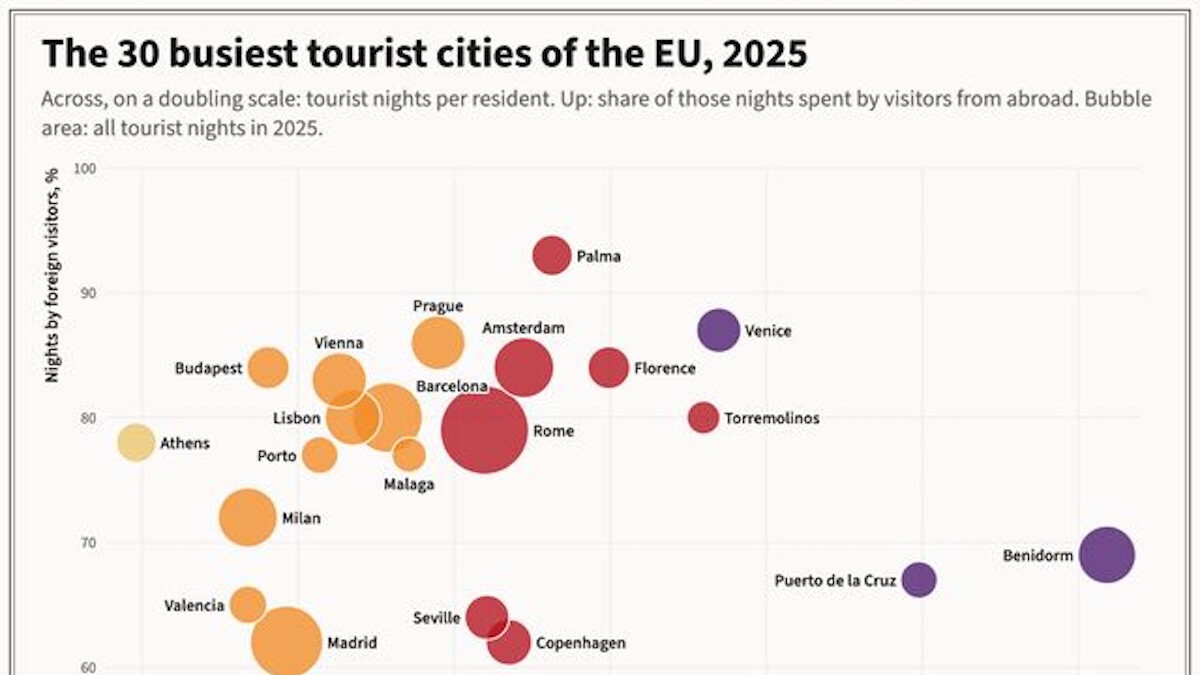
European cities with the most tourism per resident are concentrated in Spain, according to a new analysis of Eurostat data. The chart, titled “The 30 Most Crowded Cities by Tourism in the EU in 2025,” compares tourist nights in accommodation with the resident population to reveal tourism intensity. The results show that some Spanish cities have far more tourist nights per resident than other European destinations, raising concerns about housing, public space, and services.
What the Tourism Intensity Chart Shows
The chart uses Eurostat data on nights spent in tourist accommodation—including hotels, short-term rentals, and campsites—during 2025 in selected cities. These nights are then divided by the permanent resident population to calculate tourism intensity, or tourist nights per resident. This metric provides a clearer picture of how tourism pressure varies across cities of different sizes.
Find Original Home Decor sparking conversation at Grand Goldman Shop.

For example, a city of 20,000 residents receiving the same number of tourists as a city of 2 million will experience vastly different levels of disruption. The chart highlights these disparities, with Spanish cities often appearing at the extreme end of the scale.
Why Spain Stands Out
Spain’s popularity as a tourist destination is well known, but the intensity metric reveals just how concentrated tourism is in certain cities. Factors such as affordable flights, climate, and cultural attractions draw millions of visitors annually. However, the ratio of tourists to residents in some Spanish cities has reached levels that strain local infrastructure.
Housing is a particular concern. In tourist hotspots, the proliferation of short-term rentals reduces the availability of long-term housing, driving up rents and making it difficult for residents to afford living in their own neighborhoods. Public spaces also suffer from overcrowding, and services like waste management and public transport face increased demand.
Key Takeaways from the Data
- Tourism intensity is measured as tourist nights per resident, providing a normalized view of tourism pressure.
- Spanish cities dominate the top of the ranking, indicating high tourism concentration relative to population.
- Housing affordability is a major issue in high-intensity cities, as short-term rentals compete with residential housing.
- Public services and infrastructure face increased strain in destinations with high tourist-to-resident ratios.
- Policy responses vary, with some cities implementing regulations on short-term rentals and tourism caps.
Comparing Tourism Intensity Across European Cities
The table below illustrates tourism intensity for selected cities, based on the Eurostat data. While the full chart includes 30 cities, this sample shows the range of intensities observed.
| City | Country | Tourist Nights per Resident (2025) |
|---|---|---|
| Barcelona | Spain | High |
| Madrid | Spain | Moderate |
| Palma de Mallorca | Spain | Very High |
| Paris | France | Moderate |
| Rome | Italy | Moderate |
| Amsterdam | Netherlands | High |
Note: The table provides a qualitative summary based on the chart’s findings; exact figures are available in the original Eurostat dataset.
Implications for Housing and Local Life
The high tourism intensity in Spanish cities has direct consequences for residents. In cities like Barcelona and Palma de Mallorca, the cost of housing has risen sharply, partly due to the conversion of residential properties into tourist accommodations. This makes it harder for locals to find affordable places to live, and can lead to displacement.
Moreover, the presence of large numbers of tourists can alter the character of neighborhoods, with local shops replaced by businesses catering to visitors. The noise and congestion from tourism can also reduce quality of life for residents, especially in historic centers. The background to this story is set out in Palma Residents Use Tupperware Dinners to Reclaim Tourist-Plagued Plazas. A related thread runs through Europe Tourism Map Reveals Overtourism Pressure on 10% of Territory. Earlier coverage in Spain's 100 Million Tourist Goal Faces Extreme Heat Threat shows how the argument developed.
What to Watch Next
As tourism continues to recover and grow, the pressure on high-intensity cities is likely to increase. Local governments are responding with measures such as limiting new short-term rental licenses, increasing tourist taxes, and promoting sustainable tourism practices. The effectiveness of these policies will determine whether these cities can balance economic benefits with livability. A closer look at the same subject appears in Big Sur Overtourism Crisis: Wildfires and Tourist Deaths. Anyone following the wider picture can start with Marseille Overtourism: France's New Capital of Travel. The same theme surfaces in Footballers with Most Club Trophies: Marquinhos Tops List, which takes a different angle.
For travelers, understanding tourism intensity can help in choosing destinations and times to visit that minimize negative impacts. For residents and policymakers, the data underscores the need for careful management of tourism to protect local communities. Context on how this played out before sits in Madrid Tourism Backlash: Does 'Madrileñofobia' Really Exist in Spain. A companion piece, The Improbable Origin of Spain's Menú del Día: A Franco-Era Tourism Strategy, approaches the same subject from another angle.
FAQ
What is tourism intensity and why does it matter?
What is tourism intensity and why does it matter?
Tourism intensity is the number of tourist nights per resident in a city. It matters because it shows how much tourism pressure a city faces relative to its population size, which affects housing, infrastructure, and quality of life.
Which European cities have the highest tourism intensity?
According to the Eurostat-based chart, several Spanish cities top the list, including Palma de Mallorca and Barcelona, which have very high tourist nights per resident compared to other European cities.
How does high tourism intensity affect housing?
High tourism intensity often leads to an increase in short-term rentals, reducing the supply of long-term housing and driving up rents. This can make it difficult for residents to afford housing in their own cities.
What can be done to manage tourism intensity?
Cities can implement regulations on short-term rentals, impose tourist taxes, and promote off-season tourism. These measures aim to balance the economic benefits of tourism with the well-being of residents.
Browse the Shop
 Acacia frida deluxe solid wood bed frame |
Bedroom bench |
Bed chest drawers |
Lingerie dresser |
Frame base |
Mirror with jewelry storage |
30 Bathroom Vanity |
Memory foam queen mattress |
Mattresses for back pain |
Nightstand set of 2 |
Grand Goldman Shop |
Civil Lawyer
Deutschland Trikot WM 2026







