

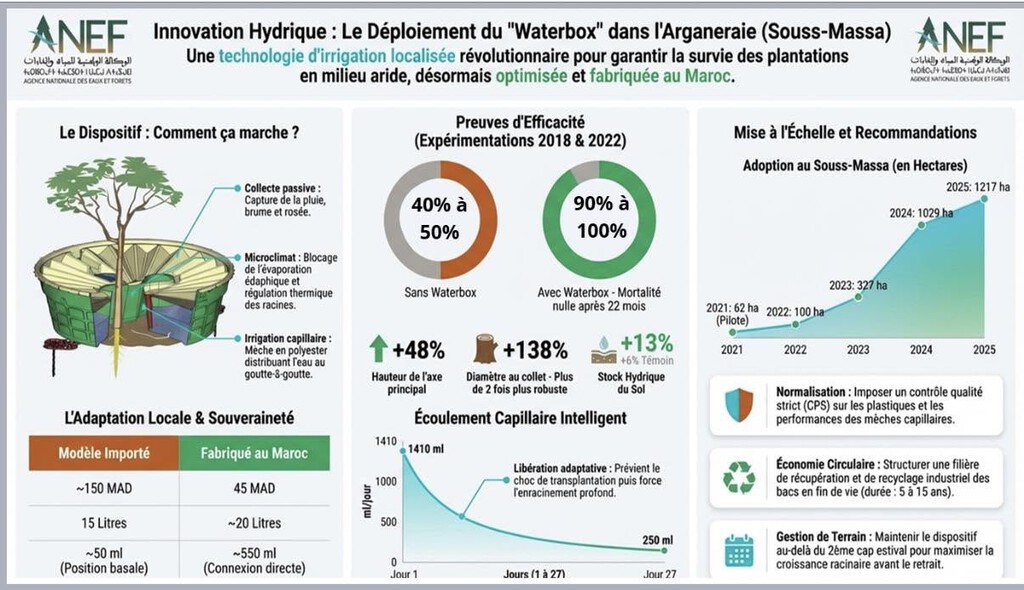
Morocco's Waterbox reforestation project has already transformed 1,200 hectares of arid land in the Souss-Massa region, offering a promising model for fighting desertification across the Mediterranean. The initiative, led by the National Agency for Water and Forests (ANEF), uses a simple, low-cost irrigation technology to help young trees survive in harsh, dry conditions.
What Is the Waterbox Reforestation Project?
At its core, Waterbox is a system designed to rethink how trees are irrigated in dry environments. Instead of relying on constant watering or complex infrastructure, it captures and stores limited water resources to give seedlings a better chance of establishing themselves. The approach is described as simple, efficient, and requiring only a modest investment.
Find Original Home Decor sparking conversation at Grand Goldman Shop.

The technology was presented by ANEF a few months ago as part of Morocco's broader efforts to combat desertification. According to Moroccan press reports, its potential has already been demonstrated across 1,200 hectares in Souss-Massa, a region known for its arid climate and agricultural importance.
Why Morocco Needs Innovative Reforestation Solutions
Climate change, extreme heat, and prolonged drought are putting pressure on countries across the Mediterranean, and Morocco is no exception. The country recognizes that much of its future depends on its fields and its ability to manage water wisely. To address these challenges, the government has launched several major water infrastructure projects, including reservoirs, desalination plants, and an ambitious "water highway."
Alongside these large-scale efforts, Morocco introduced its "Forests Strategy 2020-2030," which aims to prevent desertification and modernize forestry practices. The Waterbox project fits directly into this strategy by providing a practical tool for reforesting dry regions without exhausting already scarce water supplies.
How Waterbox Works to Restore Arid Land
While the exact technical details of Waterbox are not fully outlined in available reports, its core principle is clear: maximize the use of every drop of water. The system is designed to support tree growth in areas where rainfall is limited and irrigation is expensive. By making reforestation more affordable and water-efficient, it allows authorities to scale up restoration efforts across larger areas.
The success in Souss-Massa suggests that the approach can work at a meaningful scale. Covering 1,200 hectares is a significant achievement for a pilot or early-stage deployment, and it provides valuable data for future expansions. The longer history behind the story is traced in Morocco's Waterbox Reforestation Project Gains 1,200 Hectares.
- Water efficiency: Waterbox is built to make the most of limited water resources in arid zones.
- Low investment: The system is described as simple and cost-effective, making large-scale reforestation more feasible.
- Proven potential: It has already been applied across 1,200 hectares in the Souss-Massa region.
- Strategic alignment: The project supports Morocco's Forests Strategy 2020-2030 and broader anti-desertification goals.
- Climate resilience: By helping trees survive drought, it contributes to long-term environmental stability.
Comparing Waterbox to Traditional Reforestation Methods
Traditional reforestation in dry regions often relies on intensive irrigation, which can be costly and unsustainable. Waterbox offers an alternative that reduces water demand while still supporting tree establishment. The table below highlights key differences based on the information available. The background to this story is set out in Spanish Engineer Reforested 5,000 Hectares by Shooting Seeds. A related thread runs through Ethiopia Reforestation: 50 Billion Trees and Climate Action. Earlier coverage in Morocco World Cup 2030: Costs, Legacy, and Preparations shows how the argument developed.
| Aspect | Waterbox Approach | Traditional Irrigation |
|---|---|---|
| Water use | Optimized to maximize limited resources | Often high and continuous |
| Investment cost | Described as reasonable and low | Can be significant for infrastructure |
| Scalability | Simple design supports large areas | May require extensive plumbing |
| Suitable for arid land | Yes, specifically designed for dry environments | Challenging without abundant water |
What This Means for Morocco and Beyond
The Waterbox project demonstrates that reforestation in arid regions is possible with the right technology and a focus on efficiency. For Morocco, it represents a step toward securing its agricultural future and protecting landscapes from desertification. The success in Souss-Massa could serve as a model for other countries facing similar climate pressures. A closer look at the same subject appears in Trending: latest articles. Anyone following the wider picture can start with Toledo Reservoir Runs Dry: 10 Towns Face Water Crisis. The same theme surfaces in Tajo-Segura Water Transfer: Why It Remains Irreplaceable for Spain, which takes a different angle.
As the project moves forward, observers will watch for further updates on its expansion and impact. The combination of political will, strategic planning, and innovative technology positions Morocco as a leader in the fight against desertification in the Mediterranean region. Context on how this played out before sits in China Turns Coal Mine Scars Into Thriving Farms and Greenhouses. A companion piece, Norfolk Couple Wins Third Legal Victory for Wetland Protection, approaches the same subject from another angle.
FAQ
What is the Waterbox reforestation project in Morocco?
Waterbox is a technology presented by Morocco's National Agency for Water and Forests (ANEF) to reforest arid areas efficiently. It focuses on maximizing limited water resources and requires a relatively low investment. It has already been applied to 1,200 hectares in the Souss-Massa region.
How does Waterbox help combat desertification?
Waterbox helps combat desertification by enabling trees to grow in dry, arid environments without requiring large amounts of water. This supports Morocco's Forests Strategy 2020-2030, which aims to prevent desertification and modernize forestry practices.
Where has Waterbox been implemented?
Waterbox has been implemented in the Souss-Massa region of Morocco, where it has shown potential across 1,200 hectares. This region is known for its arid climate and agricultural significance.
What are the benefits of Waterbox compared to traditional reforestation?
Waterbox offers a more water-efficient and cost-effective alternative to traditional irrigation-based reforestation. It is designed to be simple, scalable, and suitable for arid lands, making it easier to restore large areas without depleting water resources.
Browse the Shop
 Acacia frida deluxe solid wood bed frame |
Bedroom bench |
Bed chest drawers |
Lingerie dresser |
Frame base |
Mirror with jewelry storage |
30 Bathroom Vanity |
Memory foam queen mattress |
Mattresses for back pain |
Nightstand set of 2 |
Grand Goldman Shop |
Civil Lawyer
Deutschland Trikot WM 2026







