

Using AI assistants can make you more productive in the short term, but new research shows it may also reduce your ability to solve problems independently. A controlled study from Carnegie Mellon, MIT, UCLA, and Oxford found that just ten minutes of AI use can negatively affect reasoning and persistence.
What the Study Found
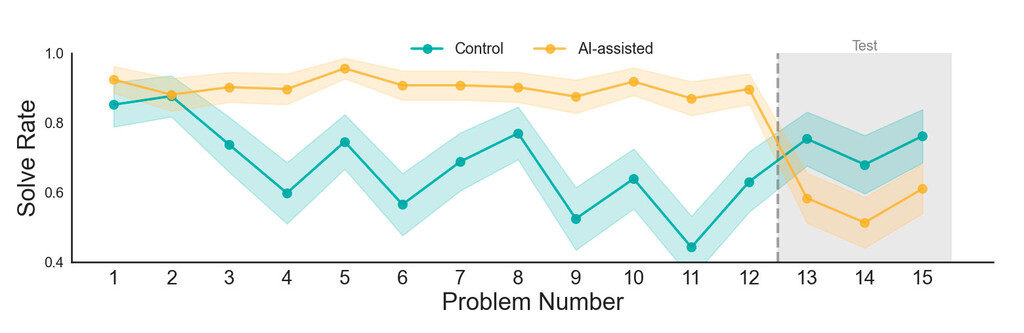
The randomized controlled experiment involved over 1,200 participants across three separate experiments. Researchers measured how using AI assistants like GPT-5 impacted immediate performance and subsequent independent problem-solving. The results confirm what earlier studies suggested: AI boosts productivity but comes with a cognitive cost.
Find Original Home Decor sparking conversation at Grand Goldman Shop.

In the first experiment, 354 participants solved twelve simple fraction problems. Some had access to an AI assistant sidebar, while others did not. When the AI was removed and participants had to answer three more questions without help, those who had used AI performed worse than the control group.
Why AI Reduces Persistence
The study highlights that AI use can lead to cognitive offloading—relying on the tool instead of engaging your own mental processes. This reduces persistence, the willingness to keep trying when problems get tough. Over time, this can erode your independent reasoning skills.
Participants who used AI were more likely to give up quickly when the AI was no longer available. They had not built the mental muscles to work through challenges on their own.
Key Takeaways for Users
- Short-term gain, long-term pain: AI improves immediate task performance but may weaken your ability to solve problems alone.
- Ten minutes is all it takes: Even brief exposure to AI can reduce persistence and reasoning.
- Cognitive offloading is real: Relying on AI prevents you from practicing critical thinking.
- Balance is essential: Use AI as a tool, not a crutch, to maintain your skills.
- Be aware of the cost: Productivity gains come with a hidden cognitive price.
How AI Impacts Different Tasks
The study used simple fraction problems, but the implications extend to complex reasoning and decision-making. The table below summarizes the observed effects.
| Factor | With AI | Without AI |
|---|---|---|
| Immediate performance | Higher | Lower |
| Persistence | Reduced | Higher |
| Independent reasoning | Weakened | Maintained |
| Error rate after removal | Increased | Baseline |
What This Means for Professionals and Students
For professionals, the takeaway is clear: while AI can speed up work, over-reliance may dull your problem-solving edge. Students, especially, should be cautious about using AI for homework without first attempting problems themselves.
Organizations should consider training programs that encourage independent problem-solving alongside AI tool usage. The goal is to use AI as an augmentation rather than a replacement for human cognition. The background to this story is set out in AI at Work: 30% of Employees Feel Less Productive. A related thread runs through Learn how to solve your home problems using these ingenious inventions. Earlier coverage in AI Gender Bias: Why Female Voice Assistants Affect Your Trust and Money shows how the argument developed.
Striking a Balance
The researchers do not suggest abandoning AI. Instead, they advocate for mindful use. Try solving a problem on your own before consulting AI. Use AI to check your work or explore alternatives, not to bypass the thinking process entirely. A closer look at the same subject appears in Corsair Galleon 100 SD: The Keyboard That Boosts Productivity. Anyone following the wider picture can start with Sand Overextraction Weakens Riverbanks as Concrete Demand Soars. The same theme surfaces in OpenAI AI Solves 100 Math Problems But Proofs Remain Unclear, which takes a different angle.
As AI becomes more integrated into daily life, understanding its cognitive impact is crucial. The study serves as a reminder that our tools shape our minds—and we must choose how. Context on how this played out before sits in Nations Championship Rugby Fails to Solve Its Own Problems. A companion piece, Manchester United Problems: How to Solve Them and Rebuild, approaches the same subject from another angle.
FAQ
How quickly does AI affect problem-solving skills?
According to the study, negative effects on reasoning and persistence can appear after just ten minutes of AI use.
Does AI always reduce independent problem-solving?
Not necessarily, but the study shows that without deliberate practice, reliance on AI can weaken your ability to solve problems alone.
What can I do to mitigate the cognitive cost of AI?
Use AI as a supplement, not a substitute. Attempt problems independently first, and use AI to verify or expand your thinking.
Who conducted this research?
Researchers from Carnegie Mellon, MIT, UCLA, and Oxford conducted the randomized controlled experiment with over 1,200 participants.
Browse the Shop
 Acacia frida deluxe solid wood bed frame |
Bedroom bench |
Bed chest drawers |
Lingerie dresser |
Frame base |
Mirror with jewelry storage |
30 Bathroom Vanity |
Memory foam queen mattress |
Mattresses for back pain |
Nightstand set of 2 |
Grand Goldman Shop |
Civil Lawyer
Deutschland Trikot WM 2026







