

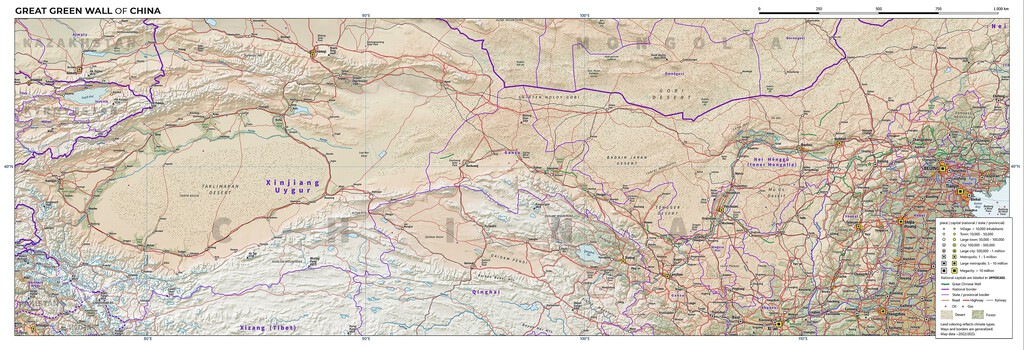
China's Great Green Wall has planted 66 billion trees across its northern regions, creating a massive barrier against desertification that now grows faster than natural forests. This nearly half-century-old project, launched in 1978, was originally designed to stop the Gobi Desert's expansion and reduce sandstorms. Today, it stands as one of the largest ecological experiments on the planet, with results that are forcing scientists to rethink reforestation.
What Is the Great Green Wall?
The Great Green Wall is a colossal tree-planting initiative spanning northern China. Its primary goal was to halt the advance of the Gobi and Taklamakan deserts into inhabited areas. Over five decades, China has planted approximately 66 billion trees, and the project continues to expand, with plans to add tens of billions more by 2050.
Find Original Home Decor sparking conversation at Grand Goldman Shop.

Unlike many desertification control projects that struggle with high tree mortality, this initiative has managed to survive and thrive. The scale is unprecedented, covering vast stretches of land and involving millions of participants, from government agencies to local communities.
Why It Matters: Beyond Sandstorm Control
When the project began, climate change was not a major international concern. The immediate objective was to protect northern China from the devastating sandstorms that plagued the region annually. These storms damaged agriculture, infrastructure, and public health.
Now, nearly 50 years later, the Great Green Wall is yielding unexpected benefits. The forests are not only stabilizing the soil but also sequestering carbon, providing habitat for wildlife, and even influencing local weather patterns. This has turned the project into a living laboratory for studying large-scale ecological restoration.
How Do These Forests Grow Faster Than Natural Ones?
One of the most surprising findings is that the planted forests are growing faster than natural forests in similar environments. This accelerated growth is attributed to several factors:
- Species selection: Fast-growing, drought-resistant tree species were chosen to quickly establish cover.
- Intensive management: Regular watering, fertilization, and protection from grazing and logging.
- Favorable microclimates: The dense planting creates a cooler, more humid microclimate that enhances growth.
- Soil improvements: The trees themselves improve soil fertility over time, creating a positive feedback loop.
- Genetic adaptation: Some species have adapted to the harsh conditions, showing rapid growth in subsequent generations.
Challenges and Controversies
Despite its successes, the Great Green Wall has faced criticism. Some experts worry about water consumption, as these fast-growing forests require significant irrigation in arid regions. There are also concerns about biodiversity, since monoculture plantations may not support as many species as natural forests.
However, recent assessments suggest that the project has evolved to incorporate more diverse species and better water management practices. The Chinese government has also emphasized the importance of balancing ecological restoration with local livelihoods.
What This Means for Global Reforestation Efforts
The Great Green Wall offers valuable lessons for other countries battling desertification, such as those in the Sahel region of Africa. Key takeaways include the importance of long-term commitment, community involvement, and adaptive management. The project demonstrates that large-scale reforestation can succeed if properly funded and maintained.
Moreover, the unexpected growth rates challenge the assumption that planted forests are always inferior to natural ones. With careful planning and management, planted forests can become robust ecosystems that provide multiple benefits. The background to this story is set out in Ethiopia Reforestation: 50 Billion Trees and Climate Action. A related thread runs through China's Great Green Wall: Tree Planting and Water Crisis. Earlier coverage in Africa's Great Green Wall: 100 Million Trees and Counting shows how the argument developed.
Comparison of Planted vs. Natural Forests
| Aspect | Planted Forests (Great Green Wall) | Natural Forests |
|---|---|---|
| Growth Rate | Faster due to management and species selection | Slower, depends on natural conditions |
| Biodiversity | Lower initially, but increasing with diversification | Higher, with complex ecosystems |
| Water Use | Higher in arid regions, requires irrigation | Adapted to local rainfall |
| Carbon Sequestration | High due to rapid growth | Moderate, but stable long-term |
| Maintenance | Intensive, especially in early stages | Self-sustaining |
What to Watch Next
As the Great Green Wall continues to expand, scientists will monitor its long-term impacts on water resources, biodiversity, and climate. The project's evolution will inform global policies on reforestation and desertification control. Upcoming research will focus on optimizing species mixtures and reducing water demand. A closer look at the same subject appears in Urban Trees and Mortality: Why Tree Canopy Growth Matters More Than Age. Anyone following the wider picture can start with Pterosaur Museum in Gobi Desert Thrives on Solar Power. The same theme surfaces in UK Economy Grows Faster Than Expected After Q2 Upgrade, which takes a different angle.
For now, the Great Green Wall stands as a testament to human determination and ecological ingenuity. It shows that with sustained effort, even the harshest environments can be transformed. Context on how this played out before sits in Morocco's Waterbox Reforestation Project Gains 1,200 Hectares. A companion piece, Yellow River Turns Clear as China's Reforestation Changes Its Color, approaches the same subject from another angle.
FAQ
How many trees has China planted in the Great Green Wall?
China has planted approximately 66 billion trees since the project began in 1978. The initiative aims to add tens of billions more by 2050.
Why do these planted forests grow faster than natural ones?
They grow faster due to intensive management, selection of fast-growing species, and the creation of favorable microclimates. Regular watering and protection from grazing also contribute.
What was the original purpose of the Great Green Wall?
The original purpose was to stop the expansion of the Gobi Desert and reduce sandstorms that affected northern China. Climate change was not a primary consideration at the time.
What are the main criticisms of the project?
Critics point to high water consumption and potential biodiversity loss from monoculture plantations. However, the project has evolved to address some of these concerns.
Browse the Shop
 Acacia frida deluxe solid wood bed frame |
Bedroom bench |
Bed chest drawers |
Lingerie dresser |
Frame base |
Mirror with jewelry storage |
30 Bathroom Vanity |
Memory foam queen mattress |
Mattresses for back pain |
Nightstand set of 2 |
Grand Goldman Shop |
Civil Lawyer
Deutschland Trikot WM 2026







