

The Soviets excavated a 227-kilometer canal in just 20 months, a feat that stunned the world—but they overlooked a critical detail: their warships couldn't use it. In 1931, the Soviet Union achieved what seemed impossible on paper: opening a navigable waterway between the White Sea and the Baltic Sea in barely 20 months. Stalin could present the Belomorkanal as a demonstration that his new state could subdue even geography at extraordinary speed. There was just one problem: the rush to finish and the restrictions imposed on the project left the canal with a depth of only about 3.5 meters.
A shortcut to the Arctic
The idea of connecting the Baltic with the White Sea had been circulating for a long time, but its enormous cost had prevented materialization. Stalin revived it within the industrialization drive of the first Five-Year Plan with a motivation beyond trade: to have an internal route that would allow naval units to be moved north without having to go around the Scandinavian peninsula.
Find Original, High-end Home Decor that spark conversation at Grand Goldman Shop.
The route between Leningrad and the White Sea could thus be shortened by thousands of kilometers and remain, moreover, within Soviet territory. In 1931 the project ceased to be an old Russian ambition and became an order.
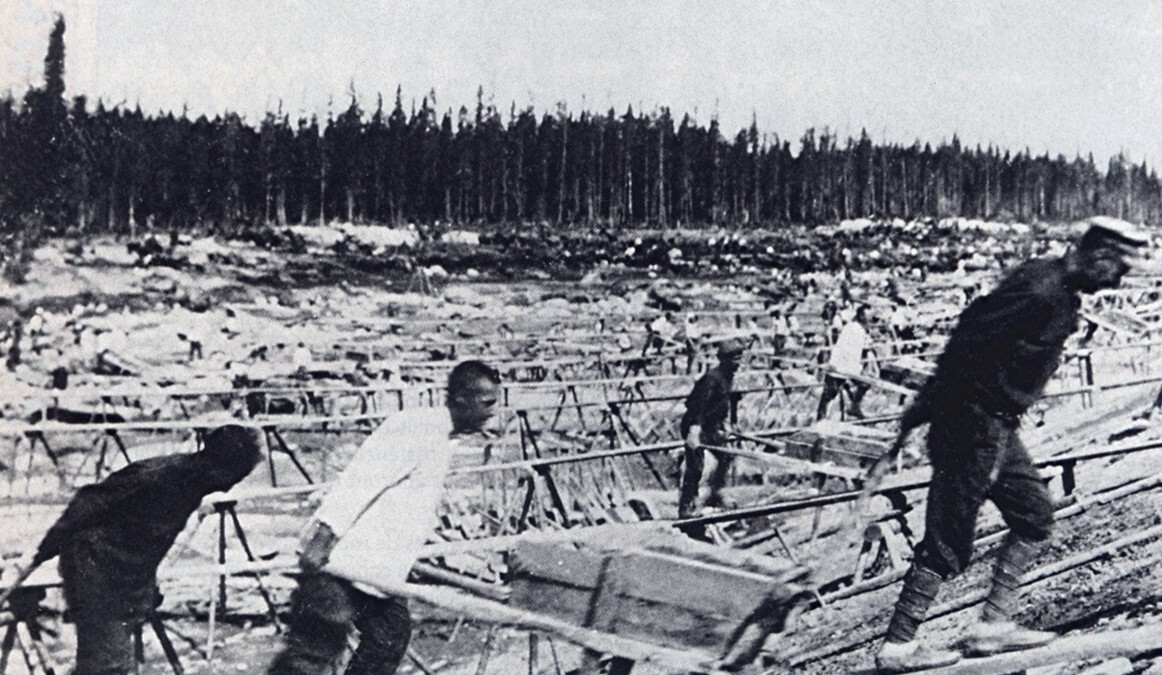
The condition: at an absurd speed
The regime imposed an extraordinarily short deadline and resorted massively to Gulag prisoners to achieve it. Tens of thousands worked excavating rock and earth under brutal conditions.

The haste had a direct consequence: the canal was built with minimal depth. While the project was presented as a triumph of socialist engineering, the reality was that the dimensions were insufficient for the warships it was supposed to accommodate.
Why the warships couldn't pass
The Belomorkanal was designed with a depth of only 3.5 meters, far less than what most warships of the era required. Soviet naval units, especially destroyers and cruisers, needed much deeper waters to navigate safely.
This meant that the canal's primary strategic purpose—moving naval units between the Baltic and the White Sea—was never fully realized. The waterway was essentially useless for the military objective that had justified its construction.
The human cost
The canal was built largely by prisoners from the Gulag system, who worked in appalling conditions. The project was completed in record time, but at a tremendous human cost. Context on how this played out before sits in Inverted Jenny Stamp: The 2 Million Dollar Error.
The use of forced labor was a hallmark of Stalin's industrialization drive, and the Belomorkanal became a symbol of the regime's willingness to sacrifice human lives for propaganda victories. The background to this story is set out in Soviet Union Dissolution: 1991 Economic Confederation Shift. A related thread runs through The August Coup Review: How the Soviet Union Collapsed in 3 Days.
What happened next
After its completion, the canal was used primarily for timber transport and other commercial goods, not for naval purposes. Its shallow depth limited its usefulness, and it never became the strategic naval route that Stalin had envisioned. Earlier coverage in The August Coup Review: Soviet Union's Collapse and Modern shows how the argument developed. A closer look at the same subject appears in The August Coup Review: Soviet Union's Drink-Soaked Collapse.
Over time, the canal was improved, but it never fully overcame the limitations of its rushed construction. The Belomorkanal remains a cautionary tale about the dangers of prioritizing speed over practicality. Anyone following the wider picture can start with Imperium Review: Soviet Union Life in a Haunting Archive Film. The same theme surfaces in The August Coup Review: Soviet Union's Collapse and Lessons for, which takes a different angle.
Lessons for today
The story of the Belomorkanal offers several key takeaways:
- Rushing major infrastructure projects can lead to critical design flaws.
- Political pressure to meet unrealistic deadlines often compromises quality.
- Strategic objectives must be matched with technical feasibility.
- Human costs are often overlooked in the pursuit of propaganda victories.
- Long-term usefulness should be prioritized over short-term spectacle.
| Aspect | Details |
|---|---|
| Length | 227 kilometers |
| Construction time | 20 months |
| Depth | 3.5 meters |
| Primary purpose | Naval route between Baltic and White Sea |
| Actual use | Timber and commercial transport |
| Labor force | Gulag prisoners |
FAQ
Why was the Belomorkanal built so quickly?
The Soviet regime imposed an extremely short deadline as part of Stalin's Five-Year Plan, using forced labor to complete the project in record time.
What was the main problem with the canal?
The canal was only about 3.5 meters deep, which was insufficient for the warships it was intended to accommodate.
Who built the Belomorkanal?
The canal was built largely by prisoners from the Gulag system, who worked under brutal conditions.
Was the canal ever used for its intended purpose?
No, the canal's shallow depth prevented its use for naval purposes, and it was primarily used for timber and commercial transport.
Browse the Shop
 Acacia frida deluxe solid wood bed frame |
Bedroom bench |
Bed chest drawers |
Lingerie dresser |
Frame base |
Mirror with jewelry storage |
30 Bathroom Vanity |
Memory foam queen mattress |
Mattresses for back pain |
Nightstand set of 2 |
Grand Goldman Shop |
Civil Lawyer
Deutschland Trikot WM 2026










