Ir para o conteúdo
Grand Goldman

How Much Is $1,000 a Month Invested for 30 Years 2025

Investing $1,000 a month for 30 years is one of the most effective ways to build long-term wealth and achieve financial independence. With consistent monthly investments and the power of compound interest, your money has decades to grow, turning a manageable contribution into a substantial investment portfolio.

But how much could that really be worth after 30 years? The answer depends on several key factors—interest rate, investment strategy, and market returns.

If you invest $1,000 per month with an average annual return of 7%, your total contributions of $360,000 could grow to over $1.2 million thanks to compounding. This demonstrates why long-term investing in stocks, index funds, or retirement accounts such as a 401(k) or IRA can significantly amplify your wealth over time. The earlier you start, the greater your compound growth, since returns start generating their own returns year after year.

Understanding how to maximize your investment returns involves balancing risk tolerance, choosing diversified asset allocations, and staying consistent—even during market fluctuations. This guide breaks down exactly how much $1,000 invested monthly for 30 years could grow under various scenarios, helping you design a winning investment plan. Whether you’re saving for retirement, financial freedom, or future generational wealth, consistent investing remains one of the smartest moves you can make.


Intellectia AI ReviewŠŠGrand Goldman

Try the #1 AI Investment Platform for Free: Intellectia


The Power of Consistent Monthly Investing

Investing a consistent amount every month can significantly grow your wealth over time. One such scenario involves investing $1,000 each month for 30 years. But how much could you actually accumulate in that period? This article will walk you through the process of calculating the growth of your monthly investment and explore the factors that influence your wealth accumulation.

Consistently setting aside a portion of your income is a key element of any financial strategy. Monthly savings can be an effective way to build wealth over time, especially when combined with a solid investment strategy.


Understanding Dollar-Cost Averaging

Regular investments, such as monthly contributions, leverage the power of dollar-cost averaging. This strategy involves investing a fixed amount regularly, which helps mitigate the effects of market volatility by purchasing more shares when prices are low and fewer when prices are high. Over time, this can lead to substantial growth.


The Role of Compound Interest

One of the most compelling aspects of investing is compound interest, which allows your investment to grow exponentially as you earn returns on both your initial principal and the accumulated interest over time.

Consider your $1,000 monthly investment. Initially, your contributions may seem to grow slowly. However, as the interest compounds, the growth accelerates. This compounding effect is what makes long-term investing so powerful.


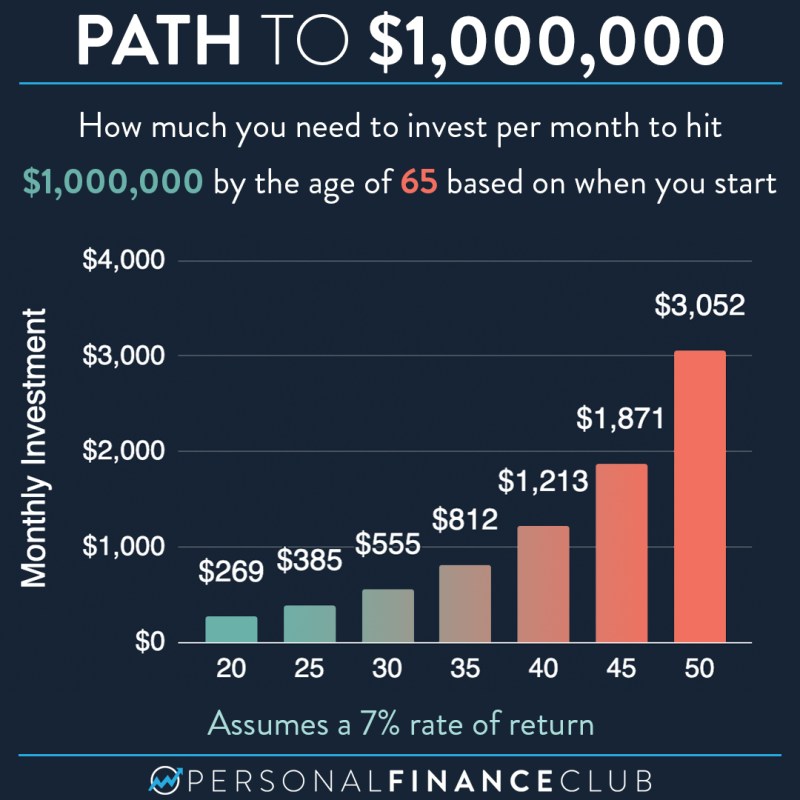
How much do I need to invest every month to become a millionaire? - Blog  Posts - Personal Finance Club


How to Calculate the Future Value of Monthly Investments

To understand how much your $1,000 monthly investment could grow over 30 years, you need to consider several factors, including the expected rate of return and the frequency of compounding.

Future Value Formula

The formula to calculate the future value of monthly investments is:

FV=P×(1+r)n1rFV = P \times \frac{{(1 + r)^n - 1}}{r}

Where:

  • FV = Future value of the investment

  • P = Monthly investment amount

  • r = Monthly interest rate (annual rate divided by 12)

  • n = Total number of contributions (months)

While the formula provides a theoretical understanding, using an investment growth calculator with monthly contributions can simplify the process. These tools allow you to input your monthly savings, expected return rate, and investment duration to quickly calculate potential growth.


Key Factors That Influence Investment Growth

Several variables affect the growth of your investments. Understanding these can help you make informed decisions about your investment strategy.

Rate of Return

The rate of return is a critical factor in determining how much your investment will grow. Historically, stocks have provided higher returns compared to bonds or savings accounts. However, higher returns often come with increased risk.

Inflation

Inflation erodes purchasing power over time, meaning your investments need to outpace inflation to preserve your wealth. Consider this when choosing your investment strategy.

Fees

Fees associated with investment products or advisors can significantly impact your overall returns. It's essential to understand and minimize these costs where possible.


Guides

Best Beginner Investment Platform | How Much Money Do I Need to Invest Make 3000 a Month | How to Make 1000 a Month by Investing | How Much is 1000 a Month Invested for 30 Years | Should I Use Robinhood or Fidelity | Robinhood Review


Example Calculation: $1,000 per Month for 30 Years at 7% Return

Let’s calculate the growth of a $1,000 monthly investment over 30 years with an average annual return of 7%, compounded monthly.

P=1,000P = 1,000 r=0.07120.00583r = \frac{0.07}{12} \approx 0.00583 n=30×12=360n = 30 \times 12 = 360 FV=1,000×(1+0.00583)36010.00583FV = 1,000 \times \frac{{(1 + 0.00583)^{360} - 1}}{0.00583}

After calculating, the future value of your investment would be approximately $1,220,000.


How to Invest in Stocks: 2025 Beginner's Guide - NerdWallet


Strategies to Maximize Long-Term Investment Growth

Diversify Your Portfolio

Diversification involves spreading your investments across various asset classes to reduce risk and volatility. A well-diversified portfolio can help achieve more stable returns over time.

Stay Invested Through Market Fluctuations

Investing is a long-term game. While market downturns can be unsettling, staying invested through the ups and downs is crucial for compounding growth. Attempting to time the market can lead to missed opportunities.

Review and Adjust Regularly

Your financial goals and market conditions may change over time. Regularly review your investment strategy and adjust it as needed to stay on track.


How Much Is $1,000 a Month Invested for 30 Years ? - My Conclusion

Investing $1,000 a month for 30 years can lead to substantial wealth accumulation, thanks to the power of compound interest. By understanding the factors that influence investment growth and employing smart strategies, you can enhance your financial future. Whether you're just starting or looking to optimize your current investment plan, the key is consistency and informed decision-making.

Remember, consulting with a financial advisor can provide personalized guidance tailored to your unique financial situation.


Intellectia AI ReviewŠŠGrand Goldman

Try the #1 AI Investment Platform for Free: Intellectia | Intellectia AI Review


Frequently Asked Questions (FAQ)

How much will I have if I invest $1,000 a month for 30 years?

Assuming a 7% annual return compounded monthly, you would accumulate roughly $1.22 million over 30 years.

What if my investment return is lower or higher than 7%?

At a 5% return, you’d have about $836,000. At a 10% return, your investment could grow to around $2.26 million. The rate of return significantly affects long-term results.

Is it better to invest monthly or yearly?

Investing monthly provides the advantage of dollar-cost averaging, which helps smooth out market volatility and builds discipline through consistent contributions.

Can I retire with $1,000 monthly investments?

Yes—depending on your total expenses and lifestyle, $1,000 monthly contributions can form a strong retirement foundation, especially if started early and combined with other savings or income streams.

What’s the safest way to invest $1,000 a month?

For balanced growth and safety, consider a diversified mix of index funds, ETFs, or target-date retirement funds matched to your risk tolerance and time horizon.


Michael Goldman
Author

Michael Goldman

Michael is an award-winning online reporter and content writer with over a decade of experience covering technology, business, and digital culture. His investigative features have been published in leading outlets such as Wired, The Verge, and Forbes, earning him recognition for accuracy and depth.


Finança

How to Make $1,000 a Month by Investing

Learning how to make $1000 a month by investing is one of the most achievable financial goals for anyone looking to build passive income and attain financial freedom. Whether you’re new to investing or refining...

Quanto Dinheiro Eu Preciso Investir para Ganhar $3.000 por Mês?

Se você já se perguntou quanto dinheiro precisa investir para ganhar $3,000 por mês, você não está sozinho. Construir passive income é um dos objetivos financeiros mais buscados por quem...

Should I Use Robinhood or Fidelity for Investing? (Comparison)

Choosing between Robinhood and Fidelity can be a pivotal decision for any investor, whether you’re just starting out or managing a diverse investment portfolio. Both platforms offer unique strengths, but cater to different types of traders and investing...

Robinhood Review: Is it Worth It for Investing ? (What I Found)

The rise of commission-free trading has completely changed how people invest, and Robinhood has been at the center of that revolution. Launched in 2013, Robinhood quickly became one of the most popular investment apps in the...

11 Melhores Plataformas de Investimento para Iniciantes (Avaliações)

Começar a investir pode parecer assustador, especialmente com tantas plataformas de negociação online, robo-advisors e aplicativos de corretagem competindo pela sua atenção. Como alguém que passou anos analisando mercados financeiros e testando diferentes ferramentas de investimento, sei que escolher...

Revisão do Intellectia AI: A Verdade Sobre o Trading Potencializado por IA

Como um analista financeiro experiente e entusiasta de tecnologia de IA, passei anos explorando a interseção entre inteligência artificial e estratégias de investimento. Quando encontrei pela primeira vez Intellectia AI,...

Diferenças Entre Fundos de Índice e ETFs: Quais São Melhores?

À medida que o mundo dos investimentos se torna mais conhecido, surgem mais perguntas sobre alguns conceitos específicos desta área, como a diferença entre fundos de índice e ETFs. Isso...

O que são Fundos de Índice Inversos? (Guia Abrangente)

Fundos de índice inversos são modelos de investimento que replicam o mesmo comportamento de um índice específico do mercado de ações, mas de forma inversa. Ou seja, se esse índice...

7 Dicas para Economizar Dinheiro Rápido: Guia Passo a Passo

Já sabemos que o primeiro passo para alcançar a independência financeira é ter dinheiro suficiente investido para gerar uma renda que cubra todas as nossas despesas. Mas qual é o...

Como Criar um Fundo de Emergência: Guia Passo a Passo

Criar um fundo de emergência deve ser quase uma obrigação para quem quer manter o mesmo padrão de vida, independentemente dos imprevistos e contratempos financeiros que possam ocorrer de vez...

Como Herdar um Fundo Mútuo / Fundo de Índice e Pagar Menos Impostos

O que é um fundo de investimento? Como ele me beneficiaria se eu fosse um de seus herdeiros? Vou explicar isso e outras questões em detalhes neste artigo. Um fundo...

Como Economizar Dinheiro Ganhando 1.000 Euros (7 Dicas)

Como economizar o dinheiro que ganho quando é pouco ou limitado? Seja você um estudante morando com seus pais ou um pai/mãe, tenho certeza que você frequentemente se pergunta, œComo...

O que é Frugalidade Financeira e Como Aplicá-la em Sua Vida

A liberdade financeira tem sido amplamente promovida nos últimos anos por muitos investidores e consultores; existem vários caminhos e estratégias para alcançá-la, sendo um deles a frugalidade financeira. A frugalidade...

5 Dicas para Organizar Melhor o Seu Orçamento Familiar

Quer saber como controlar seus gastos de forma mais eficiente? Você sabe o que deve priorizar quando se trata de poupar? Pois bem, não se preocupe, porque neste artigo vou...

Como Investir Durante a Recessão: O Que Você Precisa Saber

Neste artigo, vou explicar como invisto em tempos de recessão para multiplicar meu dinheiro, e quais oportunidades acho que teremos pela frente e que apenas alguns saberão aproveitar.E somente neste...

Há uma "Bolha" em Fundos de Índice? O Que Você Precisa Saber

Michael Burry, the renowned investor known for his accurate prediction of the 2008 financial crisis featured in the film " The Big Short," has expressed concern about a potential significant...