

Amazon has publicly disclosed the water consumption of its data centers, revealing that its servers use 2.5 billion gallons (nearly 9.5 billion liters) of water annually. The figure comes from Amazon Web Services (AWS), the world's largest cloud infrastructure provider, and marks a notable exercise in transparency.
The disclosure offers a rare glimpse into the environmental footprint of the cloud, but it also raises questions about how we measure and compare water use across industries.
Find Original Home Decor sparking conversation at Grand Goldman Shop.

Amazon's 2.5 Billion Gallons: Putting It in Perspective
The headline number—2.5 billion gallons per year—is roughly 5% of the annual water consumption for the Seattle metropolitan area. That's a significant amount, but context matters.
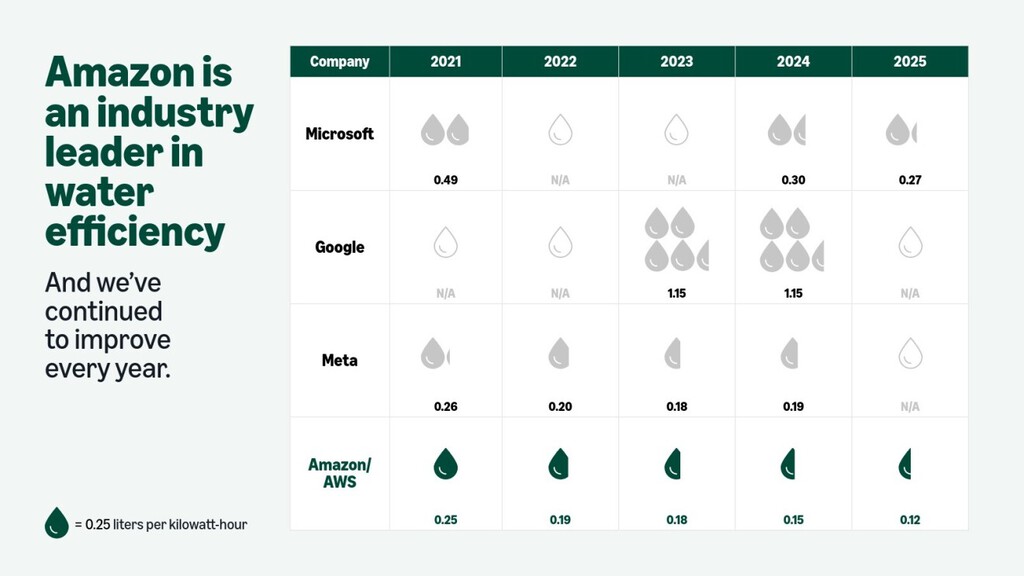
Amazon has argued that data centers use significantly less water than golf courses or car washes. The company also points to other water-intensive industries, such as meat production and textile manufacturing, as larger consumers.
Previous studies have sometimes misinterpreted data center water use, leading to inflated concerns. Amazon's disclosure aims to provide a clearer picture.
The WUE Metric: A Key to Efficiency
To gauge a data center's water impact, the industry uses a metric called Water Usage Effectiveness (WUE). It measures liters of water consumed per kilowatt-hour of energy delivered to servers.
Amazon reports a WUE of 0.18 liters per kWh, which is notably better than Microsoft's 0.27 l/kWh. This efficiency suggests that Amazon's data centers are relatively water-stingy for the computing power they deliver.
However, WUE only tells part of the story. It doesn't account for the total energy mix or the local water stress in areas where data centers operate.
Good News and Bad News
The good news is that Amazon's transparency sets a precedent for the industry. By sharing its water data, Amazon invites scrutiny and comparison, which can drive improvements across the sector.
The bad news is that the absolute volume of water consumed remains substantial. As cloud computing continues to grow, so will the demand for water, especially in regions already facing water scarcity.
Moreover, the comparison to golf courses or car washes, while valid, may deflect from the need for further reductions. Every industry must do its part.
What This Means for the Cloud Industry
Amazon's disclosure puts pressure on competitors like Microsoft and Google to follow suit with detailed water usage data. Some already report WUE, but transparency varies.
Investors and customers are increasingly factoring environmental performance into their decisions. Data on water use can influence where companies choose to host their workloads. The background to this story is set out in Data Centers' Water Consumption Triples: The Hidden Cost of AI. A related thread runs through Zaragoza Protests Data Centers Over Water, Jobs, and Taxes. Earlier coverage in Data Center Water Use: Nixval CEO on the Real Impact of AI shows how the argument developed.
Regulators may also take note, especially in water-stressed regions. Data centers could face stricter permitting requirements or incentives to adopt water-saving technologies. A closer look at the same subject appears in Spain Tightens Data Center Rules: 80% Renewable Energy and Water Use Regulated. Anyone following the wider picture can start with Nvidia's Hot Water Cooling Cuts Data Center Water Use. The same theme surfaces in Texas Governor Threatens Penalties for Data Centers Over Water Use, which takes a different angle.
Key Takeaways
- Amazon's data centers consume 2.5 billion gallons of water annually, about 5% of Seattle's metro area use.
- Amazon's WUE of 0.18 l/kWh is better than Microsoft's 0.27 l/kWh, indicating efficient water use.
- Context is crucial: data centers use less water than golf courses or car washes, but absolute volume matters.
- Transparency from Amazon could push the industry toward better water stewardship.
- As cloud demand grows, water consumption will rise, especially in water-scarce areas.
Comparing Water Efficiency: Amazon vs. Microsoft
| Company | WUE (L/kWh) | Annual Water Consumption |
|---|---|---|
| Amazon (AWS) | 0.18 | 2.5 billion gallons |
| Microsoft | 0.27 | Not disclosed |
Note: Microsoft's annual water consumption is not directly comparable as it has not disclosed a total figure in the same manner. Context on how this played out before sits in Microsoft's Climate Goal in Jeopardy as AI Data Centers Drive Emissions. A companion piece, Ireland Data Centers Now Use 23% of National Electricity, approaches the same subject from another angle.
FAQ
How much water does Amazon use in its data centers?
Amazon's data centers consume approximately 2.5 billion gallons (9.5 billion liters) of water per year, according to the company's disclosure. This is about 5% of the annual water use for the Seattle metropolitan area.
What is WUE and why does it matter?
WUE stands for Water Usage Effectiveness, a metric that measures liters of water consumed per kilowatt-hour of energy delivered to servers. A lower WUE indicates more efficient water use. Amazon's WUE is 0.18 l/kWh, compared to Microsoft's 0.27 l/kWh.
Are data centers worse for water than golf courses?
Amazon claims that data centers use significantly less water than golf courses or car washes. While this may be true on a per-facility basis, the total water consumption of data centers is still substantial and growing with cloud demand.
Why did Amazon disclose this data now?
Amazon's disclosure likely responds to increasing scrutiny over the environmental impact of data centers. By being transparent, Amazon aims to build trust and potentially influence industry standards for water reporting.
As cloud computing continues to expand, the water footprint of data centers will remain a critical issue. Amazon's move sets a benchmark, but the industry must strive for continuous improvement in water efficiency and transparency.
Browse the Shop
 Acacia frida deluxe solid wood bed frame |
Bedroom bench |
Bed chest drawers |
Lingerie dresser |
Frame base |
Mirror with jewelry storage |
30 Bathroom Vanity |
Memory foam queen mattress |
Mattresses for back pain |
Nightstand set of 2 |
Grand Goldman Shop |
Civil Lawyer
Deutschland Trikot WM 2026







