

US data center construction has become the single most powerful force in American building, and the numbers are hard to ignore. According to data from the U.S. Census Bureau, spending on data centers has soared while nearly every other category of private construction has pulled back.
This is not a niche trend. It is a structural shift in how the world's largest economy allocates capital, and it is being driven almost entirely by artificial intelligence.
Find Original, High-end Home Decor that spark conversation at Grand Goldman Shop.

US Data Center Construction Spending Hits a Record
Since December 2023, annual spending on building data centers has climbed from roughly $24 billion to more than $75 billion as of July 2026. That is an increase of about $51 billion in under three years.
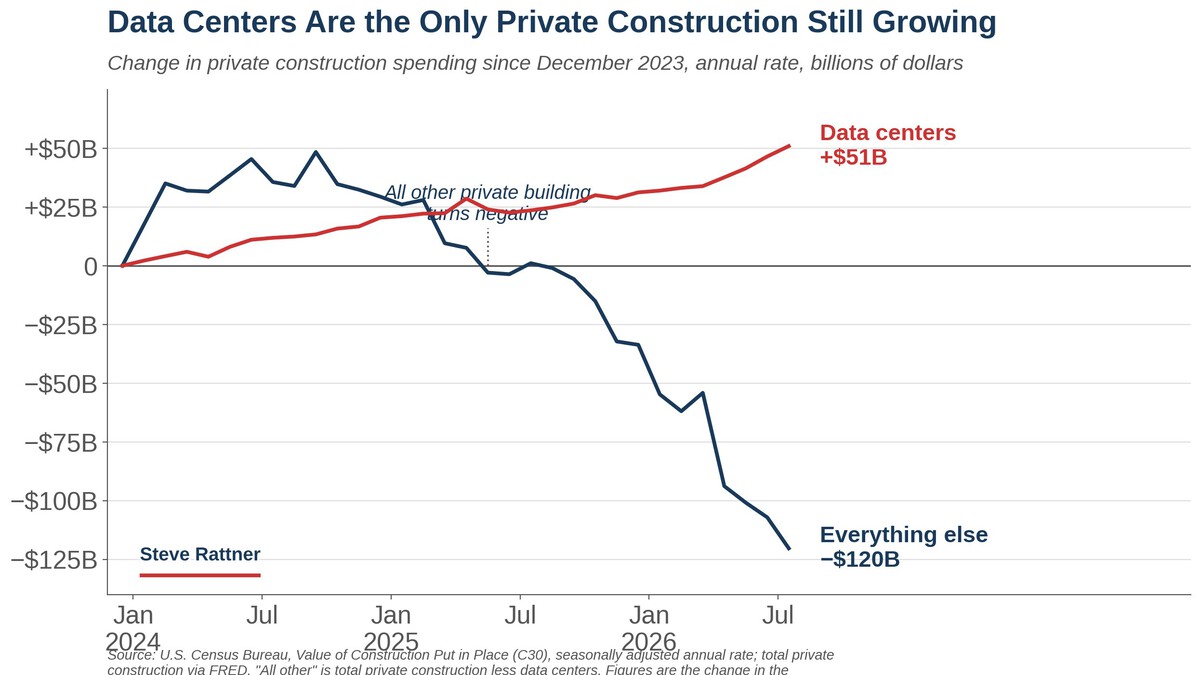
Over the same period, spending on all other private construction fell by $120 billion. The contrast is stark: one category is booming while the rest of the sector contracts.
Economist and investor Steve Rattner highlighted the gap using Census Bureau figures, and the chart tells the story clearly. The broader construction market is shrinking, but data centers keep rising.
Why AI Is Reshaping the US Economy
Artificial intelligence has become a massive promise into which big tech companies are pouring enormous sums of money. In the United States, the economy is increasingly dependent on AI.
Data from Epoch AI shows that spending on data centers, hardware, and networks already accounted for 0.8% of US GDP in the first quarter of the year. That is a significant share for a single technology category.
Part of that investment is physical: infrastructure and buildings that someone has to construct. The GDP figures already show AI's weight, but construction makes it impossible to miss.
The $51 Billion Surge in Data Center Building
The scale of the shift is best understood through the spending gap. Data center construction added $51 billion in annual spending, while the rest of private construction lost $120 billion.
That means the headline growth in nonresidential construction is largely a data center story. Strip out data centers, and the picture looks much weaker.
This concentration matters for investors, builders, and policymakers alike. It signals where capital is flowing and where economic activity is concentrated.
How the Census Bureau Tracks Data Center Construction
Starting in 2024, the Census Bureau began reporting data centers separately within office construction. The reason is simple: when combined, data centers distort the overall picture of the sector.
Separating them gives a clearer view of both trends. Office construction excluding data centers is contracting, while data center construction is expanding rapidly.
This methodological change is a quiet acknowledgment that data centers have become too large to treat as a subset of traditional office building. The longer history behind the story is traced in US Data Center Construction Boom: The Only Thing Being Built Now.
Key Takeaways for the US Economy
- US data center construction spending jumped from about $24 billion to over $75 billion annually since December 2023.
- All other private construction spending fell by $120 billion over the same period.
- Data centers, hardware, and networks accounted for 0.8% of US GDP in the first quarter, according to Epoch AI.
- The Census Bureau now reports data centers separately because they distort office construction data.
- AI investment is increasingly driving the physical economy, not just software and services.
Data Center Construction vs. Other Private Construction
| Category | Change Since December 2023 | Direction |
|---|---|---|
| Data center construction spending | +$51 billion annually | Rising |
| All other private construction spending | -$120 billion annually | Falling |
| Data centers, hardware, and networks as share of GDP | 0.8% in Q1 | Growing |
What to Watch Next in the Data Center Boom
The concentration of construction in data centers raises questions about durability. If AI spending slows, the construction pipeline could cool quickly. The background to this story is set out in Australia Housing Boom vs Data Centre Construction Surge. A related thread runs through A new diving park with shipwrecks is being built on Crete. Earlier coverage in The best glasses and cups for every drink, according to the experts - Grand Goldman shows how the argument developed.
For now, the trend shows no sign of reversing. Big tech continues to commit capital to AI infrastructure, and the physical buildout remains a core part of that strategy. A closer look at the same subject appears in Guide to Building a Storage Garage and Work Center!. Anyone following the wider picture can start with White House AI Accord Misspells United States: Trump Signs. The same theme surfaces in Business: latest articles, which takes a different angle.
Watch the quarterly Census Bureau data for signs of a peak. Also watch whether other construction categories recover or continue to lag behind the data center surge. Context on how this played out before sits in Europe Heatwaves Cost Billions in GDP and Productivity. A companion piece, UK Economy Defies Forecasts with Surprise 0.4% GDP Growth, approaches the same subject from another angle.
FAQ
How much has US data center construction spending grown?
Spending has grown from about $24 billion annually in December 2023 to more than $75 billion as of July 2026, an increase of roughly $51 billion.
What share of US GDP comes from AI-related spending?
According to Epoch AI, spending on data centers, hardware, and networks accounted for 0.8% of US GDP in the first quarter of the year.
Why did the Census Bureau separate data centers from office construction?
Because when data centers are combined with traditional office construction, they distort the overall picture of the sector. Reporting them separately provides a clearer view of both trends.
Is other private construction spending falling?
Yes. Over the same period that data center spending rose by $51 billion, spending on all other private construction fell by $120 billion.
Browse the Shop
 Acacia frida deluxe solid wood bed frame |
Bedroom bench |
Bed chest drawers |
Lingerie dresser |
Frame base |
Mirror with jewelry storage |
30 Bathroom Vanity |
Memory foam queen mattress |
Mattresses for back pain |
Nightstand set of 2 |
Grand Goldman Shop |
Civil Lawyer
Deutschland Trikot WM 2026










