

In 2008, astrophysicist Jason Steffen published a mathematical solution to the airplane boarding problem that promised to drastically cut wait times. His method, known as the Steffen method, was brilliant because it reduced passenger conflicts and allowed multiple people to stow their luggage simultaneously. Simulations showed significant time savings, but then something happened: unpredictable human beings entered the equation.
The Origin of the Steffen Method
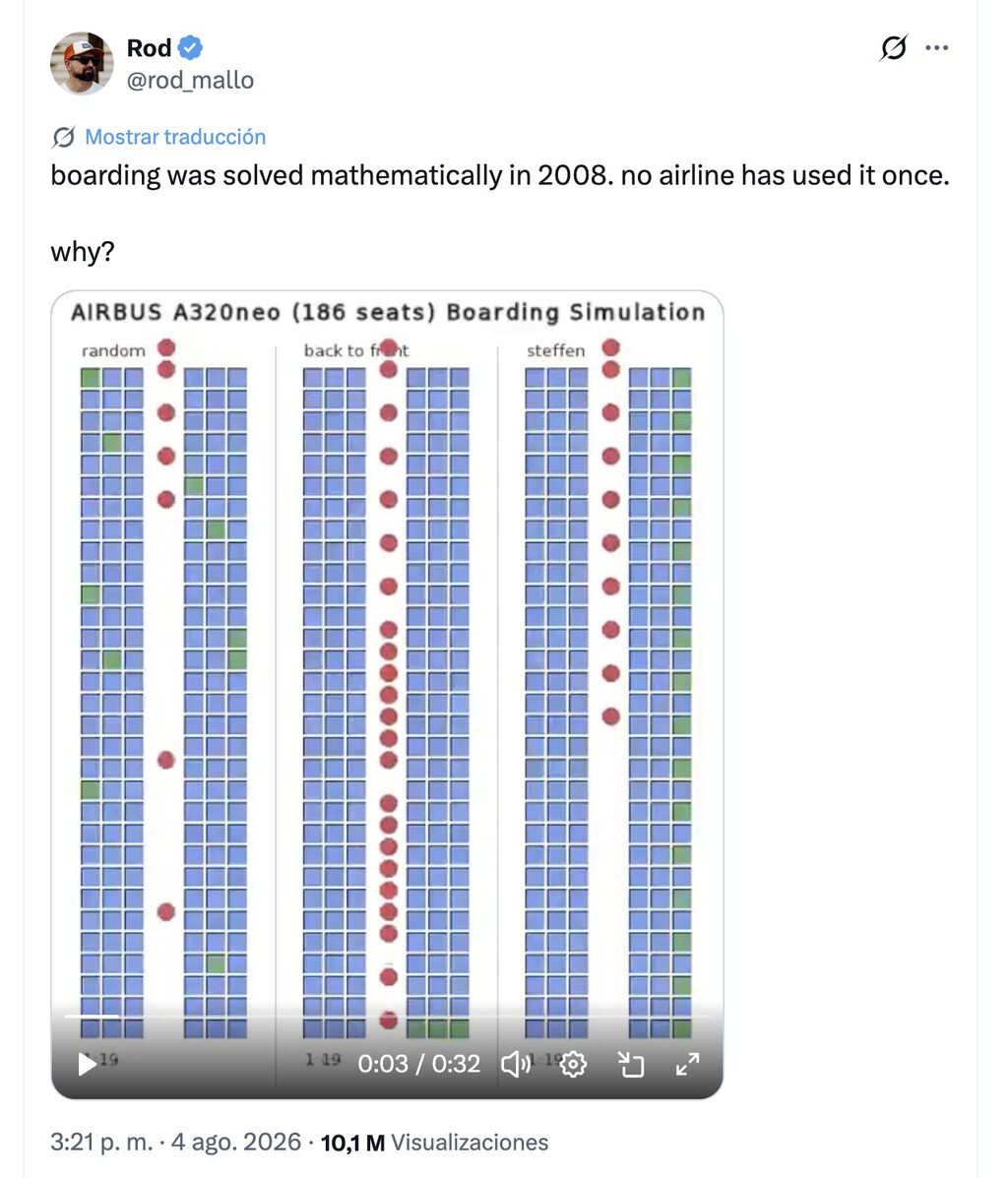
It all started in a line. Steffen, who had worked on studying planetary systems, began thinking about the optimal way to board a plane when he found himself stuck in exactly such a process at Seattle airport. Like many passengers, he assumed that filling the plane from back to front should be the most efficient. His simulations proved the opposite: concentrating travelers from nearby rows causes everyone to try to store their bags in the same area, leading to bottlenecks.
Find Original Home Decor sparking conversation at Grand Goldman Shop.

What seemed logical was actually a terrible method for solving the problem. The key was to separate people. From there, the astrophysicist ended up creating the Steffen method, which first seats window passengers and also alternates rows—for example, 12A, 10A, 8A, and 6A. Then it repeats the pattern on the other side of the plane and continues with middle and aisle seats. That distance and alternation allows multiple people to use the overhead bins at the same time without interference.
Why Airlines Haven't Adopted the Steffen Method
Despite its proven efficiency, airlines have largely ignored the Steffen method. The main reason is that it requires strict passenger compliance, which is difficult to enforce. Airlines prioritize simplicity and predictability over theoretical speed. The Steffen method also separates families and groups, causing confusion and resistance. Additionally, it disrupts the boarding process for first-class and frequent flyers, who are accustomed to boarding first. Context on how this played out before sits in Japan's Senior Driver 'L' Mark: Mandatory Safety Sticker for Elderly.
Another factor is that the method's benefits are most significant when the plane is full and passengers have carry-on luggage. In reality, many flights are not full, and checked bags reduce the need for overhead bin space. Airlines have instead focused on other improvements, such as earlier boarding for families and efficient scanning of boarding passes. The background to this story is set out in Car: latest articles. A related thread runs through Why Passengers Touch the Plane Before Boarding: Psychology Explained.
Key Takeaways from the Steffen Method
- Back-to-front boarding is inefficient because it clusters passengers in the same area, causing bottlenecks.
- The Steffen method seats window passengers first, alternating rows to spread out luggage stowing.
- Simulations show the method can cut boarding time by up to 30% compared to traditional methods.
- Airlines resist because it requires strict compliance and disrupts group seating.
- Human behavior and airline priorities often override mathematical efficiency.
Comparison of Boarding Methods
| Method | Description | Estimated Time Savings | Adoption |
|---|---|---|---|
| Back-to-front | Rows filled from rear to front | Baseline | Common |
| Steffen method | Window seats first, alternating rows | Up to 30% faster | Rare |
| Random boarding | No specific order | Similar to back-to-front | Some airlines |
| Zone boarding | Groups by seat type or status | Moderate | Widespread |
What This Means for Travelers
For travelers, the Steffen method highlights the tension between efficiency and human behavior. While the method could save time, it would require passengers to follow instructions precisely, which is unlikely in real-world settings. Instead, travelers can adopt some of its principles: board early if they have large carry-ons, avoid blocking the aisle, and be patient with the process. Earlier coverage in How Airlines Handle Mid-Flight Biological Hazards: What Travelers Need shows how the argument developed. A closer look at the same subject appears in Delta Air Lines AI Personalized Ticket Pricing: What It Means for Travelers.
Airlines continue to experiment with boarding procedures, but the Steffen method remains a fascinating case study in how mathematical solutions can be thwarted by social dynamics. As Steffen himself noted, the problem is not just about physics—it's about people. Anyone following the wider picture can start with Stream Deck for Productivity: More Than Just a Streaming Tool. The same theme surfaces in Spain Softens Data Center Rules to Attract AI Investment, which takes a different angle.
FAQ
What is the Steffen method for airplane boarding?
The Steffen method is a boarding procedure developed by astrophysicist Jason Steffen that seats window passengers first, alternating rows to reduce congestion. It was designed to minimize the time passengers spend stowing luggage and finding their seats.
Why don't airlines use the Steffen method?
Airlines avoid the Steffen method because it requires strict passenger compliance and separates groups, which can cause confusion and dissatisfaction. It also disrupts priority boarding for first-class and frequent flyers, making it impractical for most airlines.
How much time can the Steffen method save?
Simulations suggest the Steffen method can reduce boarding time by up to 30% compared to traditional back-to-front boarding, especially when passengers have carry-on luggage and the flight is full.
Can I use the Steffen method as a passenger?
While you can't control the entire boarding process, you can adopt some principles: board early if you have large carry-ons, avoid blocking the aisle, and be ready to stow your luggage quickly. Being cooperative helps everyone board faster.
Browse the Shop
 Acacia frida deluxe solid wood bed frame |
Bedroom bench |
Bed chest drawers |
Lingerie dresser |
Frame base |
Mirror with jewelry storage |
30 Bathroom Vanity |
Memory foam queen mattress |
Mattresses for back pain |
Nightstand set of 2 |
Grand Goldman Shop |
Civil Lawyer
Deutschland Trikot WM 2026







