

The Barabbas eclipse scene stands as one of cinema's most audacious gambles: filming the crucifixion of Christ during a real total solar eclipse with only 165 seconds of totality. On February 15, 1961, producer Dino De Laurentiis and director Richard Fleischer seized that fleeting cosmic window to capture a moment no filmmaker had ever attempted.
Eighty cast and crew members ascended to Roccastrada, a Tuscan hill town, with just 48 hours' notice. Cinematographer Aldo Tonti removed lens filters and opened the aperture wide, trusting celluloid to react to a light never before photographed in motion. The result remains a landmark of practical effects and astronomical timing.
Find Original Home Decor sparking conversation at Grand Goldman Shop.

The Astronomical Window That Made History
The eclipse's path crossed France, Monaco, and Italy before continuing to the Balkans. At maximum duration, the umbra completely blocked the sun for 165 seconds—less than three minutes to capture a sequence that would normally require days of careful setup.
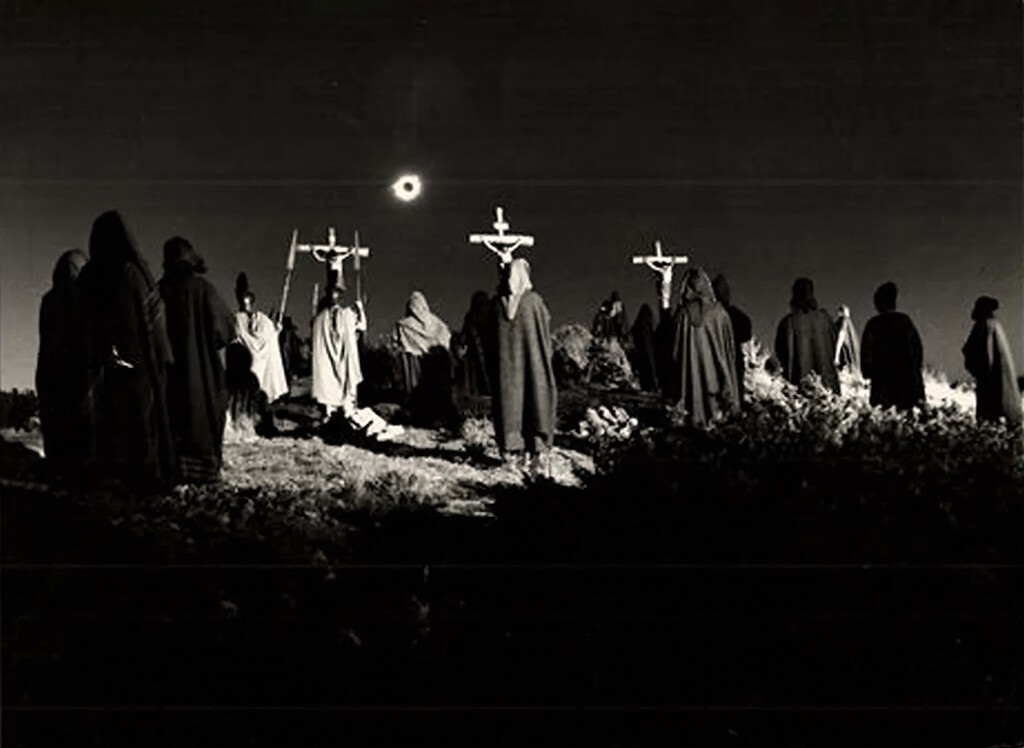
Fleischer had no precedent to follow. No feature film had ever incorporated a real total eclipse into a narrative scene. The team rehearsed meticulously, knowing that any technical hiccup would mean missing the shot entirely, as the next eclipse in that region wouldn't occur for decades.

Technical Improvisation Under Pressure
Tonti's decision to strip filters and maximize aperture was a calculated risk. Standard cinematography would have rendered the eclipse as a blown-out white disc, but he wanted the corona's ethereal glow and the sudden darkness to feel authentic. The gamble paid off: the footage shows a naturally darkening sky and a stark, unearthly light on the crucifixion set.
9,000 Extras and a 165-Second Sprint
The production employed a staggering 9,000 extras for the crucifixion sequence, dwarfing most biblical epics of the era. Coordinating that many people for a precisely timed event required military-style logistics, with assistants stationed along the hillside to relay cues as the moon's shadow approached.
Sources disagree on the number of cameras used. Some documentation cites three—a telephoto, a medium shot, and a pan—while later reports claim more than forty positioned across different exposures. The exact location is also debated: most accounts name Roccastrada, Tuscany, but some English-language reviews mention Nice, France. The sun's position in the final footage suggests the Italian site is more plausible.
What the Sequence Shows
The eclipse footage appears as the climax of the Calvary scene, around the 15-to-17-minute mark of the film. It depicts the crucifixion under a suddenly darkened sky, with the eclipse's corona providing a haunting backdrop that no studio lighting could replicate. The background to this story is set out in Total Solar Eclipse 2026: Spanish Village Prepares for. A related thread runs through Solar Eclipse Communal Magic: Cornwall's Skyward Moment. Earlier coverage in August 2027 Total Solar Eclipse in Spain: Viewing Guide shows how the argument developed.
Why the Gamble Mattered for Cinema
The Barabbas eclipse scene demonstrated that real astronomical events could be integrated into narrative filmmaking, paving the way for later productions that chased eclipses and other natural phenomena. It also highlighted the risks of practical effects in an era before CGI, when directors relied on ingenuity and split-second timing. A closer look at the same subject appears in Solar Eclipse in Cornwall: A Magical Communal Experience. Anyone following the wider picture can start with Solar Eclipse Viewing Tips from Real Observers. The same theme surfaces in Europe Solar Eclipse 2026: Rare Spectacle Draws Millions, which takes a different angle.
The production's chaotic nature extended beyond the eclipse. One actor reportedly lost his role after a handshake, and other setbacks plagued the shoot. Yet the eclipse sequence endures as a testament to what can be achieved when preparation meets a once-in-a-lifetime opportunity. Context on how this played out before sits in Solar Eclipse Night: A Social Phenomenon Despite Clouds. A companion piece, Solar Eclipse Night: Cloudy Skies Still a Phenomenon, approaches the same subject from another angle.
- The eclipse provided only 165 seconds of totality, forcing a single-take approach.
- 9,000 extras were coordinated for the crucifixion scene.
- Cinematographer Aldo Tonti removed filters and opened the aperture to capture the corona.
- Sources disagree on camera count and exact location, adding to the sequence's mystique.
- The footage appears around the 15–17 minute mark of the film.
| Aspect | Detail |
|---|---|
| Eclipse date | February 15, 1961 |
| Duration of totality | 165 seconds |
| Location (most cited) | Roccastrada, Tuscany, Italy |
| Extras | 9,000 |
| Cameras (disputed) | 3 to 40+ |
| Sequence placement | Calvary scene, ~15–17 minutes |
| Cinematographer | Aldo Tonti |
| Director | Richard Fleischer |
| Producer | Dino De Laurentiis |
FAQ
How long did the Barabbas crew have to film the eclipse?
They had exactly 165 seconds of totality, the maximum duration of the February 15, 1961 eclipse along its path. This left no room for retakes or technical errors.
Where was the Barabbas eclipse scene filmed?
Most sources say Roccastrada in Tuscany, Italy, though some English-language reviews mention Nice, France. The sun's position in the footage supports the Italian location.
How many extras were used for the crucifixion scene?
The production employed 9,000 extras, a massive logistical undertaking coordinated for the precisely timed eclipse shoot.
Why did the cinematographer remove filters?
Aldo Tonti removed filters and opened the aperture to capture the eclipse's corona and natural darkness, trusting the film stock to handle the unique light conditions.
Browse the Shop
 Acacia frida deluxe solid wood bed frame |
Bedroom bench |
Bed chest drawers |
Lingerie dresser |
Frame base |
Mirror with jewelry storage |
30 Bathroom Vanity |
Memory foam queen mattress |
Mattresses for back pain |
Nightstand set of 2 |
Grand Goldman Shop |
Civil Lawyer
Deutschland Trikot WM 2026







