

If you've ever felt that 90s TV was more optimistic than today's offerings, you're not alone—and there's data to back it up. A project by engineer Victoriano Izquierdo analyzed thousands of TV series and movies to quantify the shift from feel-good storytelling to darker, more complex narratives.
Using AI to classify shows based on their Wikipedia synopses, Izquierdo found that in the 1990s, nearly 50% of American TV series could be considered "feel good." Today, that number has plummeted to under 10%. The findings raise a pressing question: why has television lost its sunny disposition?
Find Original, High-end Home Decor that spark conversation at Grand Goldman Shop.
The Data Behind the Shift: From Feel-Good to Dark
Izquierdo's project, completed in a single day using his phone while caring for a baby, leveraged the AI model Claude Opus 5.5. He started with 1,958 TV series (600 Spanish) and 3,600 popular movies (2,922 appear in the explorer) from various eras. The AI scored each show on whether its protagonists conveyed peace, love, or a sense of belonging, and whether the stories inspired hope in people and society.
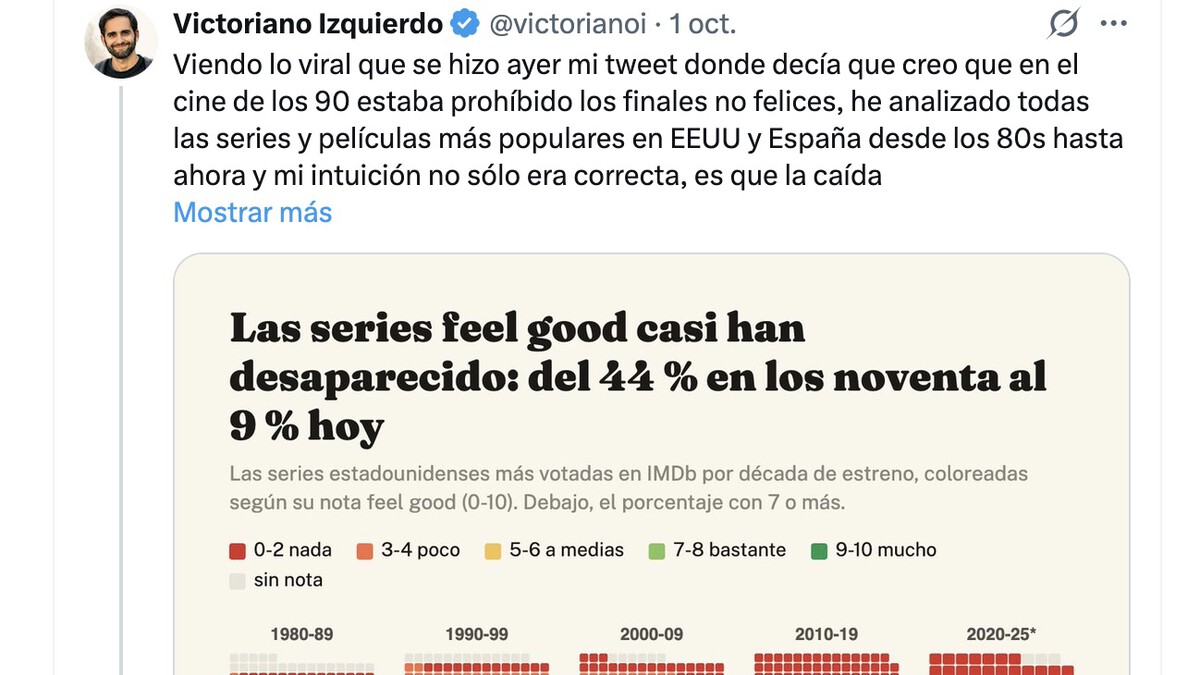
Two models independently rated each synopsis, and a third acted as an arbiter when there were significant disagreements. The results were striking: the proportion of feel-good series has shrunk dramatically over the decades. This isn't just nostalgia—it's a measurable trend.

Examples That Illustrate the Divide
To understand what the project measures, consider The Simpsons versus Rick and Morty. Both are animated sitcoms, but The Simpsons, especially in its early seasons, often ended on a note of family unity and optimism. Rick and Morty, while hilarious, is steeped in nihilism and existential dread. The AI would likely score them very differently on the feel-good scale.

Other examples abound: Friends and Full House from the 90s emphasized friendship and family warmth, while modern hits like Breaking Bad and Game of Thrones revel in moral ambiguity and brutal consequences. Even sitcoms have shifted—shows like BoJack Horseman blend humor with deep melancholy.
Why Did TV Become Darker?
Several factors contribute to this shift. First, the rise of cable and streaming has fragmented audiences, allowing for niche storytelling that explores darker themes. In the 90s, networks aimed for broad appeal, often favoring uplifting content that wouldn't alienate advertisers.
Second, societal changes play a role. The post-9/11 era brought a more cynical outlook, and the 2008 financial crisis further eroded optimism. Television reflects these anxieties, producing antiheroes and dystopian narratives that resonate with a more skeptical public. Context on how this played out before sits in Why 90s TV Was Optimistic and Today's Shows Are Darker.
Third, the prestige TV boom, kickstarted by The Sopranos, rewarded complexity and moral ambiguity. Critics and awards bodies celebrated shows that pushed boundaries, encouraging creators to explore the dark side of human nature. The background to this story is set out in Celebrity: latest articles. A related thread runs through Microdramas on Your Phone: The New Brain Drain.
What This Means for Viewers and the Industry
For viewers, the shift means fewer easy escapes. While dark shows can be deeply rewarding, they often require emotional investment and can leave us feeling drained. The scarcity of feel-good TV might explain why nostalgic reboots and comfort watches like The Office remain so popular—they fill a void. Earlier coverage in Freddie Meredith: From Bartender to SNL UK Breakout Star shows how the argument developed. A closer look at the same subject appears in Kiran Leonard on Surviving Teen Fame and Finding Full-Body Joy.
For the industry, the data suggests an opportunity. As streaming platforms compete for attention, feel-good content could be a differentiator. Shows like Ted Lasso have proven that optimism can be a hit, winning hearts and awards. Perhaps the pendulum will swing back as audiences tire of relentless grimness. Anyone following the wider picture can start with BBC Three and BBC Scotland TV Channels to Close Next Year. The same theme surfaces in TV Tech 2026: RGB Mini LED, Wireless Screens and AI Interfaces, which takes a different angle.
Key Takeaways
- In the 1990s, nearly 50% of American TV series were classified as feel-good; today, less than 10% are.
- The shift is driven by cable/streaming fragmentation, societal anxiety, and the prestige TV boom.
- Examples like The Simpsons vs. Rick and Morty illustrate the change in tone.
- Feel-good content still succeeds (e.g., Ted Lasso), suggesting room for optimism in today's landscape.
- Viewers increasingly seek comfort in nostalgia and rewatching old favorites.
Comparing Eras: Feel-Good TV Then vs. Now
| Era | Percentage of Feel-Good Series | Representative Shows |
|---|---|---|
| 1990s | ~50% | Friends, Full House, The Fresh Prince of Bel-Air |
| 2000s | ~30% | Gilmore Girls, Everybody Loves Raymond |
| 2010s | ~15% | Parks and Recreation, Brooklyn Nine-Nine |
| 2020s | <10% | Ted Lasso, Schitt's Creek (exceptions) |
Note: Percentages are approximate based on Izquierdo's analysis of American series.
FAQ
What is a "feel-good" TV series?
A feel-good TV series is one that conveys hope, warmth, and a sense of belonging. It often features characters who support each other and stories that leave viewers with a positive outlook on life and society.
How did the project classify TV shows as feel-good?
The project used AI models to analyze Wikipedia synopses. The models scored each show on whether its protagonists conveyed peace, love, or belonging, and whether the story inspired hope. Two models rated independently, and a third resolved disagreements.
Are there any modern feel-good shows?
Yes, shows like Ted Lasso, Schitt's Creek, and Abbott Elementary are contemporary examples that have found success. However, they are exceptions rather than the norm, as the overall percentage of feel-good series has declined.
Why do audiences still watch old feel-good shows?
Many viewers find comfort in nostalgia and predictable, uplifting narratives. In times of stress, rewatching familiar shows provides a sense of safety and relaxation, which darker modern series often don't offer.
Browse the Shop
 Acacia frida deluxe solid wood bed frame |
Bedroom bench |
Bed chest drawers |
Lingerie dresser |
Frame base |
Mirror with jewelry storage |
30 Bathroom Vanity |
Memory foam queen mattress |
Mattresses for back pain |
Nightstand set of 2 |
Grand Goldman Shop |
Civil Lawyer
Deutschland Trikot WM 2026










