

Spain is rotating clockwise, opposite to the rest of Europe, according to new geodetic research that sheds light on the geological forces shaping the Mediterranean. This rotation is part of a long-term plan: the closure of the Mediterranean Sea and the eventual union of the Iberian Peninsula with North Africa.
The study, conducted by researchers at the University of the Basque Country in collaboration with the universities of Palermo and Granada, analyzed geodetic data to confirm that the Iberian Peninsula is moving in a clockwise direction relative to stable Eurasia. This motion is driven by the convergence between the Eurasian and African plates, which are approaching each other at a rate of four to six millimeters per year.
Find Original Home Decor sparking conversation at Grand Goldman Shop.

Why Spain Is Moving Differently
The rotation of Spain and Portugal is a result of the complex interplay between the Eurasian and African plates. While the rest of Europe is generally moving eastward, the Iberian Peninsula is rotating clockwise, from east to west. This motion is not new, but the researchers have now precisely quantified the processes occurring at the diffuse boundary between the two plates in the western Mediterranean.
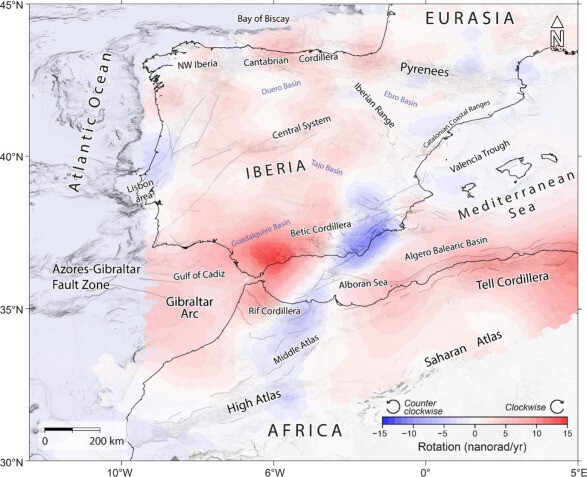
The convergence of the plates is slow, just a few millimeters per year, but over millions of years, it will have a profound impact on the geography of the region. The Mediterranean Sea is gradually closing, and in about 250 million years, another supercontinent, often called Pangea Ultima, will form. The Iberian Peninsula and Morocco will become a single unit.
The Role of Gibraltar and the Alboran Sea
The Strait of Gibraltar and the Alboran Sea play a crucial role in this tectonic drama. The researchers focused on the diffuse plate boundary in the western Mediterranean, where the convergence is accommodated by a combination of thrust faulting and strike-slip motion. The rotation of the Iberian Peninsula is a consequence of this complex deformation.
Understanding these processes is not just an academic exercise. It helps scientists better assess seismic hazards in the region and understand the long-term evolution of the Mediterranean. The study provides a more detailed picture of how the African and Eurasian plates interact, which is essential for modeling future geological changes. Context on how this played out before sits in Spain Rotates Clockwise as Mediterranean Nears Closure, Study Finds.
What This Means for Europe and Africa
In the short term, nothing will change for the people of Spain or Morocco. The movement is imperceptibly slow, and the Strait of Gibraltar will remain open for millions of years. However, the research highlights the dynamic nature of our planet and the forces that have shaped it over geological time. The background to this story is set out in Energy Utilities: latest articles. A related thread runs through Spain Heatwave Alert: AEMET Warns of 44°C Iberian Oven.
The findings also have implications for our understanding of plate tectonics in general. The Mediterranean is one of the most complex tectonic regions on Earth, and studies like this help refine models of continental deformation. The researchers used GPS and other geodetic techniques to measure the tiny movements of the Earth's crust, providing a snapshot of a process that will ultimately redraw the map of Europe and Africa. Earlier coverage in Spain's Heatwave Season Begins: Mediterranean Regions Face Growing Risk shows how the argument developed. A closer look at the same subject appears in Iberian Heatwaves Visualized as Ocean Waves Signal Escalating Climate Crisis.
Key Takeaways from the Study
- Spain and Portugal are rotating clockwise, opposite to the rest of Europe.
- The rotation is driven by the convergence of the Eurasian and African plates at 4-6 mm per year.
- The Mediterranean Sea is gradually closing, and in 250 million years, a new supercontinent will form.
- The Iberian Peninsula will eventually collide with North Africa, uniting the two landmasses.
- The study improves our understanding of seismic hazards and plate boundary processes.
Comparing Plate Movement Rates
| Plate Boundary | Convergence Rate (mm/year) | Key Feature |
|---|---|---|
| Eurasian-African (Western Mediterranean) | 4-6 | Clockwise rotation of Iberia |
| Eurasian-African (Central Mediterranean) | ~10 | Subduction beneath Italy |
| Indian-Eurasian | ~40-50 | Himalayan mountain building |
| Pacific-North American | ~50 | San Andreas Fault |
As the African plate continues to push northward, the Mediterranean will shrink. The rotation of the Iberian Peninsula is a small but significant part of this larger process. The research, published in a peer-reviewed journal, provides a new framework for understanding the kinematics of the western Mediterranean. Anyone following the wider picture can start with Kutxabank Fires Employee for Snooping on Client Salaries. The same theme surfaces in Data Center Water Use: Nixval CEO on the Real Impact of AI, which takes a different angle.
FAQ
Why is Spain rotating clockwise?
Spain is rotating clockwise due to the convergence between the Eurasian and African plates. The collision forces the Iberian Peninsula to rotate as the two plates press against each other.
Will the Mediterranean Sea disappear?
Yes, in about 250 million years, the Mediterranean will close as Africa collides with Europe. This will create a new supercontinent, often called Pangea Ultima.
How fast is the Iberian Peninsula moving?
The Iberian Peninsula is rotating at a rate of a few millimeters per year, driven by the 4-6 mm/year convergence of the Eurasian and African plates.
What does this mean for earthquakes in Spain?
The study helps scientists better understand the seismic hazards in the region by clarifying the deformation processes at the plate boundary. This can improve earthquake risk assessments.
Browse the Shop
 Acacia frida deluxe solid wood bed frame |
Bedroom bench |
Bed chest drawers |
Lingerie dresser |
Frame base |
Mirror with jewelry storage |
30 Bathroom Vanity |
Memory foam queen mattress |
Mattresses for back pain |
Nightstand set of 2 |
Grand Goldman Shop |
Civil Lawyer
Deutschland Trikot WM 2026







