

China is building a 14,000-ton crane that will require two units working together, a project by XCMG and Sinopec Heavy Lifting & Transportation in Xuzhou, Jiangsu province. The first of two main units was completed on August 28, 2026, marking a significant step toward a ring crane system designed to lift loads of up to 14,000 tons in its full configuration.
This development underscores China's continued push into mega-engineering, following iconic projects like the Three Gorges Dam and the Hong Kong-Zhuhai-Macao Bridge. The crane's dual-unit design is a novel approach to achieving unprecedented lifting capacity.
Find Original Home Decor sparking conversation at Grand Goldman Shop.

What Is the 14,000-Ton Ring Crane?
A ring crane is a type of heavy-lift equipment that uses a circular track to distribute weight and allow rotation. The XCMG-Sinopec crane is designed to lift 14,000 tons—equivalent to about 14,000 small cars—when both units operate in tandem.
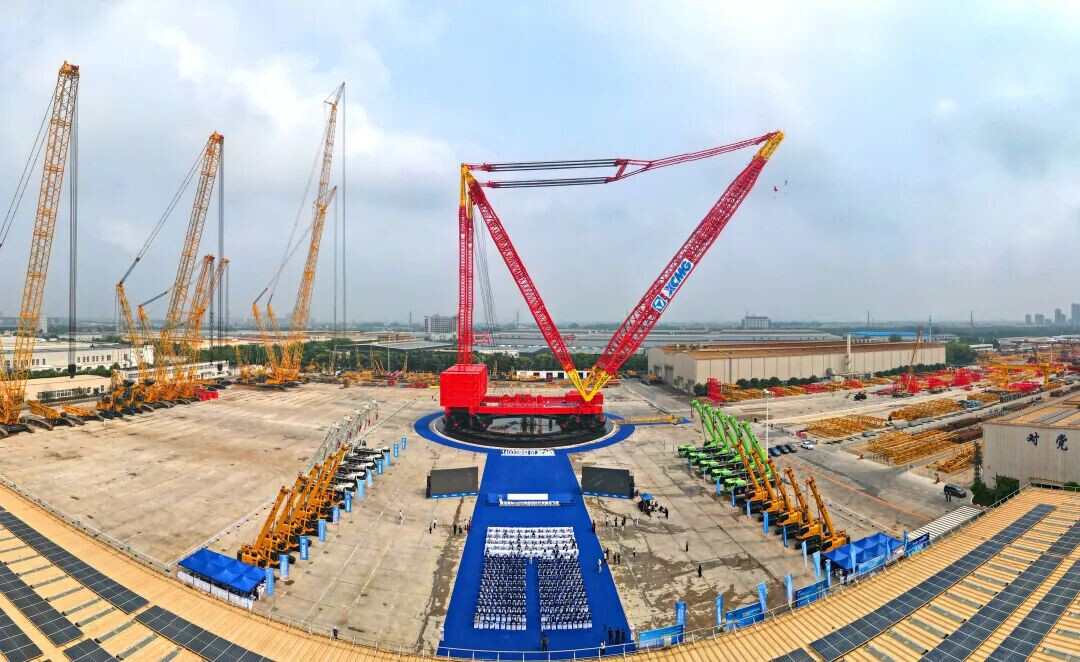
Each unit is a massive structure in its own right, but together they form a system capable of handling components for offshore platforms, nuclear reactors, and other mega-structures. The completion of the first unit signals that the project is moving from design to physical realization.
Why Two Units?
The dual-unit configuration is not merely for redundancy; it's a deliberate engineering choice to manage extreme loads. By splitting the lifting task between two coordinated units, the system can achieve greater stability and flexibility than a single monolithic crane.
This approach also allows for modular transport and assembly, which is crucial when dealing with equipment of this scale. The units can be shipped separately and assembled on-site, reducing logistical challenges.
Why This Crane Matters for Global Construction
As the world demands larger infrastructure—from offshore wind farms to next-generation nuclear plants—the need for equipment that can lift heavier modules is growing. The 14,000-ton crane will enable construction methods that were previously impossible, such as assembling entire sections of a facility on the ground and lifting them into place.
This can significantly reduce construction time and improve safety by minimizing work at height. It also opens doors for designing larger, more efficient structures.
- Unprecedented capacity: 14,000 tons is among the highest lifting capacities ever attempted.
- Dual-unit coordination: Two synchronized units work together to handle massive loads.
- Modular design: Units can be transported and assembled on-site.
- Enables mega-projects: Supports offshore platforms, nuclear modules, and more.
- Chinese engineering leadership: Demonstrates China's growing prowess in heavy machinery.
Technical Challenges and Solutions
Building a crane of this size involves overcoming numerous engineering hurdles. Structural integrity is paramount: the crane must withstand not only the weight of the load but also dynamic forces from wind and movement.
Control systems are equally critical. The two units must operate in perfect sync to avoid uneven load distribution, which could lead to catastrophic failure. Advanced sensors and real-time monitoring are likely integral to the design.
| Feature | Details |
|---|---|
| Lifting Capacity | 14,000 tons (combined) |
| Number of Units | 2 main units |
| First Unit Completed | August 28, 2026 |
| Location | Xuzhou, Jiangsu, China |
| Developers | XCMG and Sinopec Heavy Lifting & Transportation |
What Happens Next?
With the first unit assembled, attention turns to completing the second and integrating the system. Testing will be crucial to validate the dual-unit coordination and safety protocols.
Once operational, the crane is expected to be deployed on major projects, possibly including offshore oil and gas platforms or nuclear power plants. Its availability could influence project timelines and designs worldwide. The background to this story is set out in China's New Naval Monster: The Semi-Submersible Crane That Sinks to Work. A related thread runs through SpaceX Gigabay: 24 Work Zones, 400-Ton Cranes, 380 Feet Tall. Earlier coverage in China Builds Fake Ancient Towns to Attract Tourists shows how the argument developed.
Impact on the Heavy-Lift Industry
This project positions XCMG and Sinopec as leaders in ultra-heavy lifting. Competitors may need to innovate to keep pace, potentially leading to a new generation of mega-cranes. A closer look at the same subject appears in China's 40,000-Ton Amphibious Ship Launches Stealth Drone. Anyone following the wider picture can start with How does the alarm connected to the central unit (CRA) work?. The same theme surfaces in UK's Incoherent China Approach Plagued by Expertise Gap, which takes a different angle.
For project owners, the crane offers new possibilities for modular construction, which can reduce costs and risks. The ability to lift 14,000 tons in one go could simplify logistics and shorten schedules. Context on how this played out before sits in Crane Migration Spectacle: 180,000 Birds Create Oceanic Sound. A companion piece, China Builds 607-Hectare Artificial Island in South China Sea, approaches the same subject from another angle.
FAQ
What is the 14,000-ton crane used for?
It is designed for ultra-heavy lifts in mega-construction projects, such as offshore platforms, nuclear power plant modules, and large industrial facilities. Its capacity allows entire modules to be lifted into place, reducing on-site assembly time.
Why does it need two units?
Two units working together provide greater stability, flexibility, and load distribution than a single crane. This modular approach also simplifies transportation and assembly of the crane itself.
When will the crane be operational?
The first unit was completed in August 2026, but the second unit and integration are still underway. No official operational date has been announced, but testing will follow once both units are ready.
Who is building the crane?
XCMG, a leading Chinese construction machinery manufacturer, is collaborating with Sinopec Heavy Lifting & Transportation, a specialist in heavy transport and lifting.
Browse the Shop
 Acacia frida deluxe solid wood bed frame |
Bedroom bench |
Bed chest drawers |
Lingerie dresser |
Frame base |
Mirror with jewelry storage |
30 Bathroom Vanity |
Memory foam queen mattress |
Mattresses for back pain |
Nightstand set of 2 |
Grand Goldman Shop |
Civil Lawyer
Deutschland Trikot WM 2026







