

Japanese scientists have developed a method to create lunar fertilizer using only air, water, and electricity, potentially enabling agriculture on the Moon. This breakthrough could allow future lunar colonists to grow their own food, reducing reliance on Earth supplies.
Why Lunar Farming Is a Challenge
Transporting heavy supplies to the Moon is expensive and unsustainable for long-term settlements. Once initial supplies run out, colonists would need to produce food locally. However, lunar soil, known as regolith, lacks essential nutrients for plant growth, particularly nitrogen.
Find Original Home Decor sparking conversation at Grand Goldman Shop.

Regolith is composed of crushed rock and dust, with none of the organic matter that makes Earth's soil fertile. Without added nutrients, crops cannot thrive. The Japanese team's innovation addresses this by providing a key missing ingredient: nitrate.
The Science Behind Plasma-Activated Fertilizer
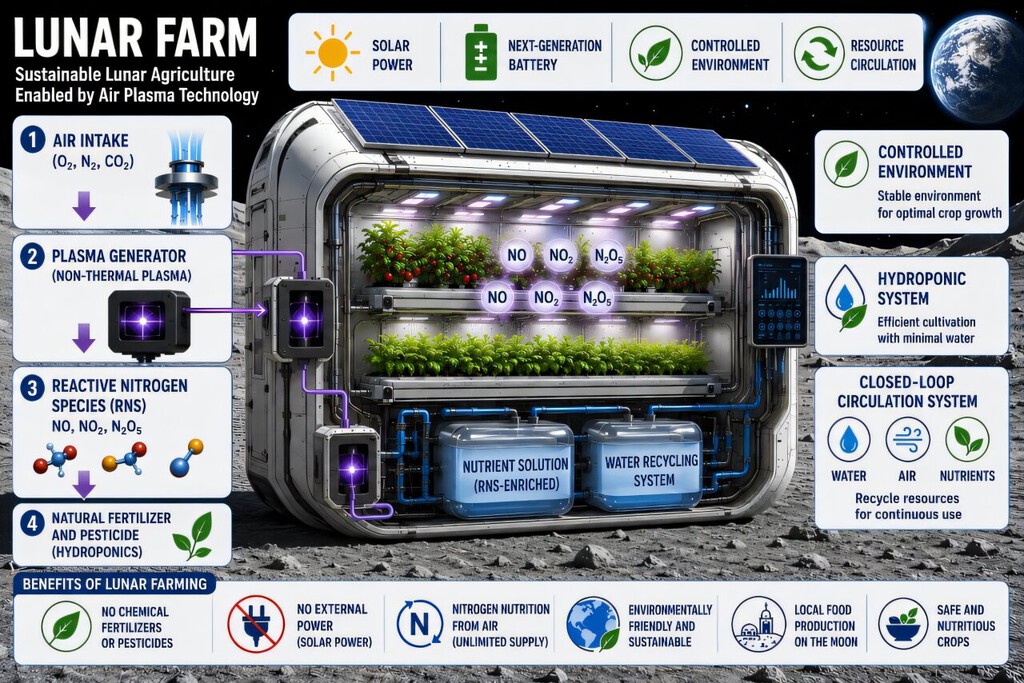
Researchers from Tohoku University and JAXA, the Japanese space agency, have devised a technique that mimics natural nitrogen fixation. They expose atmospheric air to plasma, an ionized gas created by applying electricity. This causes nitrogen and oxygen in the air to react and form dinitrogen pentoxide.
When dissolved in water, dinitrogen pentoxide converts into nitrate, a nitrogen ion that plants can absorb directly. Fertile Earth soils are rich in nitrate, but lunar regolith is not. By adding this plasma-generated nitrate, regolith can be transformed into a viable growing medium.
A Sustainable Cycle for Space Colonies
The process requires only air, water, and electricity—resources that could be available on the Moon. Air can be extracted from lunar habitats, water ice exists in shadowed craters, and electricity can be generated via solar panels. This creates a potentially self-sustaining cycle for fertilizer production.
How the Fertilizer Is Made
The team's method involves three key steps:
- Plasma generation: Air is exposed to an electrical discharge to create plasma.
- Chemical reaction: Nitrogen and oxygen in the air combine to form dinitrogen pentoxide.
- Dissolution: The gas is bubbled through water to produce nitrate solution.
- Application: The nitrate solution is mixed with regolith to create fertile soil.
This straightforward process could be scaled up for lunar agriculture, using minimal equipment.
Comparison with Earth Fertilizers
Traditional fertilizers rely on ammonia production via the Haber-Bosch process, which requires high temperatures and pressures. The plasma method operates at ambient conditions, making it more suitable for space.
| Factor | Plasma Fertilizer | Haber-Bosch |
|---|---|---|
| Inputs | Air, water, electricity | Natural gas, nitrogen, catalysts |
| Conditions | Ambient temperature and pressure | High temperature and pressure |
| Suitability for Moon | High | Low |
| Energy source | Solar electricity | Fossil fuels |
This table highlights why plasma-based fertilization is a game-changer for extraterrestrial agriculture.
Implications for Future Lunar Colonies
If successful, this technology could support food production for astronauts and settlers, reducing mission costs and increasing self-sufficiency. It also aligns with NASA's Artemis program and international efforts to establish a permanent lunar presence. The longer history behind the story is traced in Japanese Scientists Create Lunar Fertilizer Using Air and Plasma.
Growing food on the Moon would require controlled environments like greenhouses, but the fertilizer provides the necessary nutrients. The team's next steps likely involve testing the fertilizer on actual regolith simulant and eventually on the Moon. The background to this story is set out in DIY Plant Feed: Make Your Own Nutrient-Rich Fertilizer from Weeds. A related thread runs through DIY Plant Feed: Make Your Own Fertilizer from Garden Weeds. Earlier coverage in NASA and IBM Create AI to Find Lunar Ice and Craters shows how the argument developed.
Challenges and Considerations
While promising, several hurdles remain. The process needs a reliable power source, and the nitrate solution must be applied in the right concentration. Also, regolith contains other harmful elements like perchlorates, which may need removal. A closer look at the same subject appears in MIT has developed a new type of gel that can turn air into drinkable water. Anyone following the wider picture can start with Science: latest articles. The same theme surfaces in Lunar Cement Survives Space Conditions, Tests Confirm, which takes a different angle.
Moreover, the long-term effects of plasma-treated regolith on plant health are unknown. Further research will determine the optimal conditions and whether this method can sustain multiple crop cycles. Context on how this played out before sits in Fusion Scientists Solve Long-Standing Tokamak Plasma Mystery. A companion piece, Space Airbag: 400-Ton Plasma Shield Against Solar Storms, approaches the same subject from another angle.
FAQ
How does the plasma fertilizer work?It uses plasma to ionize air, causing nitrogen and oxygen to form dinitrogen pentoxide, which dissolves in water to create nitrate—a key plant nutrient.
It uses plasma to ionize air, causing nitrogen and oxygen to form dinitrogen pentoxide, which dissolves in water to create nitrate—a key plant nutrient.
Why is nitrate important for lunar farming?Nitrate is a form of nitrogen that plants can absorb. Lunar regolith lacks sufficient nitrate, so adding it enables plant growth.
Nitrate is a form of nitrogen that plants can absorb. Lunar regolith lacks sufficient nitrate, so adding it enables plant growth.
Can this method be used on Earth?Yes, the technology could potentially be adapted for sustainable agriculture on Earth, especially in areas with limited resources.
Yes, the technology could potentially be adapted for sustainable agriculture on Earth, especially in areas with limited resources.
What are the next steps for this research?The team plans to test the fertilizer on lunar regolith simulants and optimize the process for future space missions.
The team plans to test the fertilizer on lunar regolith simulants and optimize the process for future space missions.
Browse the Shop
 Acacia frida deluxe solid wood bed frame |
Bedroom bench |
Bed chest drawers |
Lingerie dresser |
Frame base |
Mirror with jewelry storage |
30 Bathroom Vanity |
Memory foam queen mattress |
Mattresses for back pain |
Nightstand set of 2 |
Grand Goldman Shop |
Civil Lawyer
Deutschland Trikot WM 2026







