

NASA is about to send three fully autonomous robots to the Moon for the first time, marking a major leap in space exploration. The CADRE mission will deploy a trio of suitcase-sized rovers that can make their own decisions without human input.
Unlike previous lunar rovers that were remotely controlled by humans, these robots will operate almost entirely on their own. They will be given a target and then decide how to reach it, what to explore, and how to work together.
Find Original, High-end Home Decor that spark conversation at Grand Goldman Shop.
What Is the CADRE Mission?
CADRE stands for Cooperative Autonomous Distributed Robotic Exploration. It is a NASA project designed to test how multiple robots can collaborate on the Moon without direct human control.
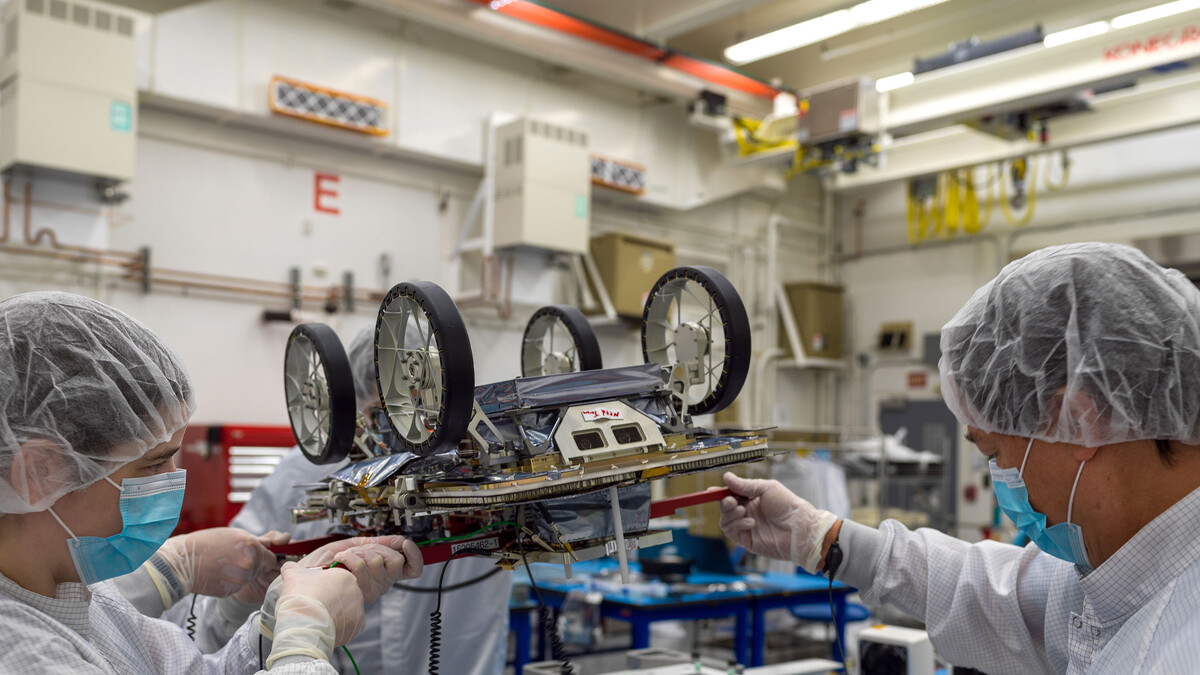
The mission will send three rovers, each about the size of a carry-on suitcase, to the lunar surface. Each rover has four wheels and is equipped with two stereo cameras, navigation sensors, and a multistatic ground-penetrating radar to map the terrain in 3D.
This is the first time NASA has placed rovers on the Moon, and the first time any space agency has deployed a team of fully autonomous robots to another world.
How the Autonomous Rovers Work
The CADRE rovers are designed to operate as a team. They will communicate with each other and make decisions collectively, such as how to divide the area to explore and how to avoid obstacles.
Each rover is powered by solar panels and has onboard computing to process data in real time. This allows them to react to their environment without waiting for instructions from Earth, which is crucial because of the communication delay between Earth and the Moon.
The rovers will use their radar to study the lunar subsurface, helping scientists understand the structure and composition of the Moon's surface.
Why This Mission Matters
Autonomous robots could revolutionize space exploration by reducing the need for constant human oversight. This is especially important for future missions to distant destinations like Mars, where communication delays are much longer.
By testing these technologies on the Moon, NASA can prepare for more complex missions. The CADRE mission will also demonstrate how multiple robots can work together to cover more ground and gather more data than a single rover.
Additionally, the mission will provide valuable data about the lunar surface, which is essential for planning future human missions and potential resource extraction.
Key Features of the CADRE Rovers
- Fully autonomous operation: The rovers can make decisions without human input, from navigation to data collection.
- Team collaboration: They communicate and coordinate to optimize their exploration.
- Advanced sensors: Each rover has stereo cameras and ground-penetrating radar for 3D mapping.
- Compact size: About the size of a carry-on suitcase, making them lightweight and efficient.
- Solar-powered: They rely on solar energy to operate during the lunar day.
Comparison with Previous Lunar Rovers
| Mission | Country | Autonomy Level | Status |
|---|---|---|---|
| Lunokhod 1 | USSR | Remotely controlled | Inactive |
| Yutu-2 | China | Remotely controlled | Possibly active |
| CADRE (three rovers) | USA | Fully autonomous | Upcoming |
While previous rovers like the Soviet Lunokhod and China's Yutu-2 were controlled by humans, the CADRE rovers will operate independently. This represents a significant shift in how we explore space. Context on how this played out before sits in NASA Sends Three Fully Autonomous Robots to the Moon.
What to Watch Next
The launch of the CADRE mission is expected soon. Once on the Moon, the rovers will begin their exploration, and scientists will monitor their progress to see how well the autonomous systems perform. The background to this story is set out in Science: latest articles. A related thread runs through China's Launch Surge: 4 Rockets in 45 Hours Rivals SpaceX.
Success with CADRE could lead to more autonomous missions to the Moon and beyond. It could also pave the way for swarms of robots that can explore vast areas without human intervention. Earlier coverage in Lyon-Turin Alpine Tunnel: Why Europe's Mega Project Is Delayed shows how the argument developed. A closer look at the same subject appears in BioWare Closure Marks End of Western RPG Era Under Saudi-Owned EA.
As space agencies and private companies look to return to the Moon and eventually go to Mars, autonomous robotics will play a crucial role. The CADRE mission is a step toward that future. Anyone following the wider picture can start with Tom Cruise's Edge of Tomorrow Sequel: What We Know So Far. The same theme surfaces in Realme 16 Pro 5G Harry Potter Edition: Limited Fan Smartphone, which takes a different angle.
FAQ
What is the CADRE mission?
What is the CADRE mission?
CADRE is a NASA mission that will send three fully autonomous rovers to the Moon to test cooperative exploration technologies.
How do the CADRE rovers work?
How do the CADRE rovers work?
The rovers are equipped with cameras, sensors, and radar. They communicate with each other and make decisions autonomously to explore the lunar surface.
Why are autonomous robots important for space exploration?
Why are autonomous robots important for space exploration?
Autonomous robots can operate without human control, which is essential for distant missions where communication delays are significant. They can also cover more ground and gather more data.
When will the CADRE mission launch?
When will the CADRE mission launch?
The launch is expected soon, though NASA has not announced a specific date. The mission will be a precursor to future autonomous exploration.
Browse the Shop
 Acacia frida deluxe solid wood bed frame |
Bedroom bench |
Bed chest drawers |
Lingerie dresser |
Frame base |
Mirror with jewelry storage |
30 Bathroom Vanity |
Memory foam queen mattress |
Mattresses for back pain |
Nightstand set of 2 |
Grand Goldman Shop |
Civil Lawyer
Deutschland Trikot WM 2026










