

Apple has introduced a touchscreen MacBook Pro, a move that directly contradicts Steve Jobs' famous 2010 dismissal of touch on laptops. The announcement, made by John Ternus, Apple's senior vice president of hardware engineering, signals a new era for the Mac and offers insight into the company's evolving design philosophy.
Jobs' Original Argument Against Touchscreen Macs
In October 2010, Steve Jobs famously projected an image of a hand touching a laptop screen and explained why Apple had rejected the idea. "Touch surfaces don't want to be vertical," he said, citing user testing that showed arm fatigue after extended use. For fifteen years, that principle guided the MacBook's design, keeping touchscreens off Apple's laptops.
Find Original Home Decor sparking conversation at Grand Goldman Shop.

Jobs' stance was rooted in ergonomics and user experience. He argued that vertical touchscreens led to discomfort and that the Mac was optimized for indirect input, such as a trackpad or mouse. This philosophy became a cornerstone of Apple's product strategy, influencing generations of MacBooks.
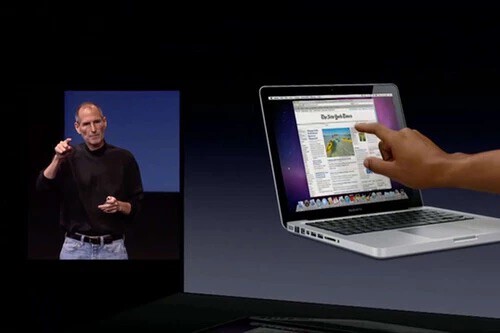
Ternus' Justification: The OLED Breakthrough
John Ternus, who has been with Apple since 2001 and became head of hardware engineering in 2021, presented the new touchscreen MacBook Pro this Wednesday. In an interview with Steven Levy of Wired, Ternus explained that the core principle remains the same: the Mac is primarily an indirect-input device. However, the conclusion has changed.
According to Ternus, Apple needed to reach a point where adding touch would not compromise the product in any way—neither weight nor thickness. That became possible with OLED technology featuring an integrated touch sensor. The result is a MacBook Pro that is fully optimized for indirect input but also offers touch as a seamless addition. As Ternus put it, "all of this and, oh yes, it's also touch."
What Changed Since 2021?
In 2021, Ternus told Joanna Stern that the Mac was optimized for indirect input and that Apple saw no reason to change that. Five years later, the principle remains, but the conclusion has flipped. The key difference is technological maturity. The OLED display with an integrated touch sensor allows Apple to add touch without the drawbacks Jobs originally identified.
This shift reflects Apple's ability to iterate and adapt when technology catches up with user needs. It also highlights Ternus' leadership style: grounded in engineering realities, willing to revisit past decisions when the time is right. The background to this story is set out in Apple's October 28 Event: New MacBook Pro With Touchscreen. A related thread runs through Apple's First Touchscreen MacBook Pro: OLED and Illuminated Logo Return. Earlier coverage in MacBook Pro Touchscreen Costs €3,349 in Spain: €1,020 More Than Non-Touch shows how the argument developed.
Implications for the Mac Lineup and Apple's Strategy
The introduction of a touchscreen MacBook Pro could reshape how users interact with macOS. While the Mac remains optimized for indirect input, touch adds a new layer of flexibility, particularly for creative professionals and casual users alike. It also aligns with broader industry trends, where touchscreens have become standard on Windows laptops and 2-in-1 devices. A closer look at the same subject appears in MacBook Pro M5 vs Touchscreen Model: Which Apple Laptop Wins. Anyone following the wider picture can start with Apple's Touchscreen MacBook Pro: The iPad's Decade-Long Identity Crisis. The same theme surfaces in Apple's 2026 Touchscreen MacBook: What to Expect From the Event, which takes a different angle.
However, Apple's approach is distinct: rather than designing a tablet-first device, it has integrated touch into a traditional laptop form factor without sacrificing performance or portability. This could set a new benchmark for what users expect from a premium laptop. Context on how this played out before sits in Apple's Next Launch: Touchscreen MacBook and OLED iPad Mini. A companion piece, Apple's M6 iMac and MacBook Pro: Price Is the Bitter Pill, approaches the same subject from another angle.
Key Takeaways
- Steve Jobs rejected touchscreen Macs in 2010 due to ergonomic concerns and user testing.
- John Ternus announced a touchscreen MacBook Pro, citing OLED technology with integrated touch sensors as the enabler.
- The core principle remains: Mac is optimized for indirect input, but touch is now added without compromise.
- Ternus' leadership emphasizes engineering-driven decisions and adaptability.
- The move could influence future Mac designs and user expectations.
Comparison: Jobs vs. Ternus on Touch
| Aspect | Steve Jobs (2010) | John Ternus (2025) |
|---|---|---|
| Position on touch | Rejected due to ergonomic issues | Embraced as additive feature |
| Core principle | Touch surfaces don't want to be vertical | Mac is optimized for indirect input |
| Technology enabler | None available | OLED with integrated touch sensor |
| User impact | Arm fatigue | No compromise in weight or thickness |
FAQ
Why did Steve Jobs oppose touchscreen Macs?
Steve Jobs opposed touchscreen Macs because user testing showed that vertical touch surfaces caused arm fatigue. He believed the Mac was better suited for indirect input like a trackpad.
What technology enabled the touchscreen MacBook Pro?
The touchscreen MacBook Pro was made possible by OLED display technology with an integrated touch sensor, which allows touch functionality without adding weight or thickness.
Does the touchscreen MacBook Pro compromise on weight or thickness?
No, according to John Ternus, the integration of touch via OLED technology ensures that the MacBook Pro remains as thin and light as previous models.
How does this change Apple's design philosophy?
It shows Apple's willingness to adapt when technology matures, while maintaining its core principle of optimizing for indirect input. Touch is now an added feature, not a replacement.
Browse the Shop
 Acacia frida deluxe solid wood bed frame |
Bedroom bench |
Bed chest drawers |
Lingerie dresser |
Frame base |
Mirror with jewelry storage |
30 Bathroom Vanity |
Memory foam queen mattress |
Mattresses for back pain |
Nightstand set of 2 |
Grand Goldman Shop |
Civil Lawyer
Deutschland Trikot WM 2026







