

Extremadura has just kicked off the campaign for one of the crops in which it stands out not only nationally but also at the European level: tobacco. In recent days, seedlings have begun leaving nurseries for the regions where about 98% of all 'tobacco made in Spain' is concentrated.
The news is interesting not only for what it means for areas like Campo Arañuelo, La Vera, Alagón, Talayuela, and Navalmoral de la Mata, where tobacco farmers work. This year the sector is also drawing attention due to the context, marked by two seemingly contradictory factors: uncertainty and an increase in both cultivated hectares and contracted merchandise.
Find Original Home Decor sparking conversation at Grand Goldman Shop.

More Hectares, More Uncertainty: The Tobacco Paradox
So, will more be cultivated? Yes. Coinciding with the start of the Extremadura campaign, the National Federation of Tobacco Growers confirmed to the Efe Agro agency a few days ago that this year 6,496 hectares will be planted, almost 7% more than last year. The figure is still far from the area cultivated at the beginning of the last decade, when Spain exceeded 10,000 hectares, but it maintains the growth trend of recent years.
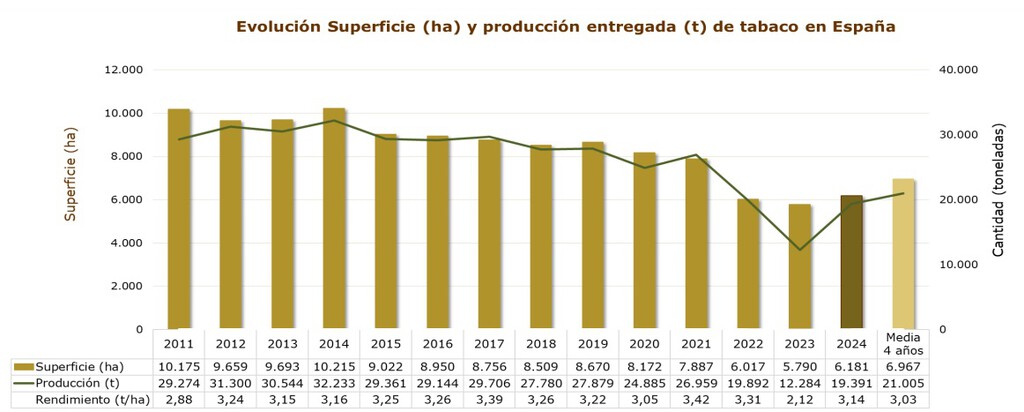
In fact, it surpasses the data from 2022, 2023, and 2024 recorded by the Government. Awaiting the final balance for 2025, last year the sector reported an area of 6,400 hectares nationwide.
Why the Increase Despite Market Risks?
The increase comes amid a complex market situation. Tobacco is one of the most regulated and controversial crops, subject to strict health policies and changing demand. However, farmers in Extremadura continue to bet on it due to several factors:
- Tradition and expertise: Extremadura has a long history of tobacco cultivation, with know-how passed down through generations.
- Contract security: Most tobacco is grown under contract with companies, providing a guaranteed buyer.
- Rural employment: The crop supports thousands of families in rural areas with few alternatives.
- EU subsidies: Although decoupled from production, EU aid remains a factor in the sector's stability.
- Quality demand: Spanish tobacco is valued for its quality, especially for cigar wrappers.
The Regions Behind Spain's Tobacco
The tobacco campaign is concentrated in specific areas of Extremadura, particularly in the provinces of Cáceres and Badajoz. The comarcas of Campo Arañuelo, La Vera, Alagón, Talayuela, and Navalmoral de la Mata are the heart of production.
These regions have the right soil and climate conditions for tobacco, and the crop is a key economic driver. In Talayuela, for example, tobacco has historically been the main source of income for many families.
Comparing Tobacco Cultivation in Spain
To understand the current situation, it's useful to look at how tobacco cultivation has evolved in Spain over recent years. The table below shows the area planted and the trend.
| Year | Hectares Cultivated | Change vs. Previous Year |
|---|---|---|
| 2021 | ~10,000 (early decade) | — |
| 2022 | Data not specified | — |
| 2023 | Data not specified | — |
| 2024 | ~6,400 | — |
| 2025 | 6,496 | +7% |
Note: The data for 2022 and 2023 are not detailed in the source, but the 2025 figure exceeds those years according to the Government. Context on how this played out before sits in Sony WH-1000XM5 at Half Price: Top Noise-Cancelling Headphones Deal. A companion piece, Extremadura Doubles Down on Tobacco: Spain's Risky Crop Bet, approaches the same subject from another angle.
What This Means for Farmers and the Region
The increase in hectares is a double-edged sword. On one hand, it shows confidence in the crop and provides economic stability for rural areas. On the other, it comes at a time when the tobacco industry faces long-term decline due to health regulations and changing consumer habits. The background to this story is set out in Trending: latest articles. A related thread runs through Spain's Pistachio Industry Poised for Major Global Opportunity.
Farmers are aware of the risks but argue that alternatives are scarce. Tobacco provides a reliable income in areas where other crops are less profitable. Moreover, the sector has been modernizing and improving quality to stay competitive. Earlier coverage in Renta 2025 by Phone: Key Dates and How to Book Your Appointment shows how the argument developed. A closer look at the same subject appears in Spain Tax Return 2025: Key Dates for 2026 Filing Campaign.
Challenges Ahead
The main challenges include adapting to EU regulations, which may reduce support in the future, and finding new markets. Additionally, climate change poses a threat to tobacco, which is sensitive to temperature and rainfall variations. Anyone following the wider picture can start with Spain's Olive Oil Crisis: 75% of Groves Now Produce at a Loss. The same theme surfaces in Spain's Water Wars: Supreme Court Ruling on Tajo-Segura Transfer, which takes a different angle.
FAQ
How many hectares of tobacco will be planted in Spain in 2025?
According to the National Federation of Tobacco Growers, 6,496 hectares will be planted in 2025, almost 7% more than the previous year.
Where is tobacco grown in Spain?
About 98% of Spain's tobacco is grown in Extremadura, particularly in the comarcas of Campo Arañuelo, La Vera, Alagón, Talayuela, and Navalmoral de la Mata.
Why is tobacco cultivation increasing despite uncertainty?
Farmers continue to plant tobacco because it offers contract security, rural employment, and tradition, even though the long-term market outlook is uncertain due to health regulations.
What are the main challenges for tobacco farmers in Extremadura?
Challenges include adapting to EU regulations, potential reductions in support, climate change impacts, and finding new markets as demand evolves.
Browse the Shop
 Acacia frida deluxe solid wood bed frame |
Bedroom bench |
Bed chest drawers |
Lingerie dresser |
Frame base |
Mirror with jewelry storage |
30 Bathroom Vanity |
Memory foam queen mattress |
Mattresses for back pain |
Nightstand set of 2 |
Grand Goldman Shop |
Civil Lawyer
Deutschland Trikot WM 2026







