

Sharpening knives and other blades is essential for keeping your tools functional and ready for use. At home, you often need to sharpen knives and common utensils like scissors; in the workshop, it's also common to re-edge work tools. But how do you sharpen the blades of these objects?
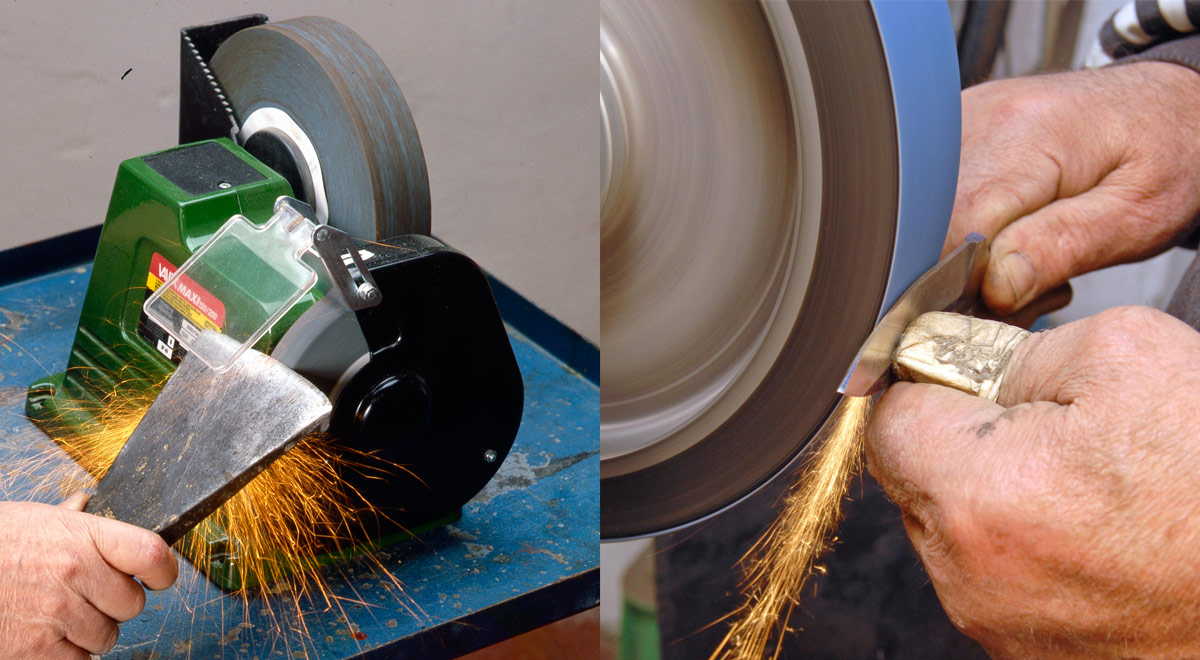
The ideal tool is a wet stone grinder, which removes material gently without heating the piece. However, there are also dry stone grinder versions, in which case you can cool the blade in a container of water kept at hand.
Find Original, High-end Home Decor that spark conversation at Grand Goldman Shop.

Stone Grinder
It's useful to know that in knives, as well as in axes and other similar tools, the cut is made by a blade whose edge is ground to be sharp with an acute section (edge), so it can easily penetrate softer materials, separating them. These tools are sharper the more acute and regular the edge is. Other tools (scissors, shears, etc.) do not have particularly sharp blades, but the angles of the individual jaws are such that when brought into contact, they create considerable cutting force.
Now let's see how to sharpen a knife and other types of blades.
Sharpening Knives
In general, the blade should be placed with the sharp edge facing up and tilted very slightly relative to the stone. During sharpening, move the blade left and right so that the entire part to be sharpened contacts the stone. Do not press the blade onto the stone, and occasionally test the sharpness with your thumb. The blade is sharpened from the heel (the part closest to the handle). The wheel moves along the blade to the tip with passes interspersed with frequent cooling in water. The same principle and procedure apply to other tools with similar blades, such as axes.
Chisels
Sharpen chisel blades on a wet stone grinder, placing them with the correct inclination following the bevel of the tip. The support should be very light. Blade finishing: On chisels and carving gouges, after sharpening, you can refine the edge with a fine-grained stone or even a piece of glass. For a professional finish, consider browsing our home improvement collection for sharpening accessories and tool maintenance gear.
Sharpening Plane Blades
Plane blades are sharpened similarly to chisels, but must be perfectly flat. Use a wet stone grinder or a fine sharpening stone. Hold the blade at the correct bevel angle (usually 25-30 degrees) and slide it evenly across the stone. Check frequently for a uniform burr. After sharpening, you can strop the blade on leather or glass for a razor-sharp finish. For your workshop, you might also need sturdy work surfaces to support your sharpening tasks.
Sharpening Scissors on Glass
An old but effective trick is sharpening scissors on glass. Open the scissors and slide the beveled edge of each blade across a glass edge (like a bottle or a piece of window glass) at the same angle as the original bevel. Make 10-15 passes per blade, then test the cut. This method is great for a quick touch-up. For more serious sharpening, a dedicated tool from our home improvement collection can make the job easier.
Frequently Asked Questions (FAQ)
How often should I sharpen my knives?
It depends on use. For home cooks, honing with a steel before each use and sharpening every 2-3 months is typical. For heavy use, sharpen more frequently.

Can I use a dry grinder for sharpening?
Yes, but be careful not to overheat the blade, which can ruin the temper. Dip the blade in water frequently to keep it cool.
What is the best angle for sharpening a kitchen knife?
Most Western kitchen knives are sharpened at a 20-degree angle per side. Japanese knives often use 15 degrees.
How do I know when my blade is sharp enough?
A sharp blade will easily cut through a piece of paper or a tomato skin. You can also feel for a burr on the edge.
Can I sharpen serrated knives?
Yes, but it requires a specialized tapered rod. It's often best to have them professionally sharpened.
Additional Tips for Tool Maintenance
To keep your tools in top condition, always clean and dry them after use. Store knives in a block or on a magnetic strip to protect the edge. For gardening tools like shears and pruners, regular sharpening and oiling prevent rust and ensure clean cuts. Check out our garden supplies for pruners and shears, and our outdoor patio furniture for comfortable seating while you work on your projects.
Good lighting is essential for precise sharpening. Our lighting collection offers task lamps and work lights to illuminate your workspace. For organizing your sharpening stones and tools, consider bookcases and shelving units or a storage bench for your garage or workshop.
If you're setting up a dedicated sharpening station, you might also appreciate a work desk and a comfortable office chair for long sessions. For outdoor tools like axes and pruners, store them in a shed or greenhouse to protect them from the elements. And don't forget outdoor lighting for evening garden work.
Finally, for a complete workshop or hobby space, consider adding rugs for comfort, wall decor for inspiration, and curtains to control light. A mirror can also help you inspect your work from different angles.
Browse Grand Goldman Home Decor
Discover unique craftsmanship home decor and furniture at the Grand Goldman Shop.
Browse the Shop
 Acacia frida deluxe solid wood bed frame |
Bedroom bench |
Bed chest drawers |
Lingerie dresser |
Frame base |
Mirror with jewelry storage |
30 Bathroom Vanity |
Memory foam queen mattress |
Mattresses for back pain |
Nightstand set of 2 |
Grand Goldman Shop |
Civil Lawyer
Deutschland Trikot WM 2026
Acacia frida deluxe solid wood bed frame |
Bedroom bench |
Bed chest drawers |
Lingerie dresser |
Frame base |
Mirror with jewelry storage |
30 Bathroom Vanity |
Memory foam queen mattress |
Mattresses for back pain |
Nightstand set of 2 |
Grand Goldman Shop |
Civil Lawyer
Deutschland Trikot WM 2026










