

The glutes are one of the muscle groups we tend to undervalue the most, beyond being a mere "aesthetic" muscle, which is why they are often not given the importance (in terms of physical activity in the gym) they truly deserve. Today we present a series of exercises to help you get them in shape for this summer at the beach.
Squat

The squat isn't only useful for building strength in our legs, but it can be a wonderful ally for shaping and adding volume to our glutes, perhaps not with the classic squat but rather through its variations.
Find Bleeding Edge Supplements at Scandalous Prices on iHerb.

One of these variations is the sumo-style dumbbell squat on steps: to perform it, we need two steps on which we will place our feet (one foot on each step) and between which we should leave a small gap to place the dumbbell upright. Standing on the steps, we will grip the dumbbell by one end with both hands (a kettlebell can also work, in which case we grip it by the handle).
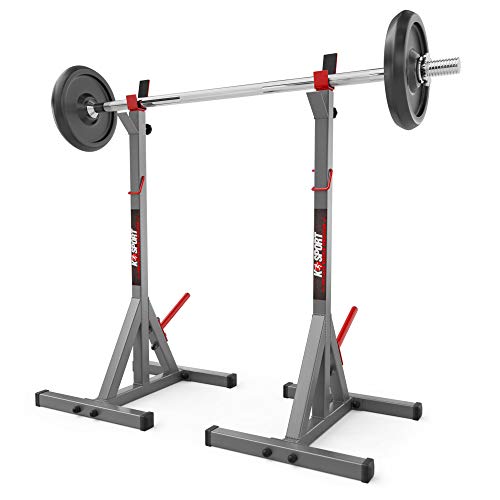
K-Sport - Olympic squat stand - Adjustable weight stand for home training
As with any squat, we must be very careful with our back posture to avoid arching and increasing the risk of injury. Additionally, we must keep in mind that this variation can increase the range of motion, and the greater the range of motion, the greater the gluteal activation.
So, once the dumbbell is held, the goal is to perform the same squatting movement as in the classic style until we are completely upright. Ideally, when lowering the dumbbell or kettlebell, it should not touch the ground, so we must adjust the height of the steps.
Glute Bridge

Another classic exercise that couldn't be missing from this post is the glute bridge, which, as its name suggests, is focused primarily on working our glutes. The basic movement involves lying on our back with knees bent and the soles of our feet flat on the floor. From this position, we should perform a hip raise, contracting the glutes at the top of the movement.
To progress, we can use a TRX or core sliders to perform the exercise. The TRX will be a great ally as we'll be incorporating the instability component into this exercise, which will force our gluteus medius to work harder on stabilization.
Another way to add difficulty or intensity to our workout would be performing this exercise on one leg. This is an ideal way to correct potential muscle imbalances between one leg and the other.
Glute Kickback

To perform this exercise, we will need a cable machine (although it can also be done without equipment and just using our body weight), as this is where we can most easily perform it. Additionally, we will need the ankle strap to place on the sole of our foot.
Once positioned facing the cable machine, we will place the strap on our foot over the instep (some gyms have specific "straps" for placing your feet in) and perform a backward kick with the leg (some also say it's like giving a mule kick).
To ensure this exercise primarily involves our glutes, we must make sure that the movement of the leg originates from the hip and glute rather than being a knee flexion. Also, since it's another unilateral exercise, it will allow us to correct imbalances.
Box or Step-Ups

Although the primary target muscle of this exercise is the quadriceps, step or box ups will allow us to focus the work on a very important muscle for our lower body: the gluteus medius. Often, when we lose our balance, this can be caused by a weak gluteus medius, so strengthening this muscle will help us improve our balance and prevent accidental falls.
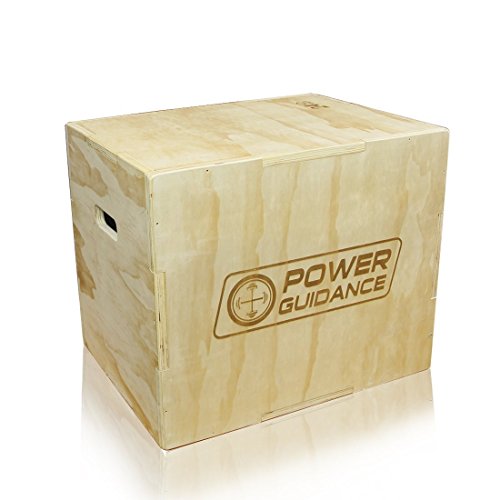
POWER GUIDANCE 3-in-1 wooden plyometric box - Ideal for cross training - 40/35/30CM, Plyo wooden box, Plyo Box
To perform it, we only need a step, a box, or a chair (if doing this exercise in our living room): positioned facing the step or box, we will place one of our feet on it (the smaller the surface area of the foot supported, the more instability we will generate). We'll place our arms at both sides of our body, as they will also help us stabilize and maintain balance.
Next, we will try to step up, bringing the knee of the leg that was on the floor towards our chest and return to the floor. Ideally, we should perform this movement in one fluid motion, but if we find it too difficult, we can place the foot on the chair and lower in two stages until we are able to do it continuously.
Lunge or Bulgarian Split Squat

You can find this exercise referred to by either of these two names, as in English it's very common to see it called the Bulgarian split squat. You can also find the exercise referenced as "lunges".
The most basic way to perform the exercise is starting from a standing position with hands at your sides and taking a step forward into a lunge so that the knee of the leading leg is bent at approximately 90 degrees. From here, we can progress to different variations:
- Free lunge (no weight) with foot resting on a bench or step.
- Free lunge with TRX.
- Free lunge with fitball: this differs from the bosu lunge in that the foot we rest on the fitball is the one placed behind.
- Free lunge with bosu: the foot we rest on the bosu is the front foot, which forces greater stabilization work from the gluteus medius.
- Dumbbell lunge: this exercise also has several ways to perform it: we can hold the dumbbell against our chest with both hands, have a dumbbell in each hand, hold just one dumbbell with the hand on the side of the leg that stays back...
- Barbell lunge: we will start from a classic position as if we were going to perform a squat, but instead, we will perform a lunge. Obviously, the weight should be considerably less than what we would use for the squat.
Hip Thrust

Possibly, this is the most effective exercise of all the ones we can name. However, it's an exercise where, like the deadlift, technique is crucial.
As we can see in the image, the green lines indicate the correct posture: knees at 90 degrees in the final position of the movement and the neck-hip-knee axis forming a straight line. On the other hand, the red dotted line points out the most common mistake of this exercise: flexing the neck, which implies excessive tension in the muscles of that area.
The sequence for this exercise is as follows: we start seated on the floor with our back against the edge of the bench and knees bent. As we perform a hip raise, our shoulders should move onto the bench, as seen in the image (the position of the arms will be whatever is most comfortable for us, as long as we don't use them to assist the movement). Upon reaching the point of maximum hip elevation, we will contract the glutes for one or two seconds and return to the starting position.
The recommendation is to start performing this exercise with just our body weight and gradually add extra weight.
"The Dog" (Fire Hydrant)

This exercise has a fairly simple mechanism: starting from a quadruped position, we will raise one of our legs with the knee bent at approximately 90 degrees, as seen in the image above. We must try to avoid arching or hunching our back at all times to prevent injuries.
From this position, we will perform an abduction movement with the raised leg, similar to when a dog urinates.
Bonus track: The Deadlift

We wanted to add one last exercise, even though it's outside the main category of glute exercises, given its impact on the entire posterior chain and its multiple benefits: the deadlift. This exercise will allow us to work our entire posterior chain (from the shoulders to the lower body) and it's also one of the great exercises that shouldn't be missing from any routine.

C.P. Sports Weight plates for barbell, Olympic, 50 mm, rubber, 5 mm, for weights of 5, 10, 15, 20 kg, 5 kg - Paar
Starting from a standing position, in this case with a dumbbell in each hand, we should begin by performing a hip hinge movement while sliding the dumbbells down our legs. When the dumbbells pass our knees, we should perform a slight bend in them (this will reduce the tension generated in the hamstring and lower back). Our final position should be, as we see in the image, with our back as neutral as possible, avoiding arching it. From here, we will return to the starting position.
This exercise can be performed with dumbbells, a barbell, plates, a kettlebell, or even with resistance bands. The range of options will allow us to prevent our routine from becoming boring and monotonous.
Home Decor Shop
 Acacia frida deluxe solid wood bed frame |
Bedroom bench |
Bed chest drawers |
Lingerie dresser |
Frame base |
Mirror with jewelry storage |
30 Bathroom Vanity |
Memory foam queen mattress |
Mattresses for back pain |
Nightstand set of 2 |
Grand Goldman Shop |
Civil Lawyer
Deutschland Trikot WM 2026
Acacia frida deluxe solid wood bed frame |
Bedroom bench |
Bed chest drawers |
Lingerie dresser |
Frame base |
Mirror with jewelry storage |
30 Bathroom Vanity |
Memory foam queen mattress |
Mattresses for back pain |
Nightstand set of 2 |
Grand Goldman Shop |
Civil Lawyer
Deutschland Trikot WM 2026










