

Countries with the most battle tanks are led by China, which fields 5,870 tanks, according to a new graphic from Visual Capitalist based on Global Firepower data updated to this year. The ranking reveals a surprising third-place entry: North Korea, a country that has long prioritized armored forces despite economic constraints.
Since their debut on World War I battlefields, tanks have symbolized land power. World War II saw them star in major battles and stratagems that remain legendary. Today, conflicts like the war in Ukraine show that while technologically imposing, tanks are also highly vulnerable to a new enemy: drones.
Find Original, High-end Home Decor that spark conversation at Grand Goldman Shop.
Yet tanks remain a key element in national defense, and this graphic shows which countries continue to bet on tanks as the core of their ground forces. Most countries provide official figures for their forces (since, like nuclear weapons, tanks serve as a deterrent), but there is also room for estimation.
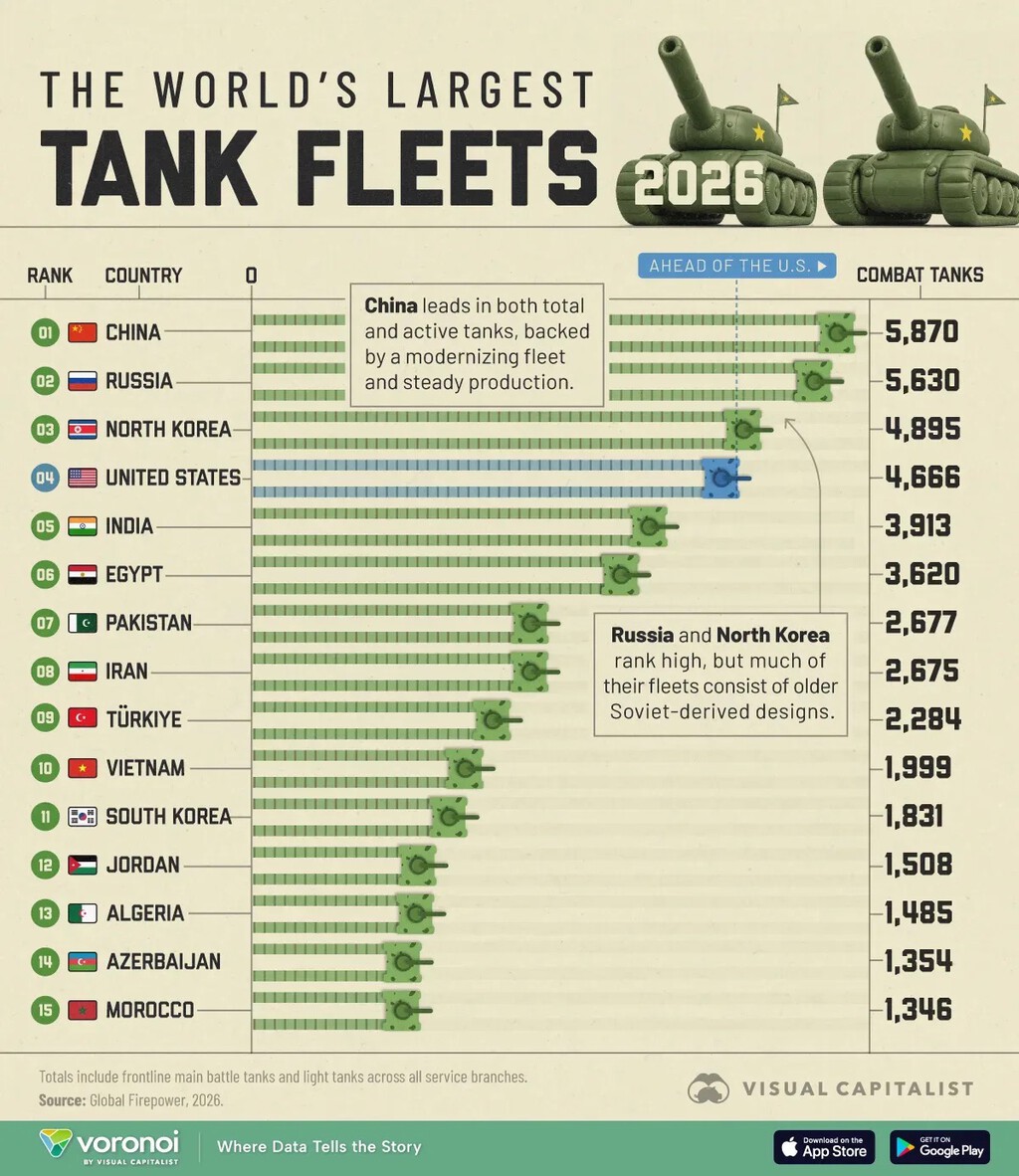
China Leads the Global Tank Rankings
China has become the spearhead in terms of tank numbers, with 5,870 tanks. Its main battle tank is the Type-99, a third-generation tank that is not the most numerous in its ranks but is the most advanced in operation.

The Type-99 represents China's push toward modernization, blending firepower, protection, and mobility. While older models like the Type-96 still form the bulk of the fleet, the Type-99 signals China's ambition to field a world-class armored force.
China's top position reflects its broader military modernization drive, which has seen significant investment in land, sea, and air capabilities. The country's tank fleet is the largest in the world, and its emphasis on indigenous production means it can sustain and expand this force independently.
North Korea's Surprising Podium Finish
North Korea comes in third, a surprising placement given its limited resources. The country has long maintained a massive armored force, largely consisting of older Soviet-era designs and local variants. Despite international sanctions and economic struggles, North Korea has continued to prioritize its military, including its tank fleet.
This ranking underscores North Korea's focus on conventional forces as a deterrent and its willingness to allocate significant resources to defense. The exact number of tanks is estimated, as North Korea does not release transparent military data, but the figure places it ahead of many larger and wealthier nations.
Why Tank Numbers Still Matter
Despite the rise of drones and precision weapons, tanks remain a critical component of ground warfare. They provide mobile protected firepower, essential for breaking through enemy lines and holding territory. The war in Ukraine has shown both the vulnerabilities and the enduring utility of tanks.
Countries continue to invest in tanks because they offer a combination of firepower, protection, and mobility that few other systems can match. However, the threat from drones and anti-tank guided missiles has forced militaries to adapt tactics and upgrade defenses, including active protection systems and improved armor.
The ranking also highlights the disparity in military capabilities. While China and North Korea field massive tank fleets, many advanced militaries focus on quality over quantity, investing in fewer but more sophisticated platforms.
Key Takeaways from the Global Tank Ranking
- China leads with 5,870 tanks, showcasing its massive land force modernization.
- North Korea's third-place ranking reflects its prioritization of conventional forces despite economic challenges.
- Tank numbers remain a key metric of ground power, but modern warfare increasingly values technology and survivability.
- Drones and precision weapons pose new threats, pushing militaries to adapt tactics and upgrade defenses.
- Data transparency varies, with some countries providing official figures and others relying on estimates.
How the Top Tank Fleets Compare
| Country | Number of Tanks | Main Battle Tank | Notes |
|---|---|---|---|
| China | 5,870 | Type-99 | Largest fleet; Type-99 most advanced |
| Russia | ~12,000 (estimated) | T-90, T-72 variants | Large but varying readiness |
| North Korea | ~6,000 (estimated) | Chonma-ho, Songun-ho | Older designs, massive numbers |
| United States | ~5,500 | M1 Abrams | High quality, advanced tech |
| India | ~4,500 | T-90, Arjun | Mix of imported and domestic |
Note: Figures for Russia and North Korea are estimates due to limited transparency. The table is based on available data and may not reflect exact operational numbers. The longer history behind the story is traced in Spanish Island with Castle Near Madrid Lists for €3.25 Million.
What to Watch Next
As military technology evolves, the role of tanks will continue to adapt. The integration of unmanned systems, active protection systems, and advanced sensors will shape future tank designs. Countries like China and Russia are already developing next-generation tanks, while the United States and European nations focus on upgrading existing fleets. The background to this story is set out in Trump Deportation Policy: Supreme Court Battle Over Third-Country. A related thread runs through Typhoon Saudel Forces Mass Evacuations in Southeast China. Earlier coverage in Country Diary: Butterflies, Battle Re-enactments, and Ancient Oaks shows how the argument developed.
The balance between quantity and quality will remain a key debate. While massive fleets like North Korea's can overwhelm opponents, advanced militaries argue that superior technology and training can offset numerical disadvantages. The war in Ukraine has provided a testing ground for these theories, with both sides adapting rapidly. A closer look at the same subject appears in Australia Warns China: No Bullying Over Provocative Military. Anyone following the wider picture can start with Australia Warns China: No Bullying Over Provocative Actions. The same theme surfaces in Australia Warns China: No Bullying Amid Military Buildup, which takes a different angle.
For now, the tank remains a symbol of land power, and the countries that invest in them signal their intent to maintain a strong ground force. As the graphic shows, the race for armored dominance is far from over. Context on how this played out before sits in US Military Power Limits: Iran Conflict Lessons. A companion piece, Why US Military Power Not Enough: Trump Pauses Iran Attacks, approaches the same subject from another angle.
FAQ
Which country has the most battle tanks?
China has the most battle tanks, with 5,870 according to Global Firepower data. Its fleet includes the advanced Type-99 and numerous older models.
Why is North Korea ranked so high in tank numbers?
North Korea has prioritized its military and maintains a large fleet of mostly older tanks. Despite economic challenges, it allocates significant resources to conventional forces.
Are tanks still relevant in modern warfare?
Yes, tanks remain crucial for ground operations, providing mobile protected firepower. However, they face new threats from drones and precision weapons, requiring upgrades and tactical adaptations.
How reliable are the tank numbers?
Data varies: some countries publish official figures, while others rely on estimates. Global Firepower compiles available data, but exact numbers can be uncertain, especially for closed regimes.
Browse the Shop
 Acacia frida deluxe solid wood bed frame |
Bedroom bench |
Bed chest drawers |
Lingerie dresser |
Frame base |
Mirror with jewelry storage |
30 Bathroom Vanity |
Memory foam queen mattress |
Mattresses for back pain |
Nightstand set of 2 |
Grand Goldman Shop |
Civil Lawyer
Deutschland Trikot WM 2026










