

Spain's car age map reveals a stark divide: the average passenger car is 14.6 years old, but some provinces like Madrid enjoy much newer vehicles while Ourense struggles with an aging fleet. This visualization, created by Cartografía Digital using data from the DGT and ANFAC, highlights the contrasts in vehicle age across the country.
The map uses a traffic-light color scheme with five age intervals, from blue (young) to red (old), ranging from 11.4 to 17.2 years. Nationally, nearly a third of vehicles are over 20 years old, a figure ANFAC's director general José López-Tafall called "concerning." Compared to Europe's average of 12.7 years (according to ACEA), Spain lags behind, though disparities exist across the continent as well.
Find Original, High-end Home Decor that spark conversation at Grand Goldman Shop.
Why Car Age Matters for Spain's Economy and Safety
Vehicle age is more than a statistic; it reflects economic vitality, environmental impact, and road safety. Older cars tend to have higher emissions and fewer safety features, posing risks to occupants and pedestrians. They also require more frequent repairs, which can burden low-income households.
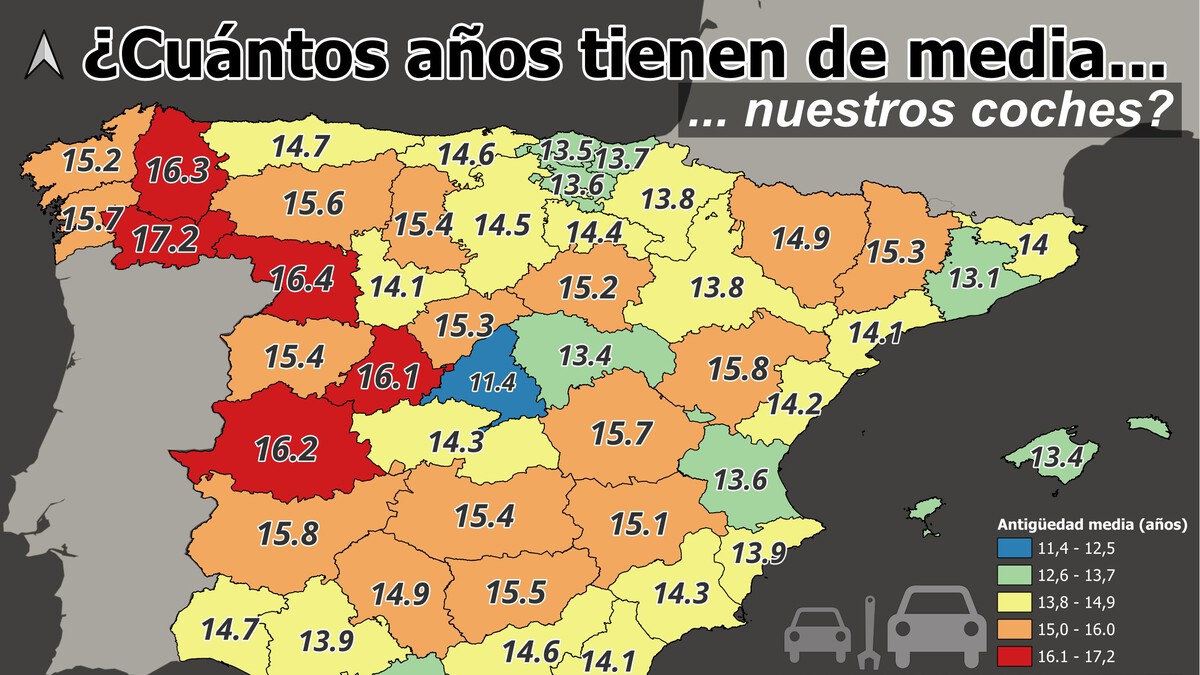
In Spain, the average car age has been rising steadily since the 2008 financial crisis, as new car sales plummeted and drivers held onto their vehicles longer. The map shows that this trend is not uniform: provinces with stronger economies, like Madrid, have younger fleets, while rural and economically lagging areas like Ourense have older ones.
Madrid: An Oasis of Newer Cars
Madrid stands out as an exception, with an average car age well below the national figure. This is likely due to higher incomes, a concentration of company cars, and policies that encourage fleet renewal, such as Madrid Central's low-emission zone. The city's residents also have better access to public transport, which may reduce the need for older, cheaper cars.
However, even within Madrid, disparities exist between the affluent north and the less wealthy south. The map's granularity by province masks intra-provincial differences, but the overall pattern is clear: economic prosperity correlates with newer vehicles.
Ourense: Resistance to Renewal
Ourense, in Galicia, has one of the oldest car fleets in Spain, with an average age approaching 17 years. This reflects the province's aging population, lower average income, and rural character, where long distances make car ownership essential but new car purchases less affordable.
Similar patterns appear in other inland and northern provinces, such as Lugo, Zamora, and Teruel. These areas face depopulation and limited economic opportunities, making it hard for residents to invest in newer, safer, and cleaner vehicles.
- National average: 14.6 years for passenger cars in 2025.
- Nearly one-third of vehicles are over 20 years old.
- Madrid has the youngest fleet, thanks to higher incomes and low-emission zones.
- Ourense has one of the oldest fleets, linked to rurality and lower incomes.
- Europe's average is 12.7 years, putting Spain behind.
How Spain Compares to Europe and the World
Spain's car fleet is older than the European average, but it's not alone. Countries like Greece and Estonia also have aging fleets, while Norway and Germany boast younger ones. The contrast with Norway is particularly striking: electric vehicles are widespread there, thanks to generous incentives, while Spain's EV adoption remains slow.
Globally, Spain's situation is middling. In Shenzhen, China, electric cars and motorbikes dominate, reflecting aggressive government push for electrification. In contrast, Spain's older fleet slows the transition to cleaner mobility, as older cars are more polluting and less efficient.
| Province | Average Car Age (years) | Category |
|---|---|---|
| Madrid | ~11.4 | Young (blue) |
| Barcelona | ~13.0 | Moderate (green) |
| Valencia | ~14.0 | Moderate (yellow) |
| Ourense | ~17.2 | Old (red) |
| Spain average | 14.6 | — |
What's Driving the Divide?
Several factors explain the provincial differences. First, income levels: wealthier provinces can afford new cars, while poorer ones rely on used vehicles. Second, urbanization: cities with good public transport may have lower car ownership overall, but those cars tend to be newer. Third, policy: local incentives for scrapping old cars or buying electric vehicles can accelerate renewal.
Fourth, demographics: aging populations in rural areas tend to hold onto cars longer. Finally, the used car market: in areas with low demand for new cars, the used market thrives, keeping older cars in circulation.
The Environmental and Safety Implications
Older cars emit more CO2 and pollutants like NOx and particulate matter, contributing to air quality problems. They also lack modern safety features such as electronic stability control, advanced airbags, and driver-assistance systems. This puts drivers and pedestrians at greater risk, especially in rural areas where roads may be less safe.
From an economic perspective, an aging fleet means higher fuel consumption and maintenance costs for owners. It also slows the adoption of electric vehicles, as consumers are less likely to switch from an old gas car to a new EV if they can't afford it.
What Can Be Done to Renew Spain's Fleet?
Policy interventions can help. Scrappage schemes, where the government pays owners to trade in old cars for newer, cleaner ones, have been used in various countries. Spain has had such programs, but they've been limited in scope and funding. Expanding them, especially targeting low-income households in rural areas, could accelerate renewal. Anyone following the wider picture can start with Spain's Car Age Map: Madrid's New Cars vs Ourense's Old Fleet. The same theme surfaces in A-76 Highway: 20 Years On, Still Zero Miles Open to Traffic, which takes a different angle.
Another approach is to promote electric vehicles through purchase subsidies, tax breaks, and charging infrastructure. However, these measures often benefit urban, wealthier drivers more than rural ones. A more equitable strategy might include support for used EV purchases or community car-sharing schemes in depopulated areas. The background to this story is set out in Car: latest articles. A related thread runs through Huawei Watch 6 Pro Review: A Premium Smartwatch With a Rival at Home.
Finally, improving public transport in rural areas could reduce dependence on old cars. But given the dispersed population, this is challenging and costly. Earlier coverage in Medieval English Expats in Rome: The First Community Near the Vatican shows how the argument developed. A closer look at the same subject appears in RTX 5060 Gaming Laptops: Best MediaMarkt VAT-Free Day Deals.
FAQ
What is the average age of cars in Spain?
As of 2025, the average age of passenger cars in Spain is 14.6 years, according to data from the DGT and ANFAC. This is higher than the European average of 12.7 years.
Why does Madrid have newer cars than Ourense?
Madrid has higher average incomes, more company cars, and policies like low-emission zones that encourage fleet renewal. Ourense, being rural and with an aging population, has lower incomes and less access to new car financing, leading to an older fleet.
How does Spain's car age compare to other countries?
Spain's average car age of 14.6 years is higher than the European average of 12.7 years. It is lower than Greece's but higher than Germany's. Countries like Norway have much younger fleets due to high EV adoption.
What are the consequences of an aging car fleet?
An aging fleet leads to higher emissions, poorer safety, and greater maintenance costs. It also slows the transition to electric vehicles and can exacerbate economic disparities between regions.
Understanding these regional contrasts is key to designing effective policies. As Spain grapples with the twin transitions of decarbonization and digitalization, addressing the age of its car fleet will be crucial for achieving climate goals and ensuring safe, affordable mobility for all.
Browse the Shop
 Acacia frida deluxe solid wood bed frame |
Bedroom bench |
Bed chest drawers |
Lingerie dresser |
Frame base |
Mirror with jewelry storage |
30 Bathroom Vanity |
Memory foam queen mattress |
Mattresses for back pain |
Nightstand set of 2 |
Grand Goldman Shop |
Civil Lawyer
Deutschland Trikot WM 2026










