

Carbon capture technology has long faced a troubling trade-off: turning CO2 into stone underground requires massive amounts of water—between 20 and 50 times the mass of the CO2 being stored. But a new industrial-scale study published in Nature demonstrates that it's possible to petrify carbon dioxide without wasting a single drop of freshwater.
The research, conducted in western Saudi Arabia by an international team from Iceland, Saudi Arabia, and Italy, upends assumptions about the water footprint of carbon mineralization. It shows that fractured volcanic rocks can serve as a viable storage site, even in arid regions lacking traditional saline aquifers.
Find Original Home Decor sparking conversation at Grand Goldman Shop.

The Water Problem That Plagued Carbon Capture
Mineralizing CO2—essentially turning it into rock—has been touted as a permanent storage solution. However, the process demands enormous volumes of water to facilitate the chemical reactions that lock carbon into solid form. In water-scarce regions, this has been a dealbreaker.
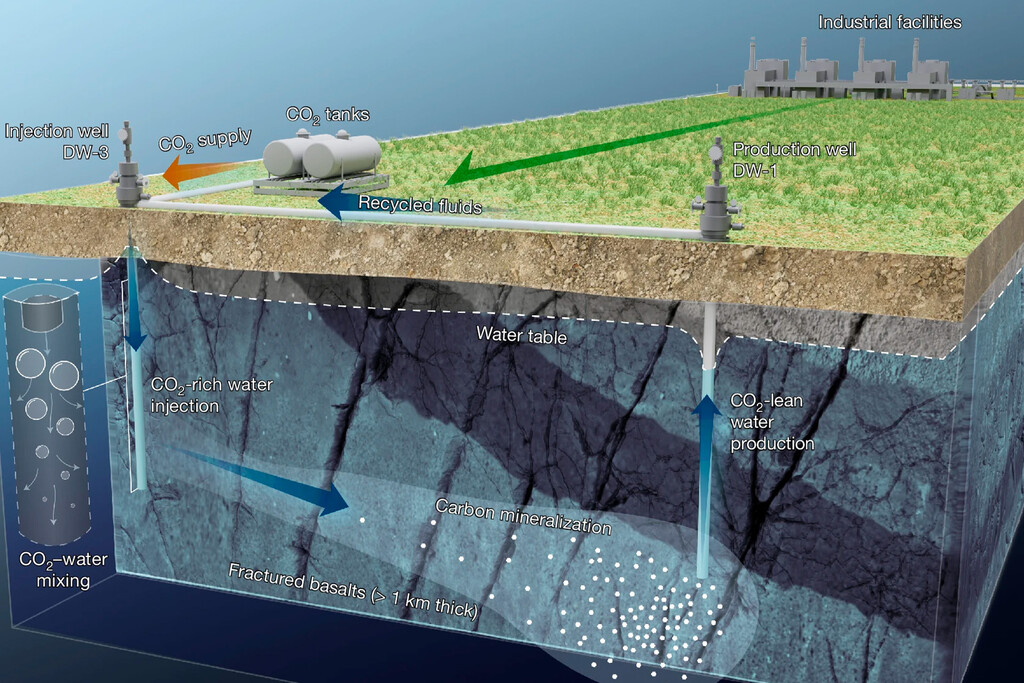
Previous projects typically relied on deep saline aquifers or sedimentary traps, which are not available everywhere. The new study tackled this limitation head-on by finding a way to use existing groundwater or seawater, avoiding competition with drinking water supplies.
Inside the Saudi Basalt Breakthrough
The team focused on a massive basaltic rock formation about 24 kilometers from the Jazan Economic City and Refinery. These volcanic rocks, fractured and between 21 and 30 million years old, provided the perfect conditions for CO2 injection.
Unlike sedimentary rocks, basalts are rich in calcium, magnesium, and iron, which react with CO2 to form stable carbonate minerals. The fractures create pathways for the CO2 to spread and react, while the rock itself acts as a natural reactor.
The study demonstrated that by using water already present in the formation—or by using seawater—the need for external freshwater is eliminated. This is particularly crucial in Saudi Arabia, where desalination plants and refineries emit significant CO2 but freshwater is scarce.
Why This Location Matters
The Jazan region hosts heavy industry, including refineries and desalination facilities, which are major CO2 emitters. Traditional carbon capture and storage (CCS) would require pipelines to distant aquifers. The basalt formation sits right beneath the industrial zone, reducing transport costs and infrastructure needs.
Moreover, the area lacks the saline aquifers typically used for CO2 injection. The basalt offers an alternative that turns a geological liability into an asset.
How the Process Works Without Freshwater
The key is to use the water that is already in the basalt pores or to inject seawater. When CO2 is dissolved in water, it forms carbonic acid, which then reacts with the basaltic minerals to precipitate carbonate minerals like calcite.
This process, known as mineral trapping, permanently locks the carbon in solid form. The study showed that the water can be recycled or that seawater can be used without harming the rock's reactivity.
By avoiding freshwater, the technology becomes viable in arid regions and reduces the overall environmental footprint of carbon capture.
- Carbon mineralization typically requires 20-50 times more water than the CO2 mass stored.
- The Saudi study used fractured basalt 24 km from Jazan refinery to store CO2.
- Seawater or in-situ water eliminated the need for external freshwater.
- The basalt formation is 21-30 million years old and rich in reactive minerals.
- This approach could enable carbon capture in water-scarce regions worldwide.
Comparing Carbon Storage Methods
Different geological storage options have distinct requirements and trade-offs. The table below summarizes key characteristics.
| Storage Method | Water Requirement | Geological Availability | Permanence |
|---|---|---|---|
| Saline Aquifer | High (20-50x CO2 mass) | Limited to sedimentary basins | High (trapping mechanisms) |
| Basalt Mineralization (new) | Low (seawater or in-situ) | Widespread volcanic regions | Very high (solid minerals) |
| Depleted Oil/Gas Fields | Low | Limited to hydrocarbon provinces | Medium (leakage risk) |
Implications for Global Carbon Capture
This breakthrough could unlock carbon capture in regions previously deemed unsuitable due to water scarcity. Countries with abundant basalt—such as Iceland, India, and parts of the United States—could adopt similar approaches.
The study also highlights the importance of site-specific solutions. Rather than relying on a one-size-fits-all approach, the researchers adapted the technology to local geology and resources.
As carbon capture scales up, minimizing water use will be critical to gaining public acceptance and meeting sustainability goals. This study provides a proof-of-concept that industry can sequester carbon without exacerbating water stress.
What to Watch Next
The next step is to scale the project and monitor long-term storage security. The team will need to verify that the CO2 remains locked in minerals over decades and centuries. The background to this story is set out in Europe Opens Its Largest Carbon Capture Plant in the Netherlands. A related thread runs through Carbon Capture: A Fig Leaf for Fossil Fuel Expansion. Earlier coverage in Carbon Capture Spending: Campaigners Urge Chancellor to Cut £24bn shows how the argument developed.
Regulatory frameworks will also need to adapt to this new method. Current CCS regulations often focus on saline aquifers, so basalt storage may require new guidelines. A closer look at the same subject appears in Carbon Capture: Fig Leaf for Fossil Fuel Expansion Exposed. Anyone following the wider picture can start with Energy Utilities: latest articles. The same theme surfaces in Russia, Saudi Arabia, Australia Top CO2 Exporters in History, which takes a different angle.
Finally, cost will determine adoption. The study suggests that using seawater and local rock could reduce costs, but further economic analysis is needed. Context on how this played out before sits in Chernobyl Wildlife Cameras Capture Russia's Invasion.
FAQ
How does carbon mineralization work in basalt?
CO2 is dissolved in water and injected into fractured basalt. The acidic solution reacts with calcium, magnesium, and iron in the rock to form solid carbonate minerals, permanently storing the carbon.
Why is water use a concern for carbon capture?
Traditional mineralization requires 20-50 times more water than the CO2 mass, which is unsustainable in arid regions. The new method avoids freshwater use by utilizing seawater or existing groundwater.
Can this method be used elsewhere?
Yes, regions with basaltic rocks and CO2 sources could adopt this approach. It is particularly suitable for areas lacking saline aquifers but rich in volcanic rock.
What are the next steps for this research?
The team plans to scale up the project, monitor long-term storage, and work on regulatory and economic assessments to facilitate widespread adoption.
Browse the Shop
 Acacia frida deluxe solid wood bed frame |
Bedroom bench |
Bed chest drawers |
Lingerie dresser |
Frame base |
Mirror with jewelry storage |
30 Bathroom Vanity |
Memory foam queen mattress |
Mattresses for back pain |
Nightstand set of 2 |
Grand Goldman Shop |
Civil Lawyer
Deutschland Trikot WM 2026







