

The Pyrenees glaciers are facing an irreversible collapse, and the Aneto glacier in Spain is the most dramatic example. Recent photographs from summer 2025 show a stark transformation: where a white mass of snow and ice once stood, bare rock and dirty ice now dominate. This visual evidence confirms what scientists have been measuring for years—the glacier is in its final agony.
Climate change is worsening desertification across Spain, destabilizing river flows, and making the Pyrenees more Mediterranean than ever. The loss of the Aneto glacier is not just a symbolic casualty; it signals profound changes for water resources and ecosystems in the region.
Find Original, High-end Home Decor that spark conversation at Grand Goldman Shop.
What Happened to the Aneto Glacier?
The Aneto glacier, one of the few remaining in the Iberian Peninsula, has been shrinking at an alarming rate. The CryoPyr group at the Pyrenean Institute of Ecology (IPE-CSIC) has been monitoring its retreat using drones and laser technology. After their September 2025 campaign, they reported that the main body had fragmented beneath the Pico del Medio, and the mass under the Collado de Coronas is now classified as a helero—a small, less dynamic ice patch.
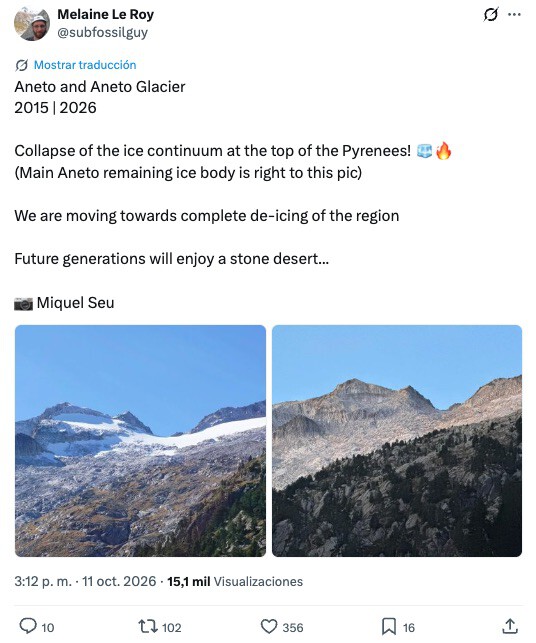
The result is three disconnected ice masses, a state far removed from the continuous glacier seen in 2015. Preliminary results from this summer's campaign indicate a loss of more than two meters of average thickness, leaving the glacier's mean thickness at around 12 meters. Researcher Ignacio López-Moreno from IPE-CSIC notes that over the past two decades, the loss was about one meter per year, but in 2022 and 2023 it exceeded three meters annually.
Why This Matters for Spain's Water and Environment
The disappearance of the Aneto glacier has far-reaching consequences. Glaciers act as natural water reservoirs, releasing meltwater during dry months. Their loss exacerbates water scarcity in a country already grappling with desertification. As the Pyrenees become more Mediterranean, river flows become more erratic, affecting agriculture, hydropower, and ecosystems downstream.
Moreover, the glacier's retreat is a visible indicator of climate breakdown. It underscores the urgency for adaptation strategies and emissions reductions. The Spanish government and local communities must prepare for a future with less reliable water sources and more extreme weather events.
Key Takeaways from the Aneto Glacier's Decline
- The Aneto glacier has fragmented into three disconnected ice masses, with a mean thickness of only 12 meters.
- Summer 2025 saw a loss of over two meters of ice thickness, accelerating from the previous average of one meter per year.
- The Pyrenees are becoming more Mediterranean, leading to unstable river flows and increased desertification in Spain.
- Glacier loss threatens water availability for agriculture, hydropower, and ecosystems across the region.
- Researchers emphasize that the collapse is not surprising but highlights the need for urgent climate action.
Comparing Glacier Health: 2015 vs. 2025
| Metric | 2015 | 2025 |
|---|---|---|
| Glacier status | Continuous body | Three disconnected masses |
| Mean thickness | ~14 meters (estimated) | ~12 meters |
| Annual thickness loss | ~1 meter per year | Over 2 meters in 2025 |
| Classification | Glacier | Glacier with helero under Collado de Coronas |
Note: The 2015 thickness is estimated based on the reported loss of about one meter per year over two decades, but exact figures were not provided in the source. The background to this story is set out in 300 Glaciers Gone From Western US Since Mid-20th Century. A related thread runs through US West Lost Nearly 300 Glaciers Since the 1960s, Study Finds. Earlier coverage in Swiss Glaciers Shrink 20% in Five Years: Alarming Melt Rates shows how the argument developed.
What to Watch Next
Scientists will continue monitoring the Aneto glacier's remnants, but the trend is clear: without significant climate mitigation, the Pyrenees will lose their glaciers entirely. This will have cascading effects on water management, tourism, and biodiversity. The images from 2025 serve as a rallying cry for stronger climate policies and adaptation measures. A closer look at the same subject appears in Glacier Collapse Triggers Nepal Flash Floods: What Caused. Anyone following the wider picture can start with Climate Change and Geological Disasters: The Cryosphere Warning. The same theme surfaces in Glacier Melt Reveals Hiker's Backpack After 60 Years in Austria, which takes a different angle.
As the planet warms, the fate of the Aneto glacier is a warning for other mountain regions. The time to act is now, before more iconic landscapes vanish. Context on how this played out before sits in Climate Solutions: Global Transformation Ideas for Positive Change. A companion piece, Climate Change Kills: Spain's Sánchez Warns of Crisis, approaches the same subject from another angle.
FAQ
What is the current state of the Aneto glacier?The Aneto glacier has fragmented into three disconnected ice masses. Its mean thickness is now around 12 meters, with a loss of over two meters in summer 2025 alone.
Why is the Aneto glacier disappearing?The glacier is retreating primarily due to climate change, which is causing rising temperatures and reduced snowfall. This has accelerated melting, especially in recent years with extreme heatwaves.
How does glacier loss affect Spain?Glacier loss reduces water availability during dry periods, exacerbates desertification, and destabilizes river flows. It also impacts ecosystems, agriculture, and hydropower generation.
Can the Aneto glacier be saved?Given current warming trends, the complete loss of the Aneto glacier appears inevitable. However, reducing emissions could slow the decline of remaining ice and help preserve other glaciers worldwide.
Browse the Shop
 Acacia frida deluxe solid wood bed frame |
Bedroom bench |
Bed chest drawers |
Lingerie dresser |
Frame base |
Mirror with jewelry storage |
30 Bathroom Vanity |
Memory foam queen mattress |
Mattresses for back pain |
Nightstand set of 2 |
Grand Goldman Shop |
Civil Lawyer
Deutschland Trikot WM 2026







