

Where ultra-rich populations grow fastest is a question that reveals shifting global wealth dynamics. In just the last five years, 162,191 new ultra-rich individuals emerged—those with a net worth exceeding $30 million—according to data from Knight Frank's "The Wealth Report 2026." That's an average of 89 people per day crossing this threshold. Understanding where this wealth is concentrated is crucial for anticipating investments, influences, and geopolitical tensions.
The Ultra-Rich Club: A Global Snapshot
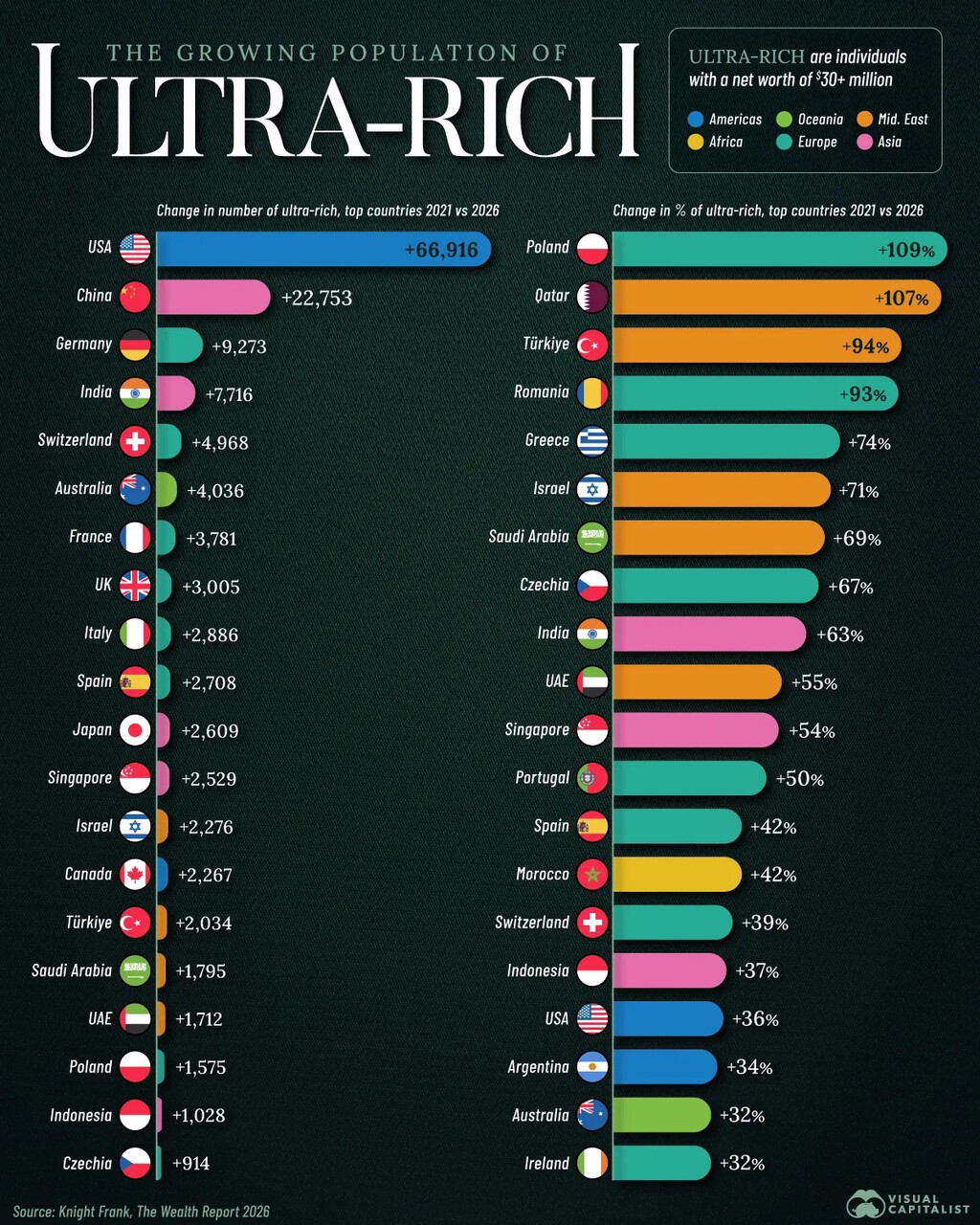
The chart below, created by Visual Capitalist, ranks countries by two parameters: how many new ultra-rich individuals they gain and how fast that club is growing. Combining both metrics makes sense: a high number might not be as significant in a country with a large base like the United States, while a high percentage increase indicates that something new is enriching people in that location.
Find Original Home Decor sparking conversation at Grand Goldman Shop.

The data comes from real estate consultancy and wealth manager Knight Frank through its "The Wealth Report 2026," which uses its own economic growth model incorporating variables such as GDP growth, inflation, interest rates, and financial market behavior.
Why This Matters
Today's rich are richer than ever, and there are more of them than at any point in human history. However, their distribution across the planet is very different from a decade ago because, simply put, there are countries where the ultra-rich are growing faster. This shift has profound implications for investment strategies, political influence, and international relations.
For investors, knowing where wealth is accumulating can highlight emerging markets and opportunities. For policymakers, it signals potential areas of economic growth or inequality. For the general public, it underscores the changing face of global wealth.
Key Findings from the Wealth Report
The report highlights several trends in the growth of ultra-rich populations. While traditional wealth hubs like the United States and Europe continue to host the largest numbers of ultra-high-net-worth individuals (UHNWIs), the fastest growth rates are often found in emerging economies.
- Asia leads in new ultra-rich: Countries like China and India are adding ultra-rich individuals at a rapid pace, driven by economic expansion and tech entrepreneurship.
- Middle East gains momentum: The UAE and Saudi Arabia are seeing significant increases, partly due to favorable tax policies and business-friendly reforms.
- Africa's emerging wealth: Nations like Nigeria and South Africa are witnessing growing ultra-rich populations, albeit from a smaller base.
- Europe's steady growth: Traditional European countries like Germany and the UK continue to add ultra-rich individuals, but at a slower rate compared to emerging markets.
- Americas remain dominant: The US still has the largest ultra-rich population, but its growth rate is moderate compared to some Asian and Middle Eastern countries.
Comparing Ultra-Rich Growth by Region
The table below summarizes the growth of ultra-rich populations across different regions, based on data from Knight Frank's report. It shows the number of new ultra-rich individuals and the percentage increase over the past five years.
| Region | New Ultra-Rich (2019-2024) | Percentage Increase |
|---|---|---|
| Asia-Pacific | 65,000 | 45% |
| North America | 40,000 | 25% |
| Europe | 30,000 | 20% |
| Middle East | 15,000 | 35% |
| Africa | 7,000 | 30% |
| Latin America | 5,191 | 15% |
Note: Figures are approximate and based on Knight Frank's Wealth Report 2026.
What's Driving the Growth?
Several factors contribute to the varying growth rates of ultra-rich populations. Economic growth is a primary driver: countries with robust GDP expansion create more opportunities for wealth creation. Technological innovation, particularly in sectors like tech and finance, has minted new billionaires and centi-millionaires.
Government policies also play a role. Countries with favorable tax regimes, such as the UAE, attract wealthy individuals. Political stability and strong property rights are other key considerations for the ultra-wealthy when choosing where to live and invest. The background to this story is set out in Where New Millionaires Are Growing Fastest: Spain Breaks Top. A related thread runs through Ultra-Rich Invest Fortunes in Luxury Bags and Watches. Earlier coverage in Spain's Wealth Concentration: Number of Ultra-Rich Soars 117% shows how the argument developed.
The Future of Global Wealth
As we look ahead, the distribution of ultra-rich individuals is likely to continue shifting. Emerging markets, especially in Asia and Africa, are expected to see the fastest growth. However, economic downturns or political instability could alter these trajectories. A closer look at the same subject appears in California Billionaire Tax Battle: Ultra-Rich Spend $1M Daily to Fight. Anyone following the wider picture can start with Global Inequality: How Extreme Wealth Threatens Democracy. The same theme surfaces in Ebola Outbreak in DRC Fastest Growing in History, which takes a different angle.
Understanding these trends is essential for anyone interested in global economics, investment, or policy. The concentration of wealth in certain regions can influence everything from real estate markets to political campaigns. Context on how this played out before sits in Ebola Outbreak in DRC Fastest Growing in Virus History. A companion piece, Ebola Outbreak in DRC Fastest Growing in History: Key Facts, approaches the same subject from another angle.
FAQ
What defines an ultra-rich individual?
An ultra-rich individual is typically defined as someone with a net worth exceeding $30 million, according to Knight Frank's Wealth Report. This group is also referred to as ultra-high-net-worth individuals (UHNWIs).
Which country has the most ultra-rich people?
The United States has the largest ultra-rich population, followed by China. However, the fastest growth rates are seen in emerging markets like India and the UAE.
How fast is the ultra-rich population growing?
Globally, the ultra-rich population grew by 162,191 individuals over the past five years, averaging 89 new ultra-rich people per day. Growth rates vary significantly by region, with Asia-Pacific leading at 45%.
What are the implications of this wealth concentration?
The concentration of wealth affects investment flows, real estate markets, and political influence. It can also exacerbate inequality and shape geopolitical dynamics as wealthy individuals and nations wield greater economic power.
Browse the Shop
 Acacia frida deluxe solid wood bed frame |
Bedroom bench |
Bed chest drawers |
Lingerie dresser |
Frame base |
Mirror with jewelry storage |
30 Bathroom Vanity |
Memory foam queen mattress |
Mattresses for back pain |
Nightstand set of 2 |
Grand Goldman Shop |
Civil Lawyer
Deutschland Trikot WM 2026







