

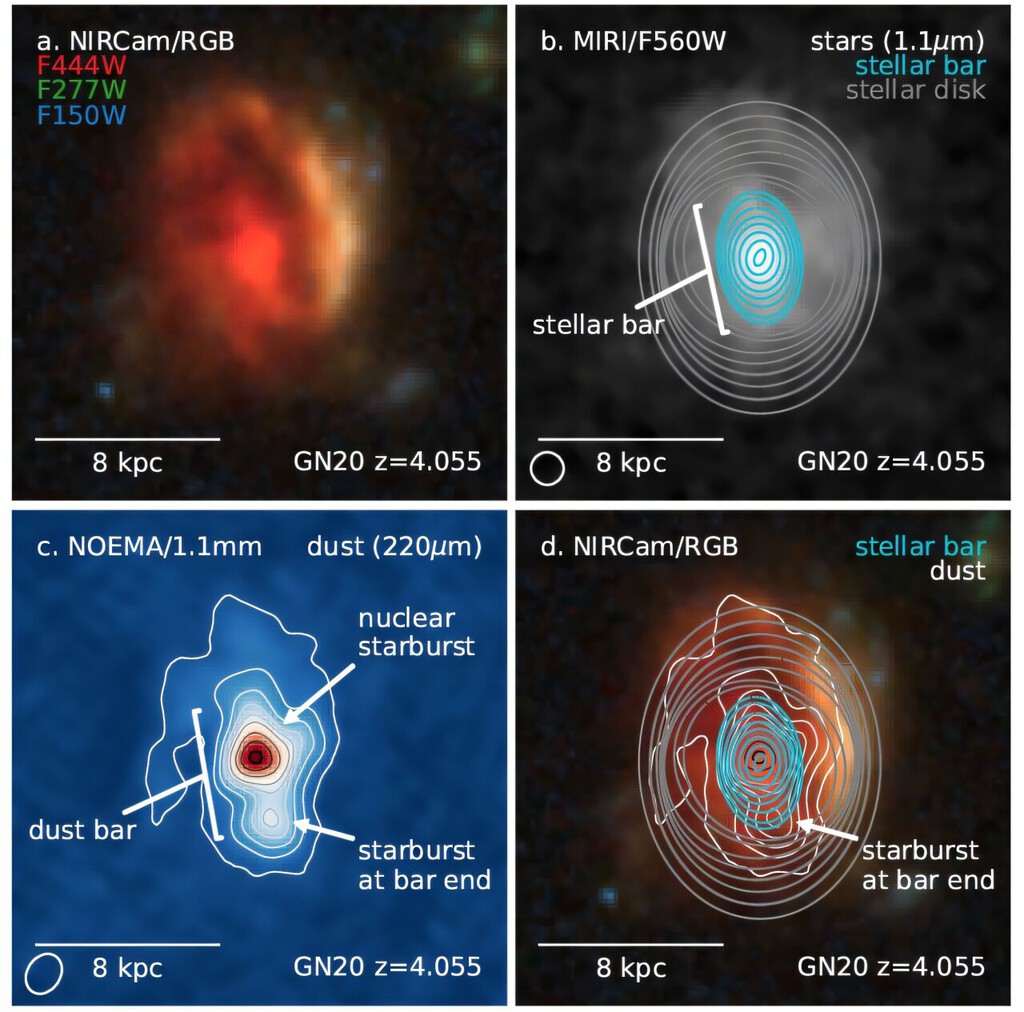
The James Webb Space Telescope has once again found something that shouldn't exist: a stellar bar in the galaxy GN20, a massive, gas-rich galaxy formed just 1.5 billion years after the Big Bang. This discovery challenges our understanding of how galaxies evolve and could help solve a long-standing mystery in astronomy.
Stellar bars are elongated structures of stars that form in the centers of some galaxies, including our own Milky Way. They are thought to develop slowly over billions of years as galaxies settle and their gas content decreases. Finding one in a young, gas-rich galaxy like GN20 is like finding a skyscraper in a prehistoric village—it simply shouldn't be there.
Find Original Home Decor sparking conversation at Grand Goldman Shop.

What Is a Stellar Bar and Why Does It Matter?
A stellar bar is a dense, elongated region of stars that rotates around the center of a galaxy. These bars are common in the nearby universe and play a crucial role in galaxy evolution by funneling gas toward the galactic center, fueling star formation and feeding supermassive black holes.
In the early universe, however, galaxies were much more gas-rich and turbulent. The prevailing theory suggests that this chaotic environment would prevent the formation of stable stellar bars. So, finding one in GN20—a galaxy that is both young and gas-rich—is a major surprise.
The GN20 Discovery: A Cosmic Puzzle
GN20 is a massive galaxy located at a redshift of about 4, meaning we see it as it was when the universe was only 1.5 billion years old. It is exceptionally rich in gas, which is the raw material for star formation. According to current models, such a galaxy should be too young and too gas-rich to host a stellar bar.
Yet, using the James Webb Space Telescope's powerful infrared instruments, a team of scientists from Leiden University identified a clear stellar bar in GN20. This finding, published in a recent study, forces astronomers to rethink how quickly and under what conditions stellar bars can form.
Why This Discovery Challenges Current Theories
The existence of a stellar bar in GN20 contradicts two key assumptions in galaxy formation theory. First, bars are thought to take billions of years to form, but GN20 is only about 1.5 billion years old. Second, the high gas content in early galaxies was expected to destabilize any bar that tried to form.
This discovery suggests that bars can form much faster than previously thought, even in gas-rich environments. It also implies that the early universe may have been more efficient at forming complex structures than our models predict.
What This Means for Our Understanding of Galaxies
Rather than overturning everything we know, this finding could help resolve a mystery: how did early galaxies grow so massive so quickly? Stellar bars are efficient at driving gas inward, triggering intense bursts of star formation. If bars formed earlier than expected, they could explain why some early galaxies appear surprisingly mature.
"We may need to modify our ideas about galaxy evolution," the researchers note, "but in return, we gain answers to questions that previously had none." This is how science progresses—by confronting theory with observation and refining our models.
- Stellar bars are elongated star structures that form slowly in galaxies and are common in the nearby universe.
- GN20 is a massive, gas-rich galaxy from 1.5 billion years after the Big Bang, where a bar shouldn't exist.
- James Webb's infrared vision allowed astronomers to detect this unexpected structure.
- The discovery suggests bars can form faster and in gas-rich environments, challenging current models.
- This finding could explain how early galaxies grew so massive so quickly.
How James Webb Made This Possible
The James Webb Space Telescope's unprecedented sensitivity in the infrared is key to this discovery. Infrared light penetrates dust and gas, revealing structures that are invisible to optical telescopes. Webb's ability to resolve fine details in distant galaxies has opened a new window on the early universe.
This isn't the first time Webb has found something that "shouldn't be there." From unexpectedly mature galaxies to complex structures, Webb is consistently pushing the boundaries of what we thought was possible. Each discovery adds a piece to the puzzle of cosmic evolution. The background to this story is set out in James Webb Telescope Detects Mysterious Signal in Fornax. A related thread runs through NASA's PRIMA Telescope to Fill James Webb's Far-Infrared Gap. Earlier coverage in 16 Oddly Creepy Pictures That Shouldn’t Exist On The Internet shows how the argument developed.
What to Watch Next
Astronomers will now search for more stellar bars in other early galaxies to see if GN20 is an outlier or part of a larger trend. Future observations with Webb and other telescopes will help refine models of bar formation and galaxy evolution. A closer look at the same subject appears in Short-Form Video Editing Trend: No Breaths Allowed. Anyone following the wider picture can start with Short-Form Video Editing: Why Everyone Sounds Breathless. The same theme surfaces in Science: latest articles, which takes a different angle.
As we continue to peer deeper into the cosmos, we can expect more surprises. The universe, it seems, is more creative than our theories allow. Context on how this played out before sits in James Webb Reveals Supermassive Black Holes Don't Sterilize. A companion piece, James Webb Solves Mystery of Extreme Debris Disks, approaches the same subject from another angle.
FAQ
What is a stellar bar?
A stellar bar is a elongated structure of stars that forms in the center of some galaxies, including the Milky Way. It helps channel gas toward the galactic center, fueling star formation and black hole growth.
Why is finding a stellar bar in GN20 surprising?
GN20 is a young, gas-rich galaxy from the early universe. Current theories predict that bars take billions of years to form and that high gas content would prevent them. Finding one there challenges those assumptions.
How did the James Webb Space Telescope detect this bar?
Webb's infrared instruments can see through dust and gas, revealing structures like bars that are invisible to optical telescopes. Its high resolution allowed astronomers to identify the bar in GN20.
What does this mean for galaxy formation theories?
It suggests that stellar bars can form much faster and in gas-rich environments than previously thought. This could help explain how early galaxies grew so massive so quickly, and may require updating our models of galaxy evolution.
Browse the Shop
 Acacia frida deluxe solid wood bed frame |
Bedroom bench |
Bed chest drawers |
Lingerie dresser |
Frame base |
Mirror with jewelry storage |
30 Bathroom Vanity |
Memory foam queen mattress |
Mattresses for back pain |
Nightstand set of 2 |
Grand Goldman Shop |
Civil Lawyer
Deutschland Trikot WM 2026







