

The James Webb Space Telescope's mysterious red dots have puzzled astronomers since they first appeared in images in late 2022. Now, the most precise simulation of the early universe yet suggests these objects could be black holes in a phase of explosive growth.
Using the Japanese supercomputer ATERUI III, researchers at the Max Planck Institute for Astrophysics created the most detailed cosmological simulation of the early universe to date. This allowed them to trace how the red dots might have formed and conclude that they are likely black holes undergoing rapid growth.
Find Original, High-end Home Decor that spark conversation at Grand Goldman Shop.
What Are the James Webb Red Dots?
Shortly after starting observations, the James Webb Space Telescope detected a series of red dots that appear to correspond to objects so massive and compact that they shouldn't exist according to the current cosmological model. These objects challenge our understanding of how structures formed in the early universe.
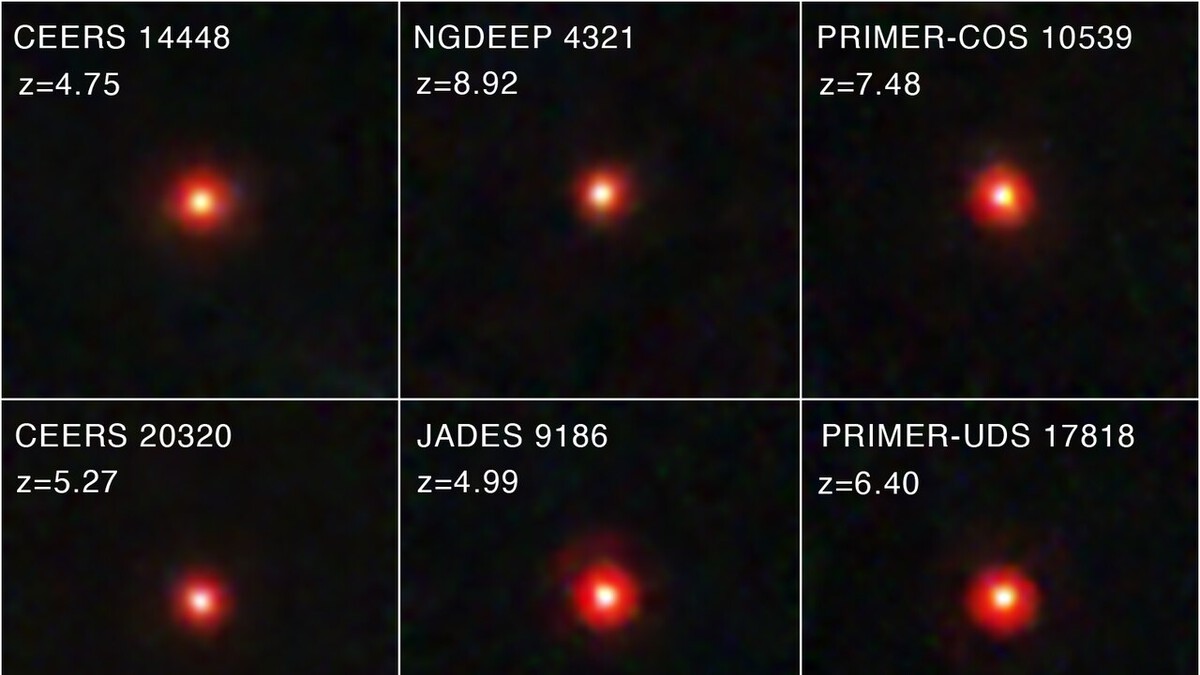
Since late 2022, when the telescope returned the first images of these red dots, several hypotheses have been proposed. However, most had gaps that prevented them from fully explaining the observations. The new simulation offers a more coherent explanation.
The Challenge of Explaining the Red Dots
The red dots are believed to have formed shortly after the Big Bang, when the universe was still in its infancy. Understanding their origin requires looking back to that early epoch, which is impossible directly but can be simulated.
Previous explanations struggled to account for the extreme mass and compactness of these objects. Some invoked exotic physics or modified gravity, but none provided a complete picture. The new simulation steps in to fill that gap.
Simulating the Early Universe with ATERUI III
To better understand the origin of the red dots, scientists at the Max Planck Institute for Astrophysics turned to the Japanese supercomputer ATERUI III. This powerful machine enabled them to run the most detailed cosmological simulation of the early universe to date.
The simulation tracked how these red dots could have formed, following the evolution of matter and black holes in the first billion years after the Big Bang. The results point to a scenario where black holes grow explosively.
Key Findings from the Simulation
- The red dots are likely black holes in a phase of rapid growth.
- The simulation is the most detailed of the early universe so far.
- It provides a more complete explanation than previous hypotheses.
- The findings challenge current models of black hole formation.
- Further observations will be needed to confirm the results.
Why This Matters for Cosmology
If confirmed, this explanation would reshape our understanding of black hole growth in the early universe. It would also help resolve the tension between observations and the standard cosmological model. The longer history behind the story is traced in James Webb Red Dots Explained by Early Universe Simulation.
The red dots are not just a curiosity; they offer a window into the processes that shaped the first galaxies and black holes. Understanding them is crucial for building a complete picture of cosmic evolution. The background to this story is set out in Black Hole Star Discovery: New Cosmic Object Found. A related thread runs through Black Holes Burp Mystery Solved by Scientists. Earlier coverage in Samsung Galaxy S26 FE: The first images have appeared shows how the argument developed.
Comparison of Hypotheses
| Hypothesis | Description | Challenges |
|---|---|---|
| Rapidly growing black holes | Black holes accreting matter at high rates | Requires efficient feeding mechanisms |
| Massive galaxies | Extremely massive galaxies with little dust | Conflicts with observed stellar masses |
| Exotic physics | Modified gravity or new particles | Lacks observational support |
What to Watch Next
Future observations with the James Webb Space Telescope and other instruments will test the simulation's predictions. Astronomers will look for signatures of rapid black hole growth in the red dots. A closer look at the same subject appears in 5 great ideas using old objects. Anyone following the wider picture can start with Forbidden Black Holes Detected via Gravitational Waves New Study. The same theme surfaces in Science: latest articles, which takes a different angle.
Meanwhile, the team plans to refine their simulations to include more detailed physics. This will help confirm whether the explosive black hole growth scenario holds up. Context on how this played out before sits in Farthest Fast Radio Burst Ever Detected Reveals Early Universe Secrets. A companion piece, Cosmic Dawn Simulation: MEGATRON Reveals Milky Way Birth, approaches the same subject from another angle.
FAQ
What are the red dots discovered by the James Webb Space Telescope?
What are the red dots discovered by the James Webb Space Telescope?
The red dots are mysterious objects that appear very massive and compact, challenging current cosmological models. They were first observed by the James Webb Space Telescope in late 2022.
How did the simulation explain the red dots?
The simulation suggests that the red dots are black holes in a phase of explosive growth, accreting matter rapidly. This scenario fits the observations better than previous hypotheses.
Why is this simulation important?
It is the most detailed simulation of the early universe to date, providing a plausible explanation for the red dots. It helps bridge the gap between observations and theoretical models.
What supercomputer was used for the simulation?
The Japanese supercomputer ATERUI III was used to run the simulation. It enabled researchers to achieve unprecedented detail in modeling the early universe.
Browse the Shop
 Acacia frida deluxe solid wood bed frame |
Bedroom bench |
Bed chest drawers |
Lingerie dresser |
Frame base |
Mirror with jewelry storage |
30 Bathroom Vanity |
Memory foam queen mattress |
Mattresses for back pain |
Nightstand set of 2 |
Grand Goldman Shop |
Civil Lawyer
Deutschland Trikot WM 2026










