

Spain's longevity map has just revealed a "Holy Land" for living past 100, confirming what many intuitively suspected: certain regions in the north and interior offer a significantly higher chance of reaching a century of life. The map, created by demographer Michel Poulain—the man behind the modern concept of Blue Zones—applies an extreme longevity index to Spanish territory and draws a clear pattern.
What the Longevity Map Shows
Michel Poulain, a Belgian demographer, first gained fame for his work in Sardinia, where he investigated an unusually high number of male centenarians. That research led to the Blue Zones concept—regions where living to 100 is common. Now, Poulain has turned his attention to Spain, and the results are striking.
Find Original Home Decor sparking conversation at Grand Goldman Shop.

Using his extreme longevity index, Poulain found that Spain's northern and interior regions have a probability of reaching 100 that is up to three times higher than in the south. This is not a cultural perception or a family anecdote; it is demographic statistics.
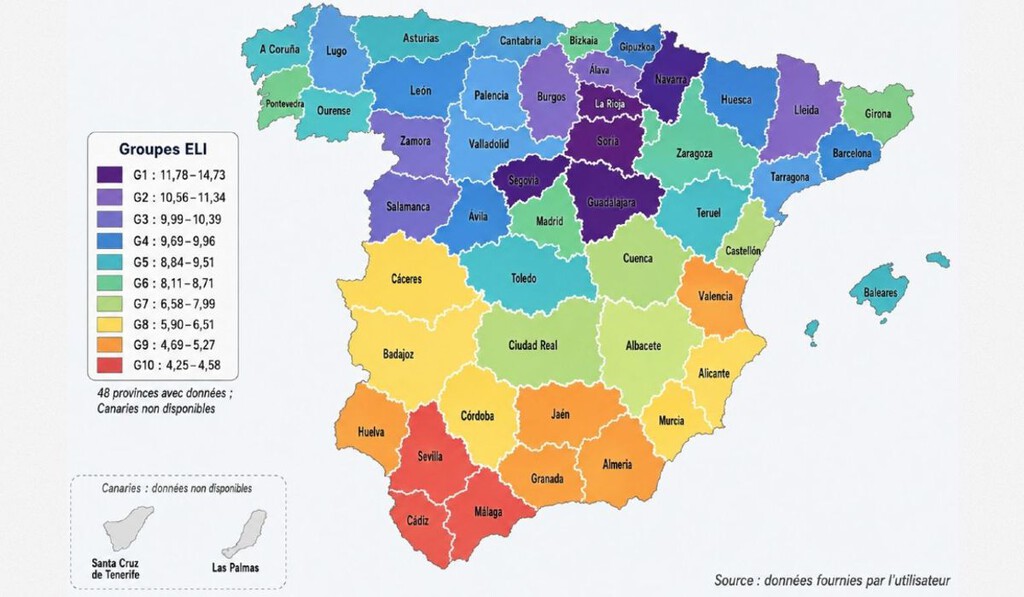
Where Is Spain's Longevity Corridor?
The map identifies a privileged belt running through the north and center of the country. The top regions include Navarra, La Rioja, Soria, Guadalajara, and Segovia, followed by other areas of Castilla y León, Cataluña, Álava, and Burgos.

These areas share certain characteristics that may contribute to longevity: a diet rich in vegetables and olive oil, a slower pace of life, strong social ties, and perhaps genetic factors. However, Poulain's work focuses on the demographic pattern rather than the causes.
Key Regions with High Longevity
- Navarra: Leads the ranking with a high concentration of centenarians.
- La Rioja: Known for its wine, but also for its long-lived population.
- Soria: A sparsely populated province with a surprising longevity rate.
- Guadalajara: Part of the interior belt with elevated extreme longevity.
- Segovia: Another province in the privileged corridor.
Why This Matters for Spain and Beyond
The confirmation of a longevity corridor in Spain has implications for public health, urban planning, and even tourism. It suggests that where you live can significantly influence how long you live.
For researchers, the map provides a new laboratory for studying the determinants of extreme longevity. For policymakers, it highlights the need to understand what these regions are doing right—and whether those factors can be replicated elsewhere.
For individuals, it offers a fascinating insight: perhaps the secret to a long life is not just in your genes, but also in your geography.
How Spain Compares to Other Blue Zones
Spain's longevity corridor is not yet officially classified as a Blue Zone, but it shares similarities with established ones like Sardinia (Italy), Okinawa (Japan), and Ikaria (Greece). The common threads often include diet, community, and a sense of purpose.
Poulain's work suggests that Spain may have its own Blue Zone-like regions, which could be studied and potentially leveraged to improve health outcomes nationwide. The background to this story is set out in Galicia's Centenarian Secret: Why So Many Live Past 100. A related thread runs through Sardinian Village Bolotana: New Blue Zone for Women's Longevity. Earlier coverage in Sardinian Blue Zone: Bolotana Women Live Exceptionally Long shows how the argument developed.
| Region | Country | Key Longevity Factor |
|---|---|---|
| Sardinia | Italy | Family cohesion, diet |
| Okinawa | Japan | Ikigai, plant-based diet |
| Ikaria | Greece | Mediterranean diet, social life |
| Navarra | Spain | Diet, social ties, genetics? |
What to Watch Next
As research continues, expect more detailed studies on the specific factors driving longevity in Spain's northern corridor. Could it be the climate, the food, or the community? Only time—and more data—will tell. A closer look at the same subject appears in Fridge-Raid Minestrone Recipe for Longevity and Health. Anyone following the wider picture can start with Longevity Secret: Why Constant Movement Beats 10,000 Steps. The same theme surfaces in Japan's 100,000 Centenarians Reveal a Growing Labor Shortage Crisis, which takes a different angle.
For now, the map stands as a confirmation of an old intuition: in some parts of Spain, living to 100 is not a rarity but almost a custom. Context on how this played out before sits in Walking Speed and Longevity: How 0.1 m/s Affects Lifespan. A companion piece, Strength Training Sweet Spot: 2 Hours Weekly for Longevity, approaches the same subject from another angle.
FAQ
What are Blue Zones?Blue Zones are regions of the world where people live significantly longer than average, often reaching 100 years. The concept was popularized by demographer Michel Poulain and author Dan Buettner.
Which regions in Spain have the highest longevity?According to Michel Poulain's longevity map, the top regions include Navarra, La Rioja, Soria, Guadalajara, and Segovia, followed by other areas in Castilla y León, Cataluña, Álava, and Burgos.
Why do people in northern Spain live longer?The exact reasons are not yet fully understood, but factors may include diet (Mediterranean), social cohesion, lifestyle, and possibly genetic factors. Researchers are studying these regions to uncover the causes.
Is Spain's longevity corridor an official Blue Zone?Not yet. While the region shows extreme longevity patterns similar to Blue Zones, it has not been officially designated as one. Further research is needed to confirm and understand the phenomenon.
Browse the Shop
 Acacia frida deluxe solid wood bed frame |
Bedroom bench |
Bed chest drawers |
Lingerie dresser |
Frame base |
Mirror with jewelry storage |
30 Bathroom Vanity |
Memory foam queen mattress |
Mattresses for back pain |
Nightstand set of 2 |
Grand Goldman Shop |
Civil Lawyer
Deutschland Trikot WM 2026







