

Europe's air conditioning divide is stark: only one in five households has AC, according to the IEA, while the US and Japan reach 90%. This gap is splitting the continent into two different summer realities.
In Spain, the difference is visible. In Navarra, domestic air conditioning is rare, like in other northern parts of the peninsula. But in Seville, AC is standard and heating is optional. That local pattern mirrors a broader European map.
Find Original Home Decor sparking conversation at Grand Goldman Shop.

Why Europe's Air Conditioning Divide Matters
Heat waves above 40°C are no longer confined to the south. They are becoming more frequent across the continent. Europe is the fastest-warming continent due to climate change, according to the World Meteorological Organization.
As temperatures rise, the lack of AC becomes a health and productivity issue. People struggle to sleep, work, and move around without overheating. The divide is not just about comfort—it is about resilience.
The Map That Shows Two Europes
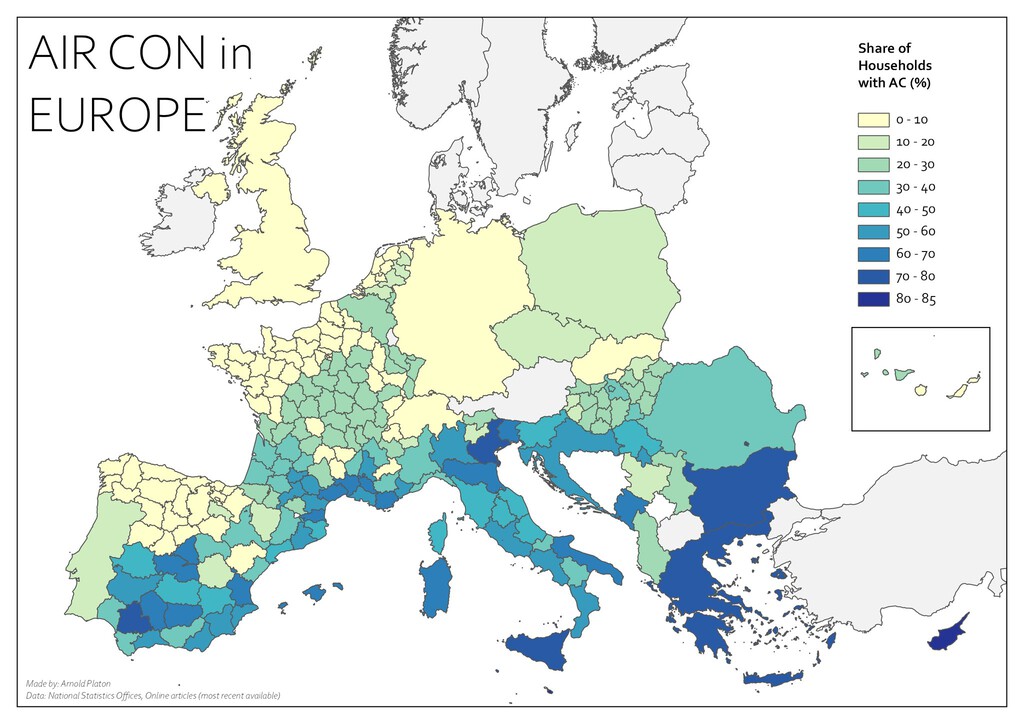
'Air Con Europe' is a color-coded map showing the percentage of households with air conditioning in each country. It reveals a clear north-south gradient, but with exceptions and nuances.
Southern countries like Spain, Italy, and Greece have higher AC adoption, while northern countries like the UK, Norway, and Germany lag behind. However, the map also shows that adoption does not always follow borders.
Key Takeaways from the Map
- Only 1 in 5 European homes has air conditioning, compared to 90% in the US and Japan.
- Southern Europe has higher AC penetration, but it is still far from universal.
- Northern Europe relies more on passive cooling and heating, with AC considered a luxury.
- Heat waves are increasing across the continent, making AC a growing necessity.
- Adoption rates vary widely even within countries, reflecting local climate and culture.
Comparing AC Adoption Across Regions
The table below illustrates the stark contrasts in AC adoption between Europe and other regions, as well as within Europe.
| Region | AC Adoption Rate | Notes |
|---|---|---|
| Europe | ~20% | Average across the continent |
| United States | ~90% | Widespread domestic AC |
| Japan | ~90% | High penetration |
| Southern Europe (e.g., Spain, Italy) | Higher than average | AC common in many homes |
| Northern Europe (e.g., UK, Scandinavia) | Lower than average | AC often rare |
These figures highlight that Europe is far behind other developed regions in cooling infrastructure. As heat waves intensify, this gap could have serious implications.
Why Some Countries Lag Behind
Historically, northern European countries have had mild summers, so AC was unnecessary. Buildings were designed to retain heat, not to cool down. Retrofitting AC is expensive and disruptive.
In southern Europe, AC is more common but still not universal. Energy costs and environmental concerns also play a role. Some people resist AC due to its contribution to urban heat islands and carbon emissions.
Passive Cooling Alternatives
Architectural passive cooling—such as shading, ventilation, and thermal mass—can improve comfort without AC. However, these measures may not suffice during extreme heat events.
As the climate warms, the debate between active and passive cooling will intensify. The map shows where the need is greatest and where infrastructure is lacking. The background to this story is set out in Europe Fastest Warming Continent: Deadly Heatwave Risks. A related thread runs through Why Europe Is the Fastest Warming Continent: Key Causes. Earlier coverage in Europeans Favor Air Conditioning Over Emissions Cuts in New Survey shows how the argument developed.
What to Watch Next
Heat waves are expected to become more frequent and severe. The AC divide could widen if northern countries do not adapt. Governments may need to incentivize cooling solutions and protect vulnerable populations. A closer look at the same subject appears in Heat Waves Are Reshaping Spain's Tourism Industry Fast. Anyone following the wider picture can start with Climate Change Kills: Pedro Sánchez's Stark Warning to Spain. The same theme surfaces in Action's Nedis Air Cooler: Beat Heat Waves for Under 40 Euros, which takes a different angle.
Energy grids will also face strain as more people install AC. The map serves as a warning and a planning tool for a hotter future. Context on how this played out before sits in Action's Nedis Evaporative Air Cooler: Beat Heat Waves for Under €40. A companion piece, Climate Change's Lethal Side Effect: Heat Waves Trap Us Indoors, approaches the same subject from another angle.
FAQ
What percentage of European homes have air conditioning?
According to the IEA, only about 20% of European households have air conditioning. This is far below the 90% adoption rate in the US and Japan.
Why is air conditioning adoption so low in Europe?
Historically mild summers in northern Europe made AC unnecessary, and buildings were designed to retain heat. High costs and environmental concerns also contribute to lower adoption.
Which European countries have the highest AC adoption?
Southern European countries like Spain, Italy, and Greece tend to have higher AC adoption due to hotter climates. However, even there, it is not universal.
How does climate change affect Europe's AC divide?
As Europe warms faster than any other continent, heat waves are becoming more frequent. This increases the need for cooling, potentially widening the gap between those with and without AC.
Browse the Shop
 Acacia frida deluxe solid wood bed frame |
Bedroom bench |
Bed chest drawers |
Lingerie dresser |
Frame base |
Mirror with jewelry storage |
30 Bathroom Vanity |
Memory foam queen mattress |
Mattresses for back pain |
Nightstand set of 2 |
Grand Goldman Shop |
Civil Lawyer
Deutschland Trikot WM 2026







